Prebiotic Supplements: Which Type and Amount Fits Your Goal?
There isn’t one established daily prebiotic dose for bowel symptoms; the type of fiber and how your gut tolerates it matter.
If you’re considering a prebiotic for constipation or digestive discomfort, choose by the specific fiber and the outcome studied, not by a universal daily target. In one four-week trial of people with constipation-predominant IBS, 10 g of acacia fiber daily improved stool frequency versus placebo, but did not significantly improve every bowel or quality-of-life measure. That trial amount is evidence about one study, not a recommended dose for everyone. 2
Start with the outcome you want
“Prebiotic” doesn’t mean every fiber supplement works the same way. Some fibers are studied for bowel frequency, some for changes in gut microbes, and some have little evidence for a particular digestive symptom. A supplement that changes bowel habits doesn’t necessarily demonstrate a prebiotic effect, either: a trial of starch-entrapped microsphere fiber found improved bowel habits but little change in gut microbes and short-chain fatty acids. 4
For constipation-predominant irritable bowel syndrome (IBS-C), the clearest example in these studies is acacia fiber. In a randomized, double-blind trial of 180 people with IBS-C, participants took 10 g daily for four weeks. Stool frequency improved compared with placebo, but stool consistency, stool mass, and quality-of-life measures did not significantly differ. The study therefore offers a specific signal for frequency, not proof that acacia relieves all IBS symptoms or works for everyone with constipation. 2
That distinction matters if your main concern is pain, bloating, or diarrhea rather than infrequent bowel movements. Prebiotic fibers can have variable effects, and some may worsen gas or other digestive symptoms, particularly at high intakes. 3
What different fibers can tell you
Acacia fiber: In the IBS-C trial, the measured benefit was higher stool frequency versus placebo. A trend toward improvement in constipation symptoms was not statistically significant, and the study did not find significant differences in stool consistency, stool mass, or quality of life. The 10 g daily amount was the trial’s intervention, not a universal target. 2
Short-chain fructo-oligosaccharides (scFOS): A seven-day trial in healthy children aged 6 to 12 tested 10 g or 20 g daily. Flatulence increased slightly at both amounts; abdominal discomfort rose slightly at 20 g, and some children reported diarrhea. This is short-term evidence in children, so it can’t establish an effective or well-tolerated amount for adult women. 5
Starch-entrapped microsphere fiber: In a three-month trial of 43 healthy volunteers reporting unsatisfactory bowel habits, stool frequency improved in all groups receiving the tested fibers, while stool consistency improved in the microsphere groups compared with psyllium. The fibers produced minimal changes in the measured microbiota and short-chain fatty acids, so the bowel-habit findings do not show that the fiber acted as a prebiotic. 4
These examples don’t provide a head-to-head comparison of the most common supplement types, and they don’t identify one best choice. They do show why a label’s fiber name and your goal are more useful than a blanket “prebiotic” claim.
Introduce it with tolerance in mind
If you decide to try a fiber supplement, avoid making a large jump in fiber intake all at once. Increasing dietary fiber too quickly can cause gas, bloating, or cramps; increasing it gradually can make tolerance easier to assess. 1 These studies don’t establish a particular step-up schedule for prebiotic supplements, so don’t treat a trial dose as an instruction to start there.
Keep a simple record while you’re figuring out whether a product suits you. Note the product and fiber type, the amount you used, when you took it, bowel frequency and stool form, and symptoms such as gas, bloating, pain, or urgency. Change one supplement at a time if you can. This isn’t a diagnostic test; it’s a way to see whether a specific product seems to help your particular goal or makes symptoms harder to manage.
What the evidence says about women’s life stages
The acacia study reports results for people with IBS-C; those findings don’t establish a dose for pregnancy, postpartum, perimenopause, or postmenopause. The scFOS study was in children, and it doesn’t answer questions about adult women. Neither study establishes a different prebiotic dose for women or shows how well a particular supplement is tolerated during pregnancy or postpartum. 2 5
If you’re pregnant, breastfeeding, or managing persistent digestive symptoms, don’t assume that a result from an IBS-C or child study applies to you. The useful next step is to identify the exact fiber and your main symptom, then weigh the limited evidence for that specific match rather than choosing a dose from a broad daily-target claim.
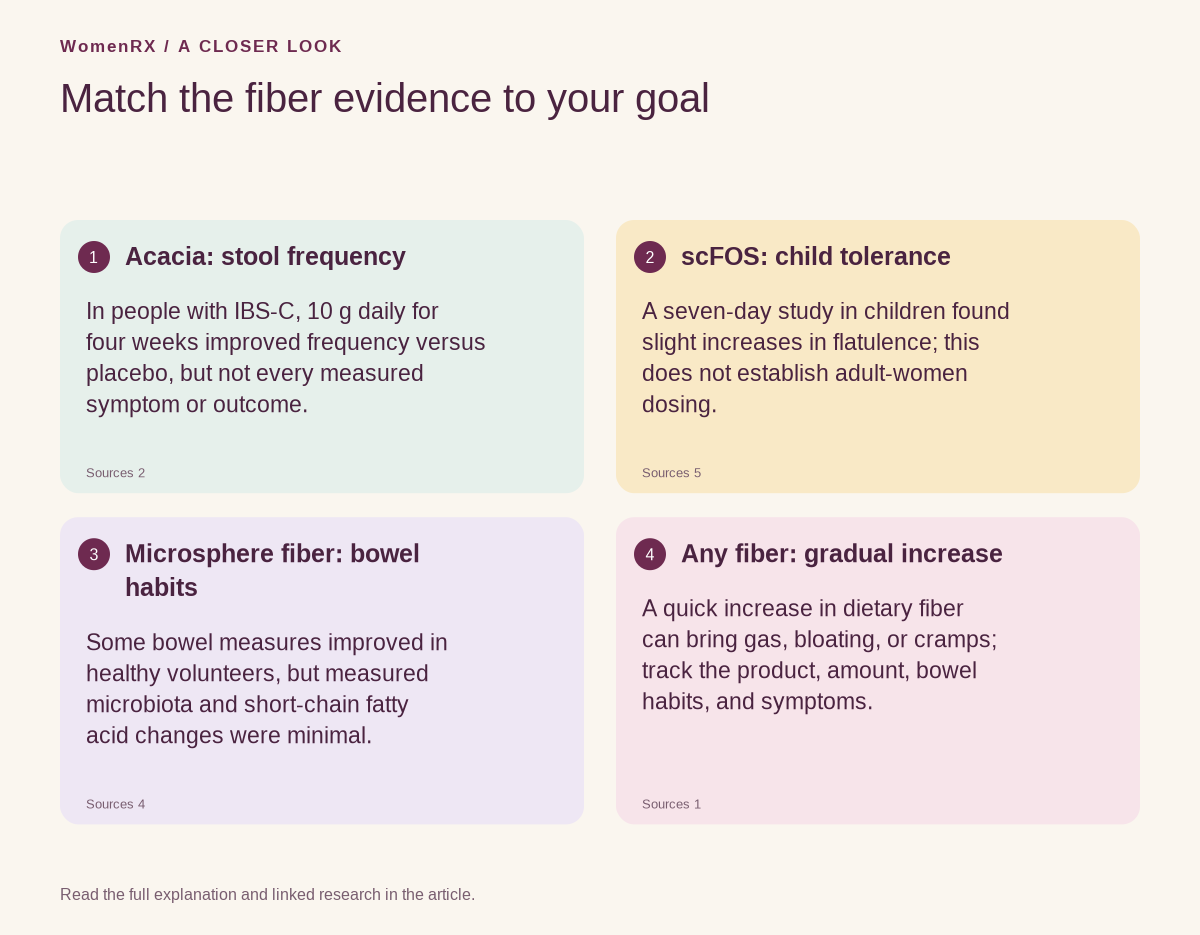
Match the fiber evidence to your goal
Acacia: stool frequency: In people with IBS-C, 10 g daily for four weeks improved frequency versus placebo, but not every measured symptom or outcome.2
scFOS: child tolerance: A seven-day study in children found slight increases in flatulence; this does not establish adult-women dosing.5
Microsphere fiber: bowel habits: Some bowel measures improved in healthy volunteers, but measured microbiota and short-chain fatty acid changes were minimal.4
Any fiber: gradual increase: A quick increase in dietary fiber can bring gas, bloating, or cramps; track the product, amount, bowel habits, and symptoms.1
Read the figure as text
These study examples differ in population, fiber, and measured outcome. They are not a head-to-head ranking or dosing guide.- Acacia: stool frequency: In people with IBS-C, 10 g daily for four weeks improved frequency versus placebo, but not every measured symptom or outcome.2
- scFOS: child tolerance: A seven-day study in children found slight increases in flatulence; this does not establish adult-women dosing.5
- Microsphere fiber: bowel habits: Some bowel measures improved in healthy volunteers, but measured microbiota and short-chain fatty acid changes were minimal.4
- Any fiber: gradual increase: A quick increase in dietary fiber can bring gas, bloating, or cramps; track the product, amount, bowel habits, and symptoms.1
More questions, answered
Is 10 g of acacia fiber the right daily amount?
It was the amount tested for four weeks in one IBS-C trial, where stool frequency improved versus placebo. The study doesn’t establish 10 g as the right amount for other people, other symptoms, or other fiber types. 2
Can a prebiotic supplement cause more gas or bloating?
Yes. Fiber can cause gas, bloating, or cramps when intake rises too quickly, and prebiotic supplements can worsen digestive symptoms for some people. 1 3
Sources you can check
- Dietary Fiber: MedlinePlusAccessed 2026-09-25Return to first citation
- Acacia fiber or probiotic supplements to relieve gastrointestinal complaints in patients with constipation-predominant IBS: a 4-week randomized double-blinded placebo-controlled intervention trial.JanssenDuijghuijsen L, van den Belt M, Rijnaarts I, Vos P, Guillemet D, Witteman B, de Wit N. · European journal of nutrition · 2024Return to first citation
- The effects of prebiotics on gastrointestinal side effects of metformin in youth: A pilot randomized control trial in youth-onset type 2 diabetes.Dixon SA, Mishra S, Dietsche KB, Jain S, Mabundo L, Stagliano M, Krenek A, Courville A, Yang S, Turner SA, Meyers AG, Estrada DE, Yadav H, Chung ST. · Frontiers in endocrinology · 2023Return to first citation
- Starch-entrapped microsphere fibers improve bowel habit but do not exhibit prebiotic capacity in those with unsatisfactory bowel habits: a phase I, randomized, double-blind, controlled human trial.Rasmussen HE, Hamaker B, Rajan KB, Mutlu E, Green SJ, Brown M, Kaur A, Keshavarzian A. · Nutrition research (New York, N.Y.) · 2017Return to first citation
- Randomized evaluation of gastrointestinal tolerance to high daily intake of short-chain fructo-oligosaccharides in school-aged children.Le Bourgot C, Rigaudier F, Herpin F, Juhel C. · Nutrition (Burbank, Los Angeles County, Calif.) · 2026Return to first citation