Prebiotic Supplements: What to Choose and What to Expect
Prebiotic fibers can support bowel regularity, but fermentation may also bring gas or bloating, and the ingredient matters.
A prebiotic is a substrate gut microbes can use; a probiotic is a live microorganism. 5 6 Inulin and fructooligosaccharides (FOS) have been studied for bowel function. 5 6 A small IBS diet study does not establish what a galactooligosaccharide (GOS) supplement does for constipation. 7 Some people experience gas or bloating. Pregnancy constipation guidance does not address prebiotic supplements. 3 5 6
A prebiotic supplement isn’t one single treatment. Products may contain different fibers, and those fibers can affect people differently. If you’re considering one for constipation or gut health, focus on the named ingredient and what the research actually says, not just the word “prebiotic” on the front of the package.
Prebiotic or probiotic: what’s the difference?
A prebiotic is a substance selectively used by microorganisms in a way intended to benefit the host. A probiotic is a live microorganism; a product combining live microbes with a prebiotic substrate is called a synbiotic. 5 6
That distinction matters when comparing labels: a fiber-only powder is not the same intervention as a capsule containing live bacteria, and studies of one can’t automatically tell you how the other will affect you.
What the main ingredients may do
Inulin is a fermentable fiber, often made from chicory. Fermentation can contribute to gas and flatulence. A clinical-trial protocol describes flatulence as a known, dose-related concern with inulin in the research it cites, but the protocol itself is not a trial showing what every person will experience. 5
FOS, or fructooligosaccharides, are another type of prebiotic fiber. A systematic review of 17 randomized trials involving 713 participants found signals of improved bowel frequency and stool consistency in people with functional constipation; mild bloating was also reported. The review called for stronger trials, and its results don’t establish a best product or a reliable effect for every person. 6
GOS, or galactooligosaccharides, also appear in research on fermentable carbohydrates. One small study of nine people with IBS found symptom improvement on a diet reducing both FOS and GOS compared with baseline. It tested food changes, not a GOS supplement, and does not establish the effect of a GOS supplement on constipation. 7
Why the same fiber can help and bother you
Some fibers are fermented by gut microbes. That process may support bowel function, but it can also produce gas. So an ingredient being studied for constipation doesn’t mean it will feel comfortable for everyone, especially if bloating is already part of your symptoms. In the FOS review, possible bowel benefits and mild bloating appeared in the same overall evidence picture. 6
The IBS evidence needs extra care in interpretation. The small FOS-plus-GOS diet study suggests that these fermentable carbohydrates may matter for some people’s symptoms, but it doesn’t test supplements or establish a universal IBS rule. 7
A cautious way to compare products
Start with the ingredient list. Look for a specific fiber, such as inulin, FOS, or GOS, rather than relying on a broad “gut health” claim. If a blend lists several fibers, it may be harder to tell which one is affecting you. Avoid starting several new fiber products at once; otherwise, a change in gas or bowel habits is harder to interpret.
If you decide to try a product, follow its label and pay attention to whether bloating, gas, or discomfort changes. A gradual introduction is a cautious approach for a fermentable fiber, but studies don’t establish one schedule that works for everyone. Don’t assume you need to push through symptoms or increase the amount to get a benefit.
For constipation, supplements are only one possibility. Dietary fiber from foods, fluids, movement, and responding to the urge to have a bowel movement are among the general measures described in constipation guidance. If your bowel habits change suddenly or constipation persists, don’t keep escalating a supplement instead of looking into the cause. 2 3
Pregnancy and women-specific evidence
Constipation is common during pregnancy. The guidance on constipation describes simple diet and lifestyle measures during pregnancy, but it doesn’t address prebiotic supplements. That guidance doesn’t establish whether prebiotic supplements are safe or beneficial during pregnancy, so findings in other adults don’t answer how a supplement may affect you during pregnancy. 3
There’s also no established women-specific effect in this evidence. One acute inulin study included healthy men and women but did not report results separately by sex; the FOS review summary doesn’t specify a women-only result. 4 6
A practical bottom line: choose by named ingredient and your main goal, keep the first trial simple, and treat new or worsening digestive symptoms as useful information rather than proof that you need more prebiotic fiber.
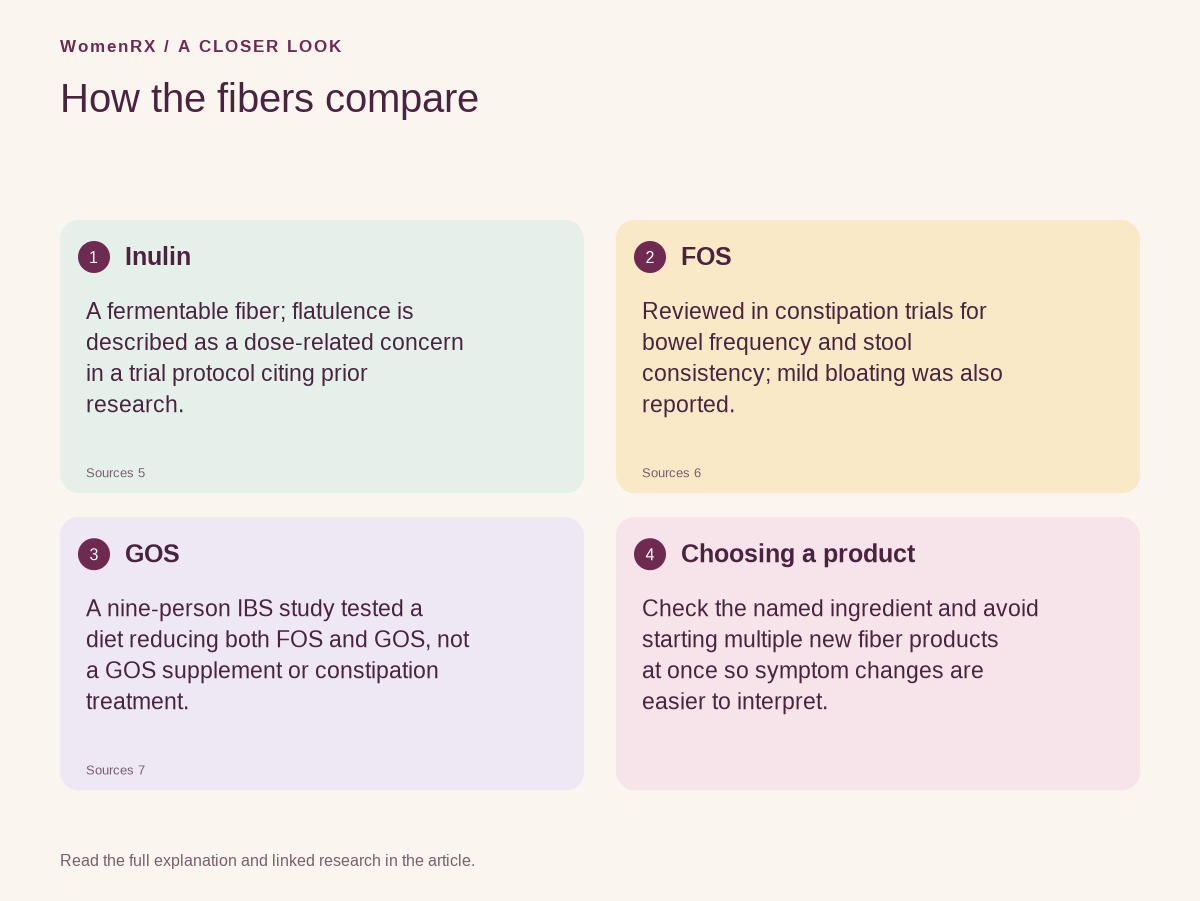
How the fibers compare
Inulin: A fermentable fiber; flatulence is described as a dose-related concern in a trial protocol citing prior research.5
FOS: Reviewed in constipation trials for bowel frequency and stool consistency; mild bloating was also reported.6
GOS: A nine-person IBS study tested a diet reducing both FOS and GOS, not a GOS supplement or constipation treatment.7
Choosing a product: Check the named ingredient and avoid starting multiple new fiber products at once so symptom changes are easier to interpret.
Read the figure as text
These ingredients aren’t interchangeable: the evidence differs by fiber, and a possible bowel benefit can come with digestive symptoms.- Inulin: A fermentable fiber; flatulence is described as a dose-related concern in a trial protocol citing prior research.5
- FOS: Reviewed in constipation trials for bowel frequency and stool consistency; mild bloating was also reported.6
- GOS: A nine-person IBS study tested a diet reducing both FOS and GOS, not a GOS supplement or constipation treatment.7
- Choosing a product: Check the named ingredient and avoid starting multiple new fiber products at once so symptom changes are easier to interpret.
More questions, answered
Can prebiotics help with constipation?
FOS has shown possible improvements in bowel frequency and stool consistency in a review of randomized trials, but the authors called for stronger evidence. Results don’t establish that every prebiotic ingredient, or every product, will help. 6
Are prebiotics a good choice if I have IBS?
Not necessarily. A small study found symptom improvement on a diet that reduced both FOS and GOS, but it didn’t test supplements and was too small to establish a rule for everyone with IBS. 7
What if my bloating gets worse?
Gas and bloating can occur with fermentable fibers, including inulin and FOS. Persistent bloating or a sudden change in bowel habits deserves attention beyond supplement adjustments. 1 2 5 6
Sources you can check
- Bloating - NHSAccessed 2026-09-25Return to first citation
- Constipation | MedlinePlusAccessed 2026-09-25Return to first citation
- Constipation - NHSAccessed 2026-09-25Return to first citation
- Oral Fructanase Administration Reduces Gastrointestinal Symptom Severity after Acute Inulin Challenge in Healthy Adults.Mah E, McKenna CF, Blonquist TM, Kaden VN, Shah AM, Qu Y, Tuck CJ, Landberg R, Cook CM, Garvey SM. · The Journal of nutrition · 2026Return to first citation
- Protocol of the LEONORA randomized clinical trial: Lower gastrointestinal symptom burden by prophylaxis with synbiotics after colorectal cancer surgery.Schöttker B, Kopp-Schneider A, Biehl L. · BMC cancer · 2026Return to first citation
- Fructooligosaccharides for Relieving Functional Constipation: A Systematic Review and Meta-Analysis of Randomized Controlled Trials.Zhen H, Qian H, Liu X, Tan C. · Foods (Basel, Switzerland) · 2024Return to first citation
- Modification of the Low FODMAP Diet Is Feasible in the Treatment of Irritable Bowel Syndrome: A Randomised Crossover Study.Jensen LG, Kjær M, Andersen JR. · Gastroenterology research and practice · 2025Return to first citation