Prebiotic Fibers for Gut Symptoms: What’s Been Studied?
Prebiotic fibers aren’t interchangeable: small trials have studied different types for constipation, diarrhea, and bloating, with mixed results.
Some specific fibers have been studied for IBS symptoms, but results depend on the fiber and the symptom. Partially hydrolyzed guar gum improved bloating diary scores in one trial; acacia and agave fructans were studied for constipation-predominant IBS, and pectin for diarrhea-predominant IBS. These findings don’t establish that prebiotics as a group work or that they’re helpful or safe in pregnancy. 3 4 5 6
Prebiotic and probiotic were tested separately
A prebiotic is a food component that supports certain gut bacteria. In one IBS trial, the probiotic intervention was identified as a Bifidobacterium lactis supplement. 4 6
In that trial of people with constipation-predominant IBS, researchers tested acacia fiber, described as having prebiotic properties, and the probiotic supplement in separate groups against a placebo. They were distinct interventions in the study, so a result for one doesn’t tell you whether the other will help. 4
That distinction matters because “prebiotic” covers fibers with different structures and effects. A fiber that might help one bowel pattern could do little for another, or add gas without easing the symptom you care about.
What trials say about particular fibers
Partially hydrolyzed guar gum (PHGG) and bloating: In a randomized, placebo-controlled trial, 108 people with IBS were included in the analysis. After 12 weeks, the PHGG group had greater improvement in diary scores for bloating and bloating with gas than the placebo group. The study didn’t find a benefit for other reported IBS symptoms, overall symptom severity, or quality of life. It also had substantially more dropouts in the placebo group, which makes the results worth interpreting cautiously. 6
Acacia fiber and constipation-predominant IBS: In a four-week trial of 180 people with IBS-C, daily acacia fiber was compared with a probiotic and placebo. Stool frequency improved more with acacia than placebo, but stool consistency, stool mass, and quality-of-life measures didn’t significantly differ between groups. The probiotic arm also improved stool frequency, but it’s a separate intervention, not evidence that acacia acts like a probiotic. 4
Agave fructans and constipation-predominant IBS: A small four-week trial tested a jelly containing 8 grams of agave fructans per serving in 50 people with IBS-C. The researchers reported increased bowel-movement frequency in the treated group; quality-of-life scores improved compared with placebo. Because this was a short study of a particular product and group, it can’t establish that other fructan products, including inulin or fructooligosaccharides (FOS), will have the same effect. 3
Pectin and diarrhea-predominant IBS: One randomized trial assigned 87 people with IBS-D to pectin or placebo for six weeks. The pectin group had improved symptom and quality-of-life scores, along with changes in measured gut bacteria. It’s one study, so it doesn’t settle whether pectin is a dependable option for IBS-D or how broadly the result applies. 5
Taken together, these trials offer clues, not a category-wide verdict. A change in gut bacteria alone also isn’t the same as a meaningful improvement in pain, bloating, or bowel habits. The studies measured different outcomes and involved different IBS subtypes, so their results aren’t a head-to-head ranking of fibers. 3 4 5 6
If gas or bloating gets worse
Adding dietary fiber too quickly can lead to gas, bloating, or cramps. 1 If symptoms worsen after introducing a product, note the exact fiber and the timing, and avoid adding several new fiber products at once. That makes it easier to see whether the change is linked to that product rather than a different dietary change.
Don’t treat worsening symptoms as a sign that a fiber is “working.” If bloating keeps returning or doesn’t settle, or comes with blood in your stool or unintentional weight loss, get medical advice rather than continuing to experiment with supplements. 2
Pregnancy is a separate question
The IBS findings discussed here don’t establish prebiotic-fiber benefits or safety for pregnancy-related digestive symptoms. They concern specific fibers and outcomes in people with IBS, so they can’t tell you how those fibers would work or be tolerated during pregnancy. That’s an evidence gap, not proof that a particular fiber is unsafe or safe. 3 4 5 6
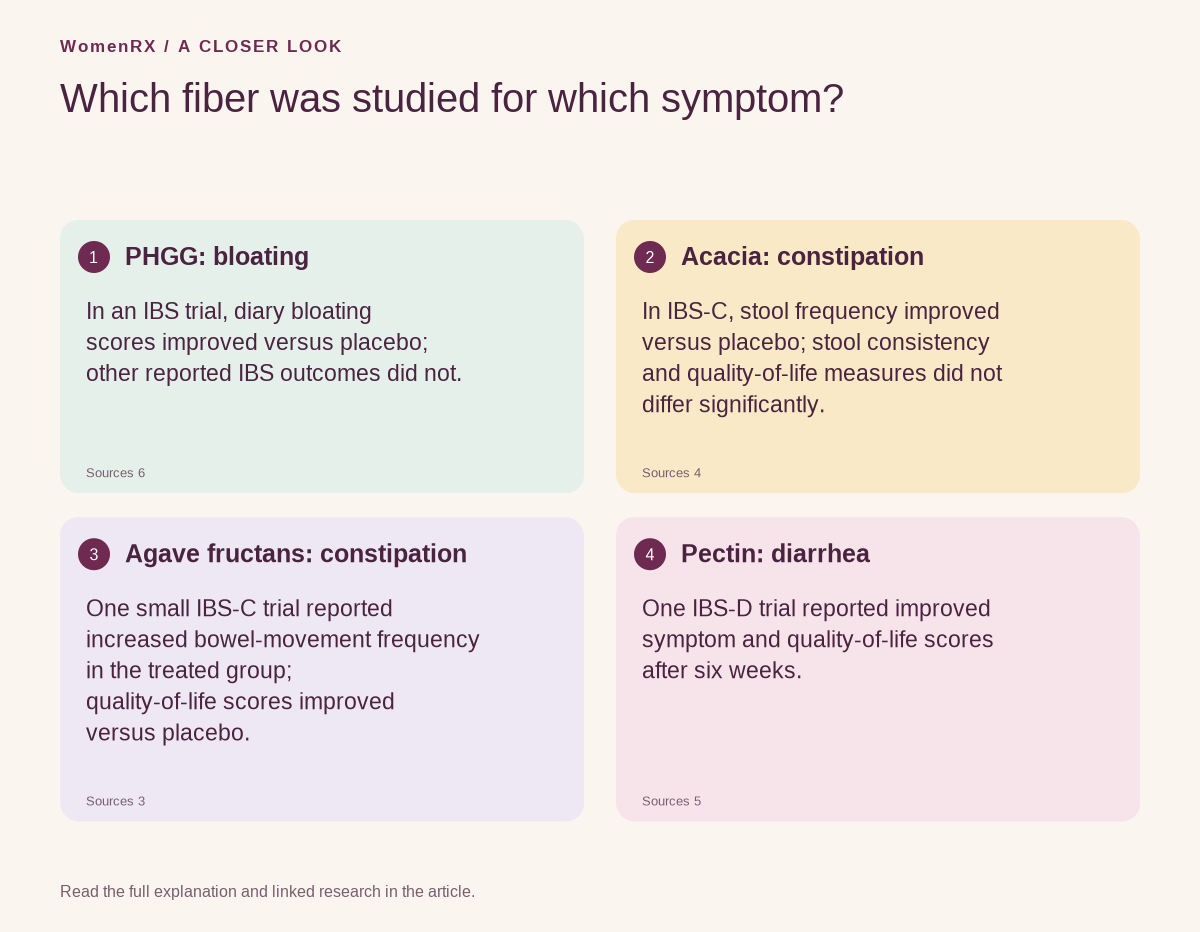
Which fiber was studied for which symptom?
PHGG: bloating: In an IBS trial, diary bloating scores improved versus placebo; other reported IBS outcomes did not.6
Acacia: constipation: In IBS-C, stool frequency improved versus placebo; stool consistency and quality-of-life measures did not differ significantly.4
Agave fructans: constipation: One small IBS-C trial reported increased bowel-movement frequency in the treated group; quality-of-life scores improved versus placebo.3
Pectin: diarrhea: One IBS-D trial reported improved symptom and quality-of-life scores after six weeks.5
Read the figure as text
These are separate trials, not a head-to-head test. The comparison shows the IBS group and symptom outcome studied for each fiber.- PHGG: bloating: In an IBS trial, diary bloating scores improved versus placebo; other reported IBS outcomes did not.6
- Acacia: constipation: In IBS-C, stool frequency improved versus placebo; stool consistency and quality-of-life measures did not differ significantly.4
- Agave fructans: constipation: One small IBS-C trial reported increased bowel-movement frequency in the treated group; quality-of-life scores improved versus placebo.3
- Pectin: diarrhea: One IBS-D trial reported improved symptom and quality-of-life scores after six weeks.5
More questions, answered
Does a prebiotic changing gut bacteria mean it will relieve symptoms?
Not necessarily. The pectin trial measured gut bacteria alongside symptoms, but a microbiome change by itself doesn’t show that pain, bloating, or bowel habits improved. Look at the symptom outcomes, not just claims about bacteria. 5
Do these results tell us whether fibers work differently for women or during pregnancy?
The reported findings don’t establish a separate treatment effect for women or pregnancy-specific benefit and safety. They can’t tell you whether a result for IBS applies to digestive symptoms during pregnancy. 3 4 5 6
Sources you can check
- Dietary Fiber: MedlinePlusAccessed 2026-09-25Return to first citation
- Bloating - NHSAccessed 2026-09-25Return to first citation
- The Effects of Agave Fructans in a Functional Food Consumed by Patients with Irritable Bowel Syndrome with Constipation: A Randomized, Double-Blind, Placebo-Controlled Trial.Camacho-Díaz BH, Arenas-Ocampo ML, Osorio-Díaz P, Jiménez-Aparicio AR, Alvarado-Jasso GM, Saavedra-Briones EV, Valdovinos-Díaz MÁ, Gómez-Reyes E. · Nutrients · 2023Return to first citation
- Acacia fiber or probiotic supplements to relieve gastrointestinal complaints in patients with constipation-predominant IBS: a 4-week randomized double-blinded placebo-controlled intervention trial.JanssenDuijghuijsen L, van den Belt M, Rijnaarts I, Vos P, Guillemet D, Witteman B, de Wit N. · European journal of nutrition · 2024Return to first citation
- [Efficacy of pectin in the treatment of diarrhea predominant irritable bowel syndrome].Xu L, Yu W, Jiang J, Feng X, Li N. · Zhonghua wei chang wai ke za zhi = Chinese journal of gastrointestinal surgery · 2015Return to first citation
- Randomized clinical study: Partially hydrolyzed guar gum (PHGG) versus placebo in the treatment of patients with irritable bowel syndrome.Niv E, Halak A, Tiommny E, Yanai H, Strul H, Naftali T, Vaisman N. · Nutrition & metabolism · 2016Return to first citation