Which Prebiotic Fiber Might Fit Your Digestive Goal?
The most useful starting point is the symptom you want to address, because different fibers have shown different results in IBS trials.
There’s no established best prebiotic fiber for every digestive concern. In separate IBS trials, partially hydrolyzed guar gum (PHGG) improved bloating measures, acacia fiber improved stool frequency in constipation-predominant IBS, and pectin improved some measures in diarrhea-predominant IBS. The fibers weren’t compared head to head, so these findings can guide a choice but can’t identify a winner. 2 3 6
Match the evidence to the symptom
A “prebiotic” label tells you something about how a fiber may interact with gut microbes. It doesn’t tell you whether that fiber will ease your bloating, change your stools, or feel comfortable to take. The distinction matters because trials of different fibers have measured different outcomes in different types of IBS. 2 3 6
If bloating or gas is the main problem
PHGG is a soluble fiber with a specific, limited result for bloating. In a randomized, double-blind trial, 108 people with IBS had data included in the analysis. After 12 weeks, bloating and combined bloating-and-gas scores improved more with PHGG than with placebo. Other journal-reported IBS symptoms, overall IBS severity, and quality-of-life scores did not show a benefit. That’s a reason to distinguish a bloating result from a claim that PHGG treats IBS as a whole. 3
The trial included women and men, but did not report its symptom results separately by sex. A smaller study followed 68 people with constipation-predominant IBS during four weeks of PHGG use and found an increase from baseline in evacuation frequency among women. Without a placebo group, it can’t show that PHGG caused that change or works better for women. 3 4
If constipation is the main problem
Ask what you mean by “better”: going more often, passing a different type of stool, or feeling less discomfort aren’t the same outcome. In a randomized trial of 180 people with constipation-predominant IBS, acacia fiber improved stool frequency more than placebo over four weeks. The study did not find significant differences from placebo in stool consistency, stool mass, or quality of life. Its abstract does not report a separate result for women. 6
That makes acacia an evidence-informed option to consider if frequency is your main concern, not a promise that it will address every part of constipation. PHGG has also been studied in constipation-predominant IBS, but the women-specific result above comes from a study without a placebo comparison. 4 6
If diarrhea-predominant IBS is the concern
One randomized trial compared pectin, another soluble fiber, with placebo in 87 people with diarrhea-predominant IBS. After six weeks, the pectin group had a greater reduction in composite symptom and Bristol stool-scale scores and an improvement in quality-of-life scores. It’s a promising result from one trial, not a direct comparison with PHGG or acacia, and the abstract does not report a women-specific effect. 2
When fermentable foods already bother you
If you’ve noticed that certain foods leave you bloated or uncomfortable, “prebiotic” alone isn’t a good reason to choose a supplement. A review of IBS diet research describes symptoms associated with fermentable, poorly absorbed carbohydrates in some people, while noting that confirmatory research was needed for dietary restriction. That doesn’t mean every prebiotic fiber will bother you. It also doesn’t identify which one you’ll tolerate. 5
The PHGG, acacia, and pectin trials do not compare those fibers specifically in people who report sensitivity to fermentable carbohydrates. Nor do these findings establish that inulin, fructooligosaccharides (FOS), or galactooligosaccharides (GOS) are better choices for a particular IBS symptom. Choosing by the ingredient and the outcome studied is more informative than choosing by the word “prebiotic.” 2 3 6
Try one change you can actually evaluate
If you decide to try a supplement, pick one outcome that matters to you, such as how often you have a bowel movement or how disruptive bloating feels. Changing one product at a time and keeping other routine changes as steady as practical can help you judge your response. Reconsider it if symptoms worsen or you don’t notice a useful change. This is a practical way to make your own trial easier to interpret, not a tested method for predicting who will benefit.
A supplement also shouldn’t have to explain symptoms that persist or change. If you’re managing a diagnosed bowel condition, discuss new or persistent symptoms with your care team rather than assuming they’re ordinary IBS or a reaction to fiber. For example, IBS-like symptoms have been reported in people with ulcerative colitis even while the disease is in remission; the symptom pattern alone doesn’t establish what’s happening in an individual case. 1
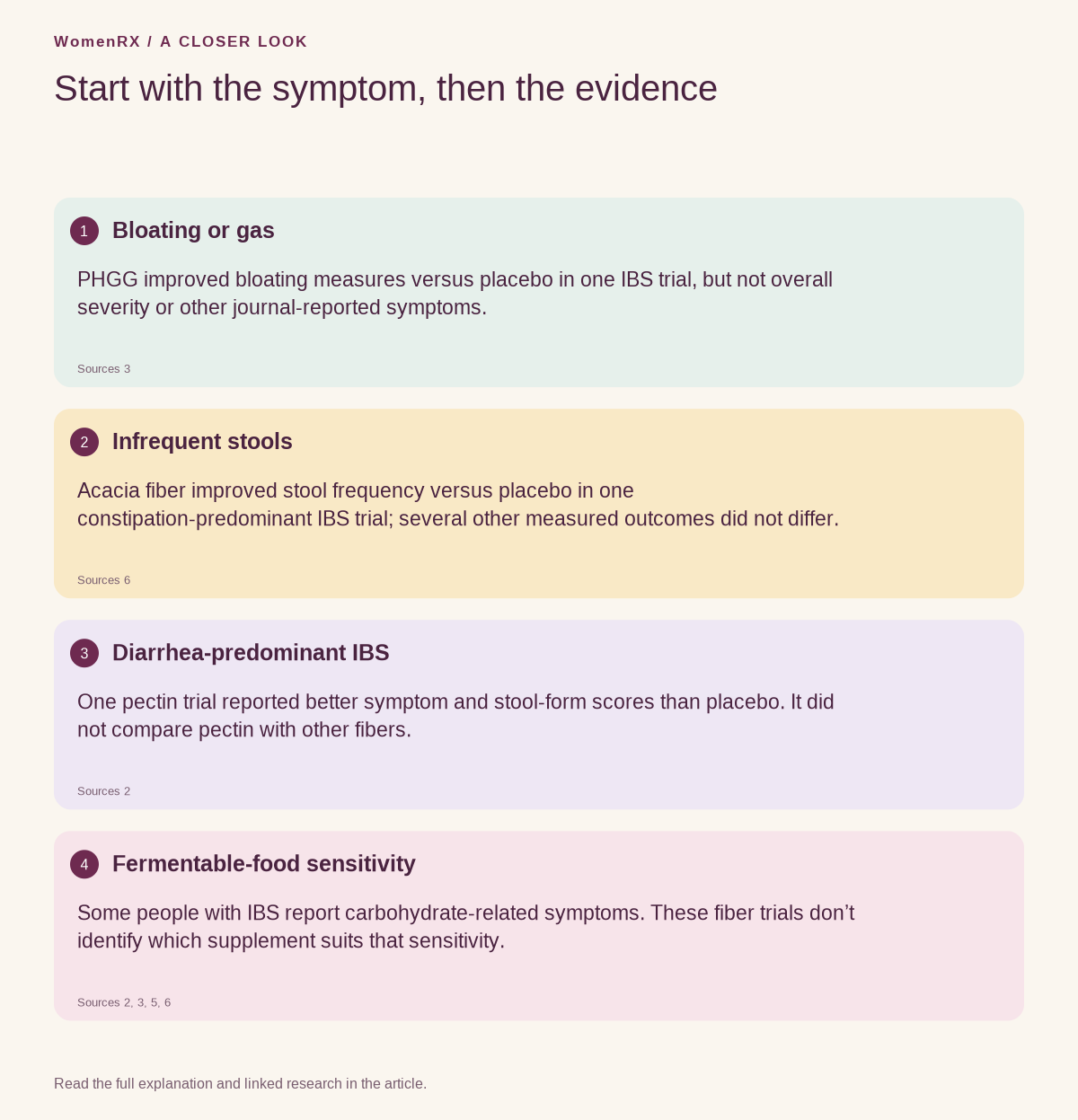
Start with the symptom, then the evidence
Bloating or gas: PHGG improved bloating measures versus placebo in one IBS trial, but not overall severity or other journal-reported symptoms.3
Infrequent stools: Acacia fiber improved stool frequency versus placebo in one constipation-predominant IBS trial; several other measured outcomes did not differ.6
Diarrhea-predominant IBS: One pectin trial reported better symptom and stool-form scores than placebo. It did not compare pectin with other fibers.2
Fermentable-food sensitivity: Some people with IBS report carbohydrate-related symptoms. These fiber trials don’t identify which supplement suits that sensitivity.2356
Read the figure as text
These are starting points for weighing a fiber, not a ranking of products or a prediction of your response.- Bloating or gas: PHGG improved bloating measures versus placebo in one IBS trial, but not overall severity or other journal-reported symptoms.3
- Infrequent stools: Acacia fiber improved stool frequency versus placebo in one constipation-predominant IBS trial; several other measured outcomes did not differ.6
- Diarrhea-predominant IBS: One pectin trial reported better symptom and stool-form scores than placebo. It did not compare pectin with other fibers.2
- Fermentable-food sensitivity: Some people with IBS report carbohydrate-related symptoms. These fiber trials don’t identify which supplement suits that sensitivity.2356
More questions, answered
Is one of these fibers proven to work better for women?
No. The placebo-controlled PHGG trial included women and men but didn’t report separate symptom results by sex. A smaller PHGG study reported changes among women, but it had no placebo group. The pectin and acacia trial abstracts do not report women-specific results. 2 3 4 6
What if I’m pregnant or breastfeeding?
These IBS trial results do not establish whether the supplements are suitable during pregnancy or breastfeeding. If that’s your situation, make the choice with a clinician who knows your symptoms and circumstances. 2 3 6
Sources you can check
- Impact of bread diet on intestinal dysbiosis and irritable bowel syndrome symptoms in quiescent ulcerative colitis: A pilot study.Lluansí A, Llirós M, Carreras-Torres R, Bahí A, Capdevila M, Feliu A, Vilà-Quintana L, Elias-Masiques N, Cueva E, Peries L, Torrealba L, Miquel-Cusachs JO, Sàbat M, Busquets D, Lóp... · PloS one · 2024Return to first citation
- [Efficacy of pectin in the treatment of diarrhea predominant irritable bowel syndrome].Xu L, Yu W, Jiang J, Feng X, Li N. · Zhonghua wei chang wai ke za zhi = Chinese journal of gastrointestinal surgery · 2015Return to first citation
- Randomized clinical study: Partially hydrolyzed guar gum (PHGG) versus placebo in the treatment of patients with irritable bowel syndrome.Niv E, Halak A, Tiommny E, Yanai H, Strul H, Naftali T, Vaisman N. · Nutrition & metabolism · 2016Return to first citation
- Partially hydrolyzed guar gum in the treatment of irritable bowel syndrome with constipation: effects of gender, age, and body mass index.Russo L, Andreozzi P, Zito FP, Vozzella L, Savino IG, Sarnelli G, Cuomo R. · Saudi journal of gastroenterology : official journal of the Saudi Gastroenterology Association · 2015Return to first citation
- The role of diet in symptoms of irritable bowel syndrome in adults: a narrative review.Heizer WD, Southern S, McGovern S. · Journal of the American Dietetic Association · 2009Return to first citation
- Acacia fiber or probiotic supplements to relieve gastrointestinal complaints in patients with constipation-predominant IBS: a 4-week randomized double-blinded placebo-controlled intervention trial.JanssenDuijghuijsen L, van den Belt M, Rijnaarts I, Vos P, Guillemet D, Witteman B, de Wit N. · European journal of nutrition · 2024Return to first citation