When Should You Take a Prebiotic Fiber Supplement?
If a prebiotic leaves you bloated, look at how quickly you added fiber before trying to solve it by changing meal times.
Follow your product’s directions, including any instruction to take it with food. If the label allows either option, choose a convenient time. The research described for these particular products doesn’t establish that fasting improves results or that taking them with food prevents gas. Increase fiber gradually, since adding too much too quickly can cause gas, bloating, or cramps. 1 3 4
Start with the ingredient, not the clock
“Prebiotic” can describe different fibers or a blend. Check the ingredient list for the specific fiber and follow the product’s directions. One human study examined a multi-ingredient formulation that included FOS and apple fiber; it doesn’t establish directions for a different product or for an isolated fiber. 4
If the label says to take it with food, follow that instruction. If it allows flexibility, choose a time that fits your routine. A pilot trial examined daily prebiotic use alongside metformin in youth, while another human study examined a multi-ingredient formulation. The reported findings don’t provide a basis for choosing meals over fasting to prevent gas. 3 4
If you feel gassy, look at the size of the fiber change
Adding dietary fiber too quickly can cause gas, bloating, and cramps. That applies to your overall fiber intake, not just what comes from a supplement. For example, starting a supplement the same week you begin eating much more fiber-rich food makes it harder to tell which change is affecting you. Increase fiber gradually rather than making several big changes at once. 1
If symptoms begin after you start a product, reread its ingredients and serving directions. Consider whether your food choices changed at the same time. If you increased several sources of fiber together, focus on making those changes gradually rather than repeatedly changing the time on the clock. 1
Pregnancy and breastfeeding need ingredient-specific advice
General advice to add fiber gradually doesn’t establish whether a particular prebiotic supplement is appropriate during pregnancy or breastfeeding. The reported findings from the youth trial and the study of a multi-ingredient formulation containing FOS and apple fiber don’t provide pregnancy- or breastfeeding-specific outcomes to guide a decision about your product. If you’re considering a product while pregnant or breastfeeding, check its full ingredient list with your prenatal or primary-care clinician rather than assuming findings about another fiber or blend apply to it. 3 4
When bloating needs a different answer
Adding fiber too quickly can cause bloating. But don’t automatically blame a supplement if bloating keeps coming back or doesn’t go away. Seek medical advice if it persists, especially if you also have unintentional weight loss or blood in your stool. A swollen belly with sudden, severe abdominal pain calls for emergency care. 1 2
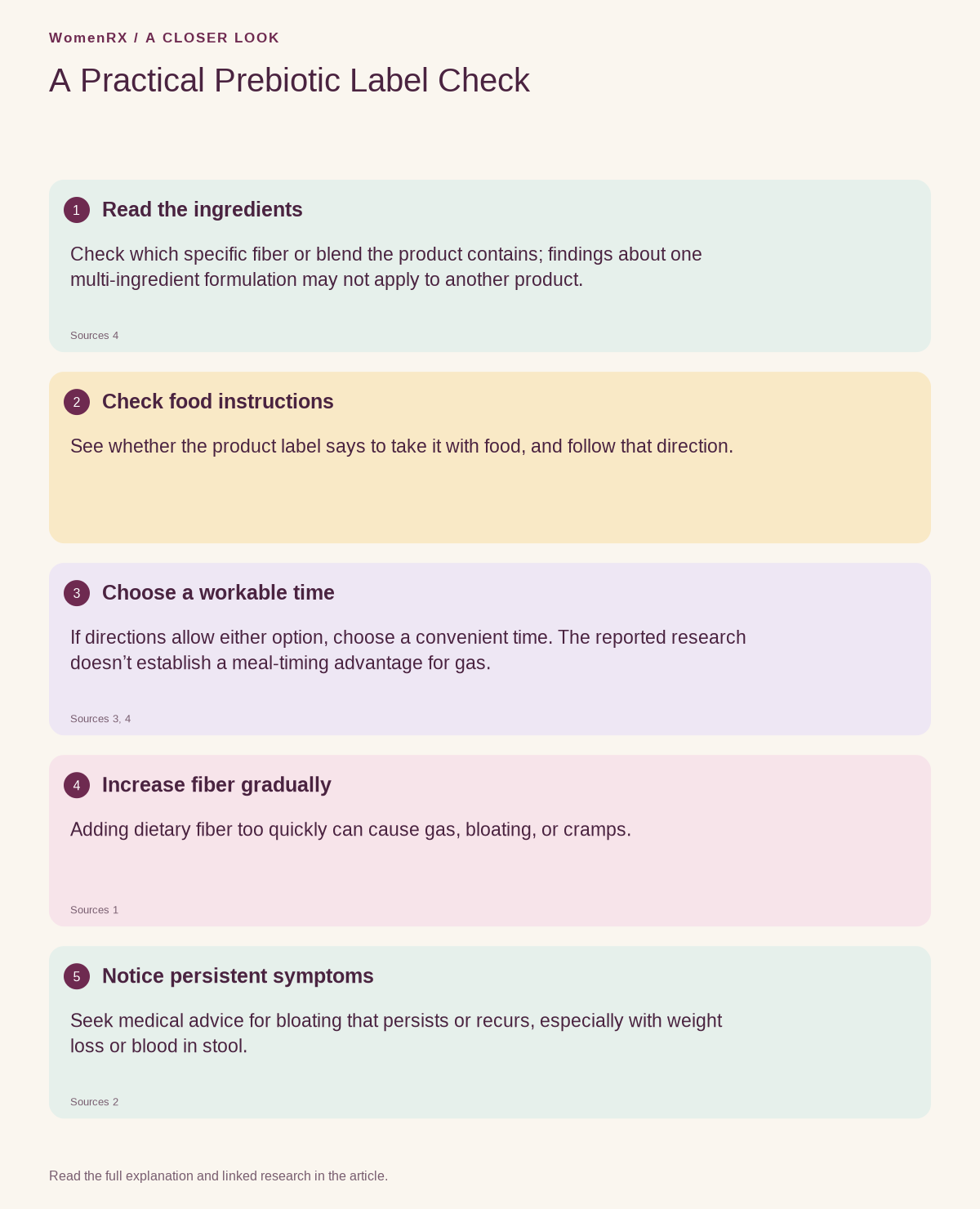
A Practical Prebiotic Label Check
Read the ingredients: Check which specific fiber or blend the product contains; findings about one multi-ingredient formulation may not apply to another product.4
Check food instructions: See whether the product label says to take it with food, and follow that direction.
Choose a workable time: If directions allow either option, choose a convenient time. The reported research doesn’t establish a meal-timing advantage for gas.34
Increase fiber gradually: Adding dietary fiber too quickly can cause gas, bloating, or cramps.1
Notice persistent symptoms: Seek medical advice for bloating that persists or recurs, especially with weight loss or blood in stool.2
Read the figure as text
Use the product directions to decide about timing, then consider your overall fiber change and symptoms.- Read the ingredients: Check which specific fiber or blend the product contains; findings about one multi-ingredient formulation may not apply to another product.4
- Check food instructions: See whether the product label says to take it with food, and follow that direction.
- Choose a workable time: If directions allow either option, choose a convenient time. The reported research doesn’t establish a meal-timing advantage for gas.34
- Increase fiber gradually: Adding dietary fiber too quickly can cause gas, bloating, or cramps.1
- Notice persistent symptoms: Seek medical advice for bloating that persists or recurs, especially with weight loss or blood in stool.2
Sources you can check
- Dietary Fiber: MedlinePlusAccessed 2026-09-25Return to first citation
- Bloating - NHSAccessed 2026-09-25Return to first citation
- The effects of prebiotics on gastrointestinal side effects of metformin in youth: A pilot randomized control trial in youth-onset type 2 diabetes.Dixon SA, Mishra S, Dietsche KB, Jain S, Mabundo L, Stagliano M, Krenek A, Courville A, Yang S, Turner SA, Meyers AG, Estrada DE, Yadav H, Chung ST. · Frontiers in endocrinology · 2023Return to first citation
- Phytonutrient-Enriched Prebiotic Mixture Primes the Gut Environment to Enhance Probiotic Efficacy: Ex Vivo Screening and a Human Clinical Trial.Lee HJ, Suh DH, Lee S, Holzapfel WH, Ji Y, Runyon MK, Jo H, Hur JY, Ryu R, Jung ES. · Biology · 2026Return to first citation