Does Taking a Fiber Supplement Without Food Matter?
For psyllium, start with the product’s liquid directions and check whether it needs spacing from your medicines.
Don’t assume an empty stomach makes a fiber supplement work better. If your product contains psyllium, its directions emphasize taking it with enough liquid and keeping it apart from certain medicines. They don’t establish whether taking it with food changes its benefits or digestive symptoms. Other fiber products may have different directions, so check the ingredient and your package. 6
Start with the fiber in your container
“Fiber supplement” can mean more than one ingredient. An article on constipation management in older adults lists psyllium, methylcellulose and polycarbophil as supplemental fiber options, but a direction written for psyllium should not automatically be applied to the others. Check the ingredient and the directions on the particular container you have. 46
Psyllium offers a useful example of why with food or without food isn’t the whole question. It absorbs liquid in the intestines, swells and helps form a bulky stool. MedlinePlus says psyllium powder and granules must be mixed with 8 ounces of liquid right before use, and that you need at least 8 ounces of liquid when taking psyllium for it to work properly and to help prevent side effects. Those are psyllium directions, not a universal amount for every fiber product. 6
MedlinePlus’s psyllium directions emphasize liquid and spacing from certain medicines, but they don’t establish whether taking it with food changes its benefits or digestive symptoms. Follow your product’s directions. If discomfort starts after you add fiber, consider how quickly your overall fiber intake has increased: adding fiber too quickly can cause gas, bloating and cramps. 16
If it leaves you bloated, look beyond the clock
Suppose you started a supplement this week and now feel gassy after breakfast. Moving it to bedtime might seem like the obvious fix, but the timing alone may not explain the discomfort. A rapid increase in fiber can cause gas, bloating and cramps; constipation itself can also leave you feeling bloated. Consider how much fiber you’ve recently added from both food and supplements before deciding that breakfast is the problem. 13
If you’re taking fiber because of constipation, food, fluids and activity are part of the picture too. Not getting enough fiber or fluids, moving less and certain medicines are among the possible contributors to constipation. If it keeps happening despite changes, or you have blood in your stool, unintentional weight loss or a sudden change in bowel habits, arrange a medical evaluation rather than repeatedly adjusting supplement timing. 23
Medicines can make timing matter
For psyllium, the clearest timing issue in these directions concerns specific medicines. MedlinePlus says not to take digoxin, aspirin or nitrofurantoin within three hours of psyllium. It also advises telling your pharmacist or clinician about other medicines and supplements you take, because your medication plan may need review. Don’t apply that three-hour rule to every drug or every fiber product. If you take a regular medicine, check its directions alongside those of your exact fiber product before settling on a routine. 6
If you’re pregnant, constipation is common, but that doesn’t establish a different with-food rule for fiber supplements. MedlinePlus advises telling your clinician if you’re pregnant or become pregnant while taking psyllium. Follow the directions for the exact product you’re considering rather than assuming all fiber supplements have the same pregnancy guidance. 36
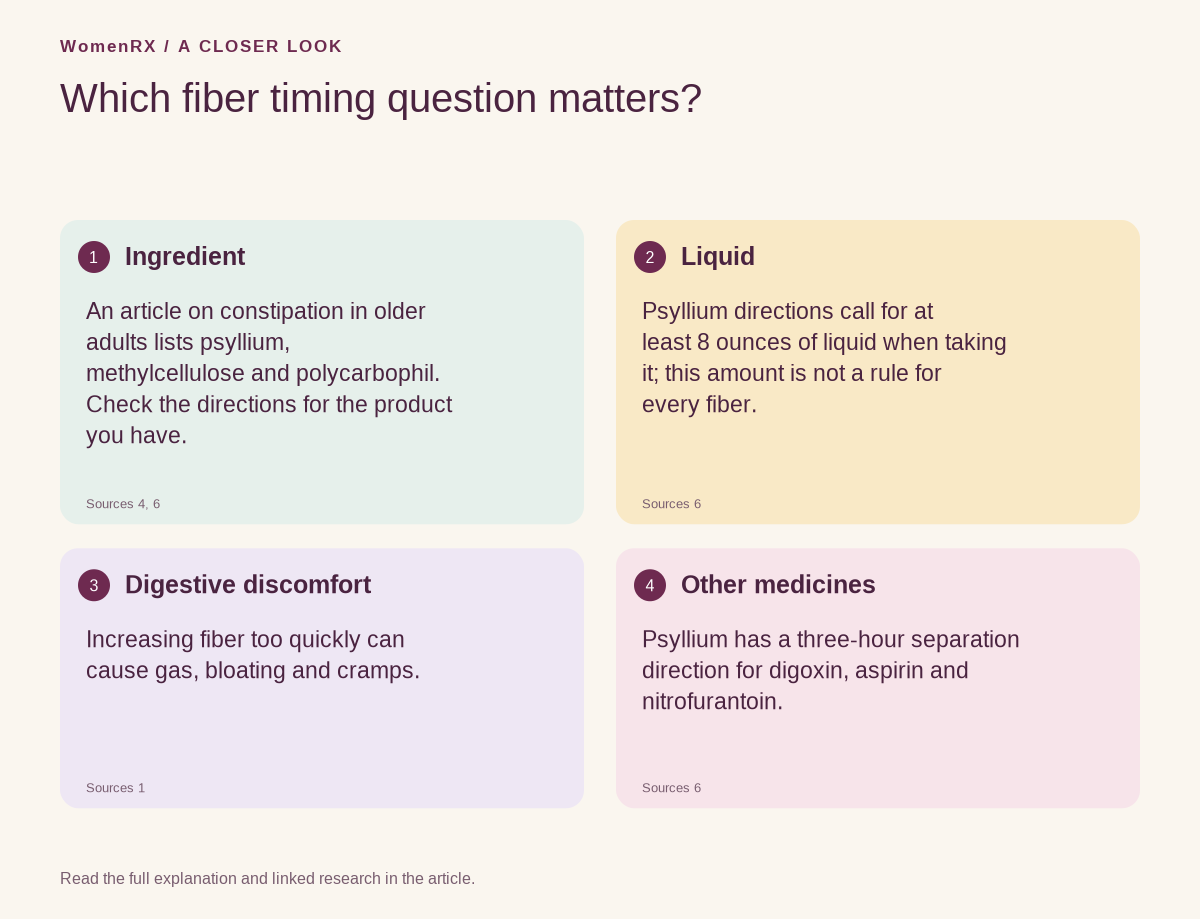
Which fiber timing question matters?
Ingredient: An article on constipation in older adults lists psyllium, methylcellulose and polycarbophil. Check the directions for the product you have.46
Liquid: Psyllium directions call for at least 8 ounces of liquid when taking it; this amount is not a rule for every fiber.6
Digestive discomfort: Increasing fiber too quickly can cause gas, bloating and cramps.1
Other medicines: Psyllium has a three-hour separation direction for digoxin, aspirin and nitrofurantoin.6
Read the figure as text
Use the ingredient and your situation to identify the direction worth checking first.- Ingredient: An article on constipation in older adults lists psyllium, methylcellulose and polycarbophil. Check the directions for the product you have.46
- Liquid: Psyllium directions call for at least 8 ounces of liquid when taking it; this amount is not a rule for every fiber.6
- Digestive discomfort: Increasing fiber too quickly can cause gas, bloating and cramps.1
- Other medicines: Psyllium has a three-hour separation direction for digoxin, aspirin and nitrofurantoin.6
More questions, answered
Is psyllium the same choice as any other fiber if I have IBS with constipation?
Not necessarily. A US-focused review summarizes IBS guidance that favors soluble over insoluble fiber for IBS symptoms. That distinction can help you choose an ingredient, but it doesn’t establish whether taking it with a meal works better. 5
Sources you can check
- Dietary Fiber: MedlinePlusAccessed 2026-09-25Return to first citation
- Constipation | MedlinePlusAccessed 2026-09-25Return to first citation
- Constipation - NHSAccessed 2026-09-25Return to first citation
- Management of Constipation in Older Adults.Mounsey A, Raleigh M, Wilson A. · American family physician · 2015Return to first citation
- Review of the Patient Burden and Therapeutic Landscape of Irritable Bowel Syndrome with Constipation in the United States.Sendzischew Shane MA, Ruddy J, Cline M, Rosenbaum DP, Edelstein S, Moshiree B. · Clinical and experimental gastroenterology · 2024Return to first citation
- Psyllium: MedlinePlus Drug InformationAccessed 2026-09-25Return to first citation