Can Food Boost GLP-1? What the Evidence Actually Shows
Fiber-rich foods have useful benefits, but a possible effect on the body’s GLP-1 signaling is not evidence that they work like prescription medicines.
Some dietary fibers may stimulate the body’s own GLP-1 through gut processes that include microbial fermentation. But this evidence doesn’t show that eating a particular food produces lasting appetite control or medication-like weight loss. Fiber-rich foods remain worthwhile for fullness and digestion, while a review describes weight loss with fiber alone as typically more modest than with GLP-1 receptor agonists. 1 5
A meal signal isn’t a medication
GLP-1 is a hormone the body releases in response to eating. Dietary fiber may influence this signaling, including through fermentation by gut microbes. A review describes fiber as one way to engage the gut-brain pathways involved in appetite and notes that weight loss from fiber alone is generally more modest than with GLP-1 receptor agonist medicines. 5
That’s a useful distinction: a food can affect a normal body process without reproducing a drug’s effects. A meal-related hormone response is not proof of lasting appetite suppression or a particular amount of weight loss. Prescription GLP-1 receptor agonists act on the same signaling system pharmacologically; they aren’t simply a stronger serving of a GLP-1-boosting food. 4 5
What fiber-rich foods can realistically offer
Fiber is found in plant foods such as whole grains, fruits, and vegetables. It adds bulk and can help you feel full sooner; it also supports digestion and can help prevent constipation. Those are practical benefits even if you set aside the question of GLP-1. 1
A reasonable takeaway is to choose fiber-rich foods as part of an eating pattern that works for you, not to chase a promised hormone spike. The review describes fiber-related GLP-1 signaling as a potential mechanism, while noting that weight-loss effects with fiber alone are typically more modest than with GLP-1 receptor agonists and depend on the fiber’s type, dose, and duration of use. That mechanism does not show that a particular food reduces appetite or weight because it raises GLP-1. 5
If you’re adding more fiber, do it gradually. A quick increase can cause gas, bloating, or cramps. 1 You don’t need a special “GLP-1 diet” to get the ordinary benefits of fiber; healthy eating can include a variety of foods and should fit your preferences, traditions, and budget. 2
How to read “GLP-1 boost” claims
Ask what a study actually measured. A rise in GLP-1 during or after a meal is a hormone measurement. Feeling fuller, eating less, losing weight, and keeping weight off are separate outcomes. One does not automatically establish the others.
For a brief illustration of that distinction, a year-long exercise study after diet-induced weight loss measured late-phase GLP-1 response to a test meal. The exercise group’s response increased compared with the usual-activity group, but the study tested exercise, not a food. Its reported hormone result cannot tell you whether eating fiber produces medication-like weight loss. Women participated, but the reported results do not establish a separate response for women or for any reproductive life stage. 3
So if a headline says a food “boosts GLP-1,” look for the population studied, how the hormone was measured, and whether the study also measured appetite or weight over time. A short-term hormone result can be biologically interesting without answering whether the food meaningfully changes weight.
The practical bottom line
Eat fiber-rich foods for their broader nutritional and digestive value if they suit you. Treat claims that a particular food acts like a GLP-1 medicine with skepticism: the review supports a plausible link between fiber and the body’s own signaling, not equivalence in clinical effect. If you’re weighing food changes against medication, compare outcomes that matter to you, not just a hormone measurement. 1 5
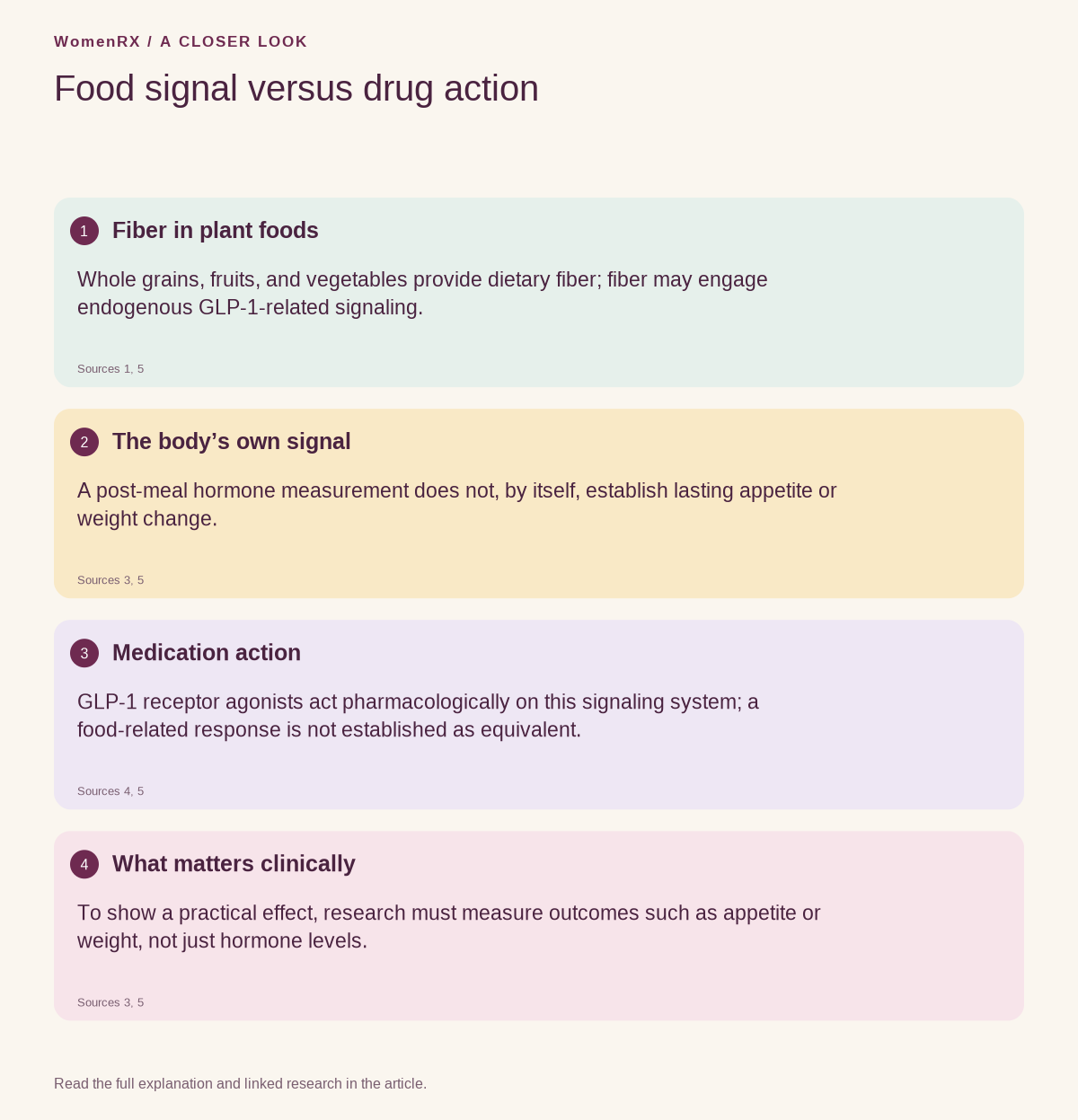
Food signal versus drug action
Fiber in plant foods: Whole grains, fruits, and vegetables provide dietary fiber; fiber may engage endogenous GLP-1-related signaling.15
The body’s own signal: A post-meal hormone measurement does not, by itself, establish lasting appetite or weight change.35
Medication action: GLP-1 receptor agonists act pharmacologically on this signaling system; a food-related response is not established as equivalent.45
What matters clinically: To show a practical effect, research must measure outcomes such as appetite or weight, not just hormone levels.35
Read the figure as text
Follow the difference between a possible fiber-related effect on the body’s own GLP-1 and the outcomes needed to show a medication-like benefit.- Fiber in plant foods: Whole grains, fruits, and vegetables provide dietary fiber; fiber may engage endogenous GLP-1-related signaling.15
- The body’s own signal: A post-meal hormone measurement does not, by itself, establish lasting appetite or weight change.35
- Medication action: GLP-1 receptor agonists act pharmacologically on this signaling system; a food-related response is not established as equivalent.45
- What matters clinically: To show a practical effect, research must measure outcomes such as appetite or weight, not just hormone levels.35
More questions, answered
Which foods are known to raise GLP-1 the most?
The fiber findings don’t establish a food-by-food ranking or show that the food producing the largest hormone response would lead to the most weight loss. Whole grains, fruits, and vegetables are useful sources of fiber, but their everyday benefits shouldn’t be mistaken for a medication-like effect. 1 5
Does the evidence show different food-related GLP-1 effects in women?
It doesn’t establish a women-specific food effect. A relevant exercise study included women, but it tested exercise rather than foods, and its reported results do not establish separate effects by sex or reproductive life stage. 3
Sources you can check
- Dietary Fiber: MedlinePlusAccessed 2026-09-25Return to first citation
- Nutrition: MedlinePlusAccessed 2026-09-25Return to first citation
- One Year of Exercise After Weight Loss Increases Postprandial GLP-1 Secretion in Contrast to Usual Activity or GLP-1 Receptor Agonist Treatment.Holt J, Sandsdal RM, Byberg S, Janus C, Juhl CR, Jørgensen JR, Hartmann B, Stallknecht B, Holst JJ, Madsbad S, Jensen SBK, Torekov SS. · Obesity (Silver Spring, Md.) · 2026Return to first citation
- 2025 ADS/ANZCA/GESA/NACOS clinical practice recommendations on the peri-procedural use of GLP-1/GIP receptor agonists.Hocking SL, Scott DA, Remedios ML, Horowitz M, Story DA, Greenfield JR, Boussioutas A, Devereaux B, Andrikopoulos S, Shaw JE, Olesnicky BL. · Anaesthesia and intensive care · 2025Return to first citation
- Dietary Fiber and Glucagon-Like Peptide-1 Receptor Agonists in Obesity Management: Converging Mechanisms, Interactions, and Strategies for Durable Weight Control.Wang Y, Liu J, Verbeke K, Retamal NG, Akkerman R, de Vos P. · Advances in nutrition (Bethesda, Md.) · 2026Return to first citation