Food Noise and GLP-1 Medicines: What Research Shows
“Food noise” describes persistent food-related thoughts; GLP-1 research discussed here measures related experiences such as appetite, cravings, and food intake.
People use “food noise” to describe persistent thoughts, urges, or preoccupation around food. Here, it’s a plain-language label for a reported experience, not a diagnosis assessed in the research discussed below. Some people report less appetite or food temptation during GLP-1 treatment, but those experiences overlap without being identical. 1 2
“Food noise” describes an experience
People use “food noise” to mean different things: recurring thoughts about what to eat, strong cravings, feeling pulled toward food cues, or having trouble feeling satisfied. Those experiences can overlap, but they aren't interchangeable. As a practical distinction, you might describe a bodily drive to eat as hunger, a desire for a particular food as a craving, and repeated thoughts about food as something that can also relate to habits, emotions, or a difficult relationship with eating. Here, “food noise” is a plain-language label for a reported experience, not a diagnosis assessed in the research discussed below.
GLP-1 medicines may affect some of these experiences. The liraglutide analysis measured satiation and food intake, while a review discusses reports about food temptation, enjoyment, cravings, and preference. The findings discussed here focus on those related outcomes rather than presenting a food-noise measure. That makes a claim that a medicine “turns off food noise” harder to assess than a claim about a specific measured outcome. 1 2
What the medicine may change
GLP-1 receptor agonists can reduce food intake and appetite. Researchers think their effects involve signaling in brain circuits that help regulate hunger, fullness, and eating behavior. Some people also report that foods seem less tempting or enjoyable during treatment. A review describes these changes as potentially involving shifts in food motivation and reward, not necessarily a basic change in the ability to taste. Responses differ: some people report a noticeable change, while others have persistent appetite or a different eating experience. 1 2
Delayed gastric emptying has been proposed as one contributor to reduced food intake during GLP-1 treatment, but the liraglutide analysis discussed below did not measure food-related thoughts. In a secondary analysis of a 16-week placebo-controlled trial of liraglutide in patients with obesity, gastric-emptying measures accounted for 4% to 6% of the variance in appetite-related measures in the full cohorts at baseline and at study completion. When the placebo and liraglutide groups were analyzed separately, those relationships were not found; within the liraglutide group, researchers found no significant relationship between gastric emptying and the appetite measures. This finding suggests that stomach emptying alone may not account for appetite suppression; it doesn't identify a single alternative explanation or establish what happens with every GLP-1 medicine. 1
What a change in food thoughts can and can't tell you
A person may notice less interest in certain foods without experiencing a complete quieting of food-related thoughts. Another person may feel fuller but still have cravings, or find that mood, routines, social settings, or food cues shape what they want. A review of altered eating experiences during GLP-1 treatment describes this variation and notes that emotional eating, binge-eating tendencies, and other psychological or behavioral factors may influence how people experience treatment. 2
So, “my food noise is quieter” can be a useful description of someone's experience, but it isn't proof of a specific biological mechanism or a measure of treatment success by itself. It also doesn't mean that distressing eating patterns have disappeared. Appetite effects and changes in food reward are not the same as addressing every reason someone thinks about or turns to food.
What the evidence says about women
The findings discussed here don't establish a women-specific effect. The reported results of the liraglutide analysis concern appetite and food intake, while the review describes varied eating experiences. Neither provides a basis here for comparing changes in persistent food thoughts by sex, menstrual stage, pregnancy, postpartum status, or menopause. Those distinctions matter if you're trying to understand whether a finding applies to your own life stage. 1 2
The practical distinction is to use “food noise” to describe what you're noticing, then be more specific about it: Is it hunger, a craving for a particular food, feeling drawn to food cues, or thoughts that feel distressing? Research supports appetite effects and suggests food reward may shift for some people. The findings discussed here don't establish how reliably treatment changes persistent food thoughts or whether that experience differs by sex, life stage, or eating-disorder history. 1 2
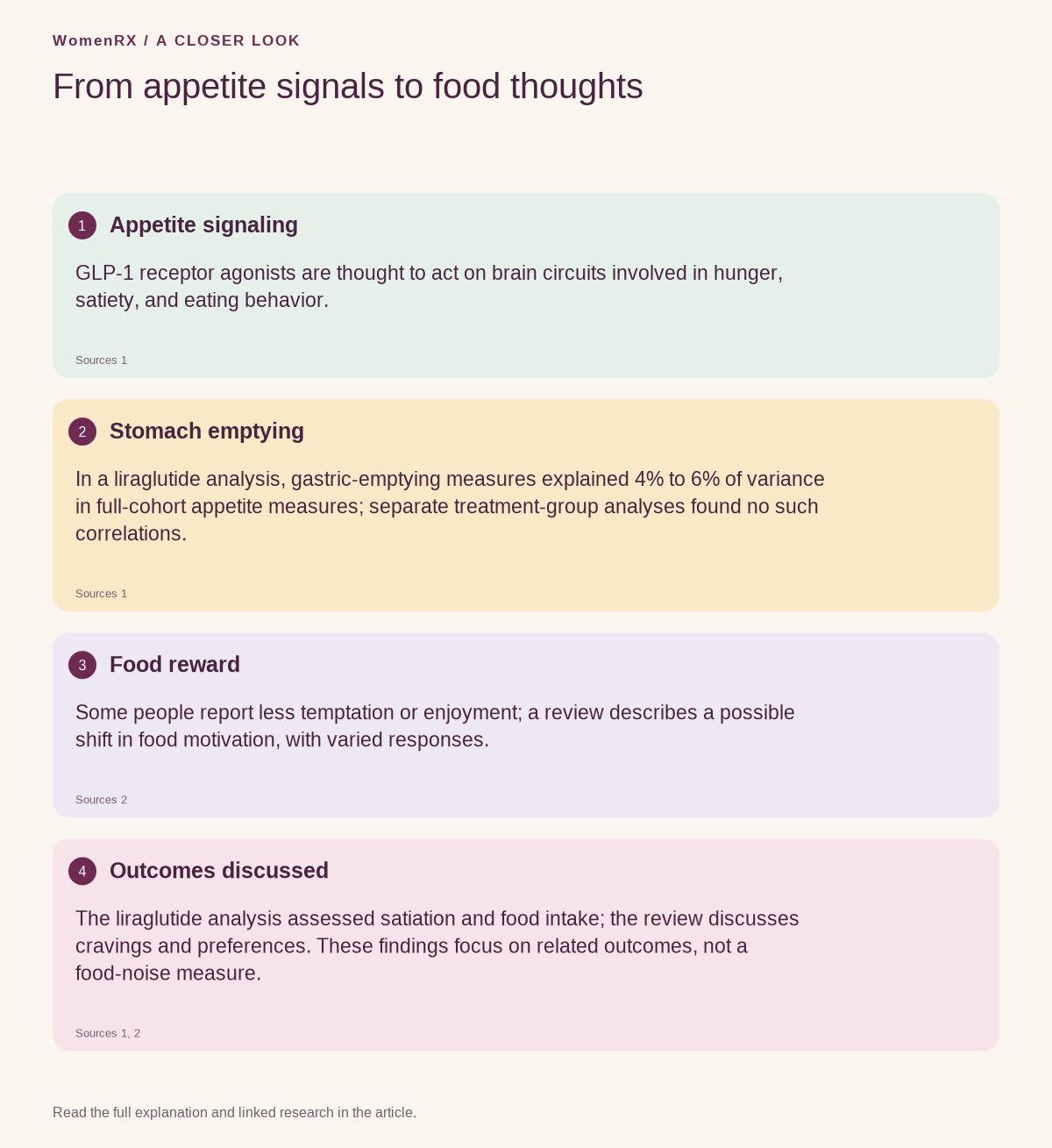
From appetite signals to food thoughts
Appetite signaling: GLP-1 receptor agonists are thought to act on brain circuits involved in hunger, satiety, and eating behavior.1
Stomach emptying: In a liraglutide analysis, gastric-emptying measures explained 4% to 6% of variance in full-cohort appetite measures; separate treatment-group analyses found no such correlations.1
Food reward: Some people report less temptation or enjoyment; a review describes a possible shift in food motivation, with varied responses.2
Outcomes discussed: The liraglutide analysis assessed satiation and food intake; the review discusses cravings and preferences. These findings focus on related outcomes, not a food-noise measure.12
Read the figure as text
GLP-1 medicines can affect appetite, but food-related thoughts are broader than any single outcome discussed in this research.- Appetite signaling: GLP-1 receptor agonists are thought to act on brain circuits involved in hunger, satiety, and eating behavior.1
- Stomach emptying: In a liraglutide analysis, gastric-emptying measures explained 4% to 6% of variance in full-cohort appetite measures; separate treatment-group analyses found no such correlations.1
- Food reward: Some people report less temptation or enjoyment; a review describes a possible shift in food motivation, with varied responses.2
- Outcomes discussed: The liraglutide analysis assessed satiation and food intake; the review discusses cravings and preferences. These findings focus on related outcomes, not a food-noise measure.12
More questions, answered
Is reduced appetite the same as quieter food noise?
Not necessarily. Appetite, cravings, fullness, and repeated thoughts about food are related but distinct experiences. A person might notice one changing without the others. The liraglutide analysis measures appetite-related outcomes, while the review discusses several aspects of eating experience; the findings discussed here focus on those related outcomes rather than presenting a food-noise measure. 1 2
Does the research show that GLP-1 medicines help with binge eating?
The review notes that binge-eating tendencies may influence how people experience treatment. That observation doesn't establish GLP-1 medicines as a treatment for binge-eating disorder or show how persistent food thoughts change for people with that history. 2
Sources you can check
- Appetite Suppression by GLP-1 Receptor Agonists: Role of Delayed Gastric Emptying.Friedman MI, Harmsen WS, Camilleri M. · Obesity (Silver Spring, Md.) · 2026Return to first citation
- Altered eating experience during GLP-1 receptor agonist therapy: a sensory-liking-wanting framework for food preference and nutritional behaviour.Du J, Yang Z, Chen Y. · Frontiers in nutrition · 2026Return to first citation