GLP-1 Medicines and Arthritis: What the Evidence Shows
Semaglutide improved knee pain and function in one trial of people with obesity and knee osteoarthritis, but that does not establish a joint-protecting effect or a treatment for psoriatic disease.
The clearest evidence is for symptoms in knee osteoarthritis: one trial found better pain and physical-function scores with semaglutide than placebo, alongside greater weight loss. But a pooled analysis found no significant overall change in osteoarthritis pain, function, or stiffness. Possible effects on inflammation are largely preclinical, and researchers have not shown that these medicines repair cartilage or slow joint damage. Direct clinical evidence for psoriatic disease is limited. 5 6 7
The strongest signal is for knee osteoarthritis symptoms
Osteoarthritis (OA) involves changes in the joint, including breakdown of protective cartilage. Pain, stiffness, and difficulty moving can vary from person to person. In the knees and hips, excess weight can also increase the load joints bear. Weight reduction may ease some OA symptoms, but that is not the same as proving a medicine directly protects the joint. 2 3 4
The most direct trial evidence comes from STEP-9, a 68-week randomized, placebo-controlled study of 407 people with obesity, moderate knee OA, and at least moderate knee pain. Participants received semaglutide or placebo, alongside counseling about physical activity and a lower-calorie diet. Average body weight fell by 13.7% with semaglutide and 3.2% with placebo. WOMAC pain scores improved by 41.7 points and 27.5 points, respectively; physical-function scores improved more with semaglutide as well. These findings support a possible symptom and function benefit for people resembling the trial participants. They do not show that every person with arthritis will respond, or that semaglutide treats arthritis itself. 6
There’s an important counterpoint: a 2026 systematic review and meta-analysis found no significant overall change in WOMAC pain, physical function, or stiffness across the studies it pooled. That broader result does not erase the positive STEP-9 findings. It means the evidence across medicines and studies is not yet consistent enough to treat the benefit as established across the board. Several GLP-1 medicines and tirzepatide, which also acts on GIP, were represented across the review’s musculoskeletal studies; the pooled joint-outcome result should not be read as proof that each medicine has the same effect. 5 6
Feeling better doesn’t prove the joint has changed
Less pain or easier walking is meaningful, but neither tells us whether cartilage loss or other structural changes have slowed. The STEP-9 outcomes described in the trial review were weight, pain, and physical function, not evidence of cartilage repair. Reviews of the research likewise conclude that a direct effect on joint structure or disease progression has not been established. 6 7 8
Inflammation is a separate question. Preclinical research discussed in a review suggests GLP-1 signaling may reduce inflammation and protect cartilage in OA. Those findings do not demonstrate that a GLP-1 medicine reduces joint inflammation or preserves cartilage in people. 6 7
That distinction helps set realistic goals. If weight management is part of your care, useful outcomes to discuss could include pain during a particular activity, such as climbing stairs, how far you can comfortably walk, and whether daily tasks feel easier. These are symptom and function goals, not proof that OA has stopped progressing. OA care can also include movement and other symptom treatments; a weight-loss medicine is not a replacement for evaluating or treating joint symptoms. 3 4
There’s another mobility-related consideration: a meta-analysis found decreases in lean body mass or fat-free mass with GLP-1 medicines, but the certainty of that evidence was low, and researchers do not yet know whether the changes lead to meaningful losses in strength or physical performance. If maintaining strength and mobility matters to you, make those goals part of the weight-management conversation too. 5
Psoriatic disease is a different question
Rheumatoid arthritis and psoriatic arthritis are not the same as OA. For psoriatic disease, a review describes a biological rationale involving inflammatory pathways and limited direct clinical evidence, much of it from studies involving people with obesity. It calls for dedicated trials. Those findings do not establish GLP-1 medicines as a treatment for psoriatic disease or answer whether they help rheumatoid arthritis. 1 6
The distinction matters when you’re trying to understand joint pain. OA commonly affects the knees, hips, or hands, and symptoms may be worse with use. A warm, swollen joint that hurts more when moved or pressed may suggest bursitis, while pain and stiffness on both sides that are worse after rest may suggest rheumatoid arthritis. A hot, swollen joint with fever or feeling unwell needs urgent medical advice because joint infection is possible. Joint aches can also occur around perimenopause and menopause, so aching alone doesn’t identify the cause. 1 2 3
What to make of the evidence as a woman
The STEP-9 results reported here are overall averages for its participants. They do not establish whether the effect on knee OA pain or function differs by sex or life stage, including around menopause. 6 If you’re considering a GLP-1 medicine as part of weight management, a useful discussion is whether the aim is weight reduction, improved OA pain or function, or both, and how you’ll judge progress without assuming the medicine is repairing the joint. Keep the goal specific to your diagnosis and daily life.
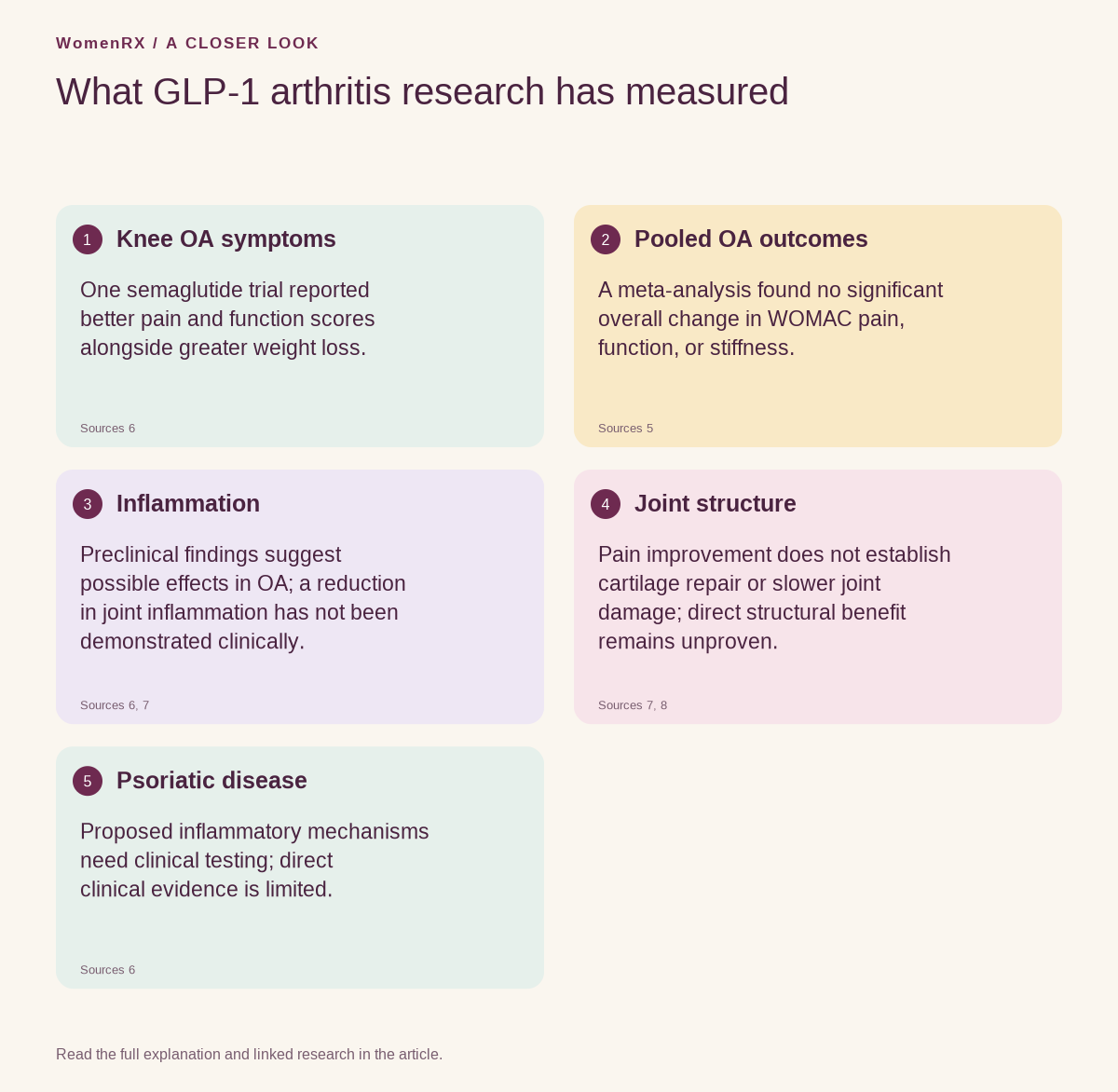
What GLP-1 arthritis research has measured
Knee OA symptoms: One semaglutide trial reported better pain and function scores alongside greater weight loss.6
Pooled OA outcomes: A meta-analysis found no significant overall change in WOMAC pain, function, or stiffness.5
Inflammation: Preclinical findings suggest possible effects in OA; a reduction in joint inflammation has not been demonstrated clinically.67
Joint structure: Pain improvement does not establish cartilage repair or slower joint damage; direct structural benefit remains unproven.78
Psoriatic disease: Proposed inflammatory mechanisms need clinical testing; direct clinical evidence is limited.6
Read the figure as text
The evidence differs by arthritis type and outcome: a knee-OA trial measured symptoms and function, while proposed inflammation effects, joint-structure effects, and treatment of psoriatic disease remain separate questions.- Knee OA symptoms: One semaglutide trial reported better pain and function scores alongside greater weight loss.6
- Pooled OA outcomes: A meta-analysis found no significant overall change in WOMAC pain, function, or stiffness.5
- Inflammation: Preclinical findings suggest possible effects in OA; a reduction in joint inflammation has not been demonstrated clinically.67
- Joint structure: Pain improvement does not establish cartilage repair or slower joint damage; direct structural benefit remains unproven.78
- Psoriatic disease: Proposed inflammatory mechanisms need clinical testing; direct clinical evidence is limited.6
More questions, answered
Does improvement in knee pain mean cartilage is healing?
No. Pain and function can improve without evidence that cartilage or other joint structures have changed. The semaglutide trial reported symptom and function outcomes, while direct structural benefit remains unproven. 6 7
Do these results apply to rheumatoid arthritis?
The knee osteoarthritis trial cannot tell you whether these medicines improve rheumatoid arthritis. A separate review examined psoriatic disease, not rheumatoid arthritis; it found limited direct clinical evidence for psoriatic disease and called for dedicated trials. 6
Sources you can check
- Joint pain - NHSAccessed 2026-09-25Return to first citation
- Osteoarthritis - NHSAccessed 2026-09-25Return to first citation
- Osteoarthritis - Symptoms - NHSAccessed 2026-09-25Return to first citation
- Osteoarthritis - Treatment and support - NHSAccessed 2026-09-25Return to first citation
- GLP-1 Receptor Agonists and Musculoskeletal Outcomes: A Systematic Literature Review and Meta-Analysis.Beaudart C, Malréchauffé Y, van Heden S, Sanchez-Rodriguez D, Scheen A, Bruyère O, Mobasheri A, Duque G, Rizzoli R, Reginster JY, Thiyagarajan JA. · Drugs · 2026Return to first citation
- GLP-1 receptor agonists in osteoarthritis and psoriatic disease: the missing link between obesity and inflammation?Angelopoulos A, Fragoulis GE, Papagoras C, Daoussis D. · Rheumatology international · 2026Return to first citation
- GLP-1 receptor agonists in obesity-related knee osteoarthritis: from weight loss to therapeutic pathway reconstruction.Wu J, Lei Y, Sa R, Zhong Y, Lu Y. · Frontiers in pharmacology · 2026Return to first citation
- Can Obesity Pharmacotherapy Modify Osteoarthritis? Interpreting Pain Relief, Weight-Loss Quality, and Structural Outcomes.Rombach J, Hannani MT, Henriksen K, Bihlet AR, Bajaj M, He Y, Bay-Jensen AC, Thudium CS, Karsdal M. · Osteoarthritis and cartilage · 2026Return to first citation