Sulfur-Tasting Burps on GLP-1 Medicines: What to Know
Belching has been reported with semaglutide and tirzepatide, but a sulfur taste doesn’t tell you what’s causing it.
Belching has appeared in adverse-event reports for semaglutide and tirzepatide, but those reports don’t explain why some burps taste like sulfur. 4 5 Notice what happens alongside the burping. Seek urgent medical advice if you keep vomiting and can’t keep fluids down; get emergency help for sudden, severe abdominal pain. 6 Constipation with constant pain, fever, vomiting, or an inability to pass gas also needs prompt assessment. 7
What the burp can, and can’t, tell you
Burping may happen during treatment with a GLP-1 medicine, but a sulfur-like taste or smell doesn’t identify the cause. Research using adverse-event reports has found a signal for eructation, the medical term for belching, with semaglutide and tirzepatide. Those reports don’t say whether the burps smelled like sulfur, prove the medicine caused them, or show how likely any one person is to experience them. 3 4 5
Tirzepatide delays stomach emptying and can cause gastrointestinal reactions, sometimes severe. Semaglutide also has reported gastrointestinal effects, including belching. A digestive effect is a possibility, but neither finding explains a particular burp’s odor. 2 5
Look at the pattern, not just the smell
For a few days, jot down when the burps happen, when you started the medicine or last increased its dose, and whether other symptoms show up. Include nausea, vomiting, abdominal discomfort, diarrhea or constipation, and whether you’re able to drink normally. This record can help your prescriber distinguish an isolated symptom from a broader or worsening digestive problem.
The available semaglutide study found that sex was not associated with the severity of reported gastrointestinal events. It did not establish whether sulfur-tasting burps differ between women and men. That overall finding shouldn’t be treated as an answer to a question the study didn’t measure. 5
When symptoms affect more than the burp
If the burps keep returning or are worsening, you can tell your prescriber and share the pattern you’ve noted. It may also help to mention whether the symptom began after starting treatment or a dose increase. These details provide context, but they don’t establish that the medicine caused the burps.
If you also have pain, fever, or a new bowel change, pay attention to the combination rather than trying to explain it by the burp’s odor. Constipation that comes with constant abdominal pain, fever, vomiting, or an inability to pass gas needs prompt medical assessment. Bloody diarrhea calls for urgent medical advice. Get emergency help for sudden, severe abdominal pain. 6 7
Vomiting or diarrhea changes the picture if it’s making it hard to keep up with fluids. Seek urgent medical advice if you keep vomiting and can’t keep fluids down. 6 Product information for tirzepatide describes postmarketing reports of acute kidney injury, most often in people whose gastrointestinal reactions, such as vomiting or diarrhea, led to dehydration. The labeling advises monitoring kidney function when reactions could cause fluid loss, especially during treatment initiation and dose escalation. 1 2
If the burps are isolated and you feel otherwise well, note the pattern and bring it up if it persists. Don’t use the odor alone to diagnose a complication. If you’re considering changing your medication because of the symptom, discuss that with your prescriber. The useful distinction is between belching by itself and symptoms that need a closer look, particularly those affecting your ability to stay hydrated.
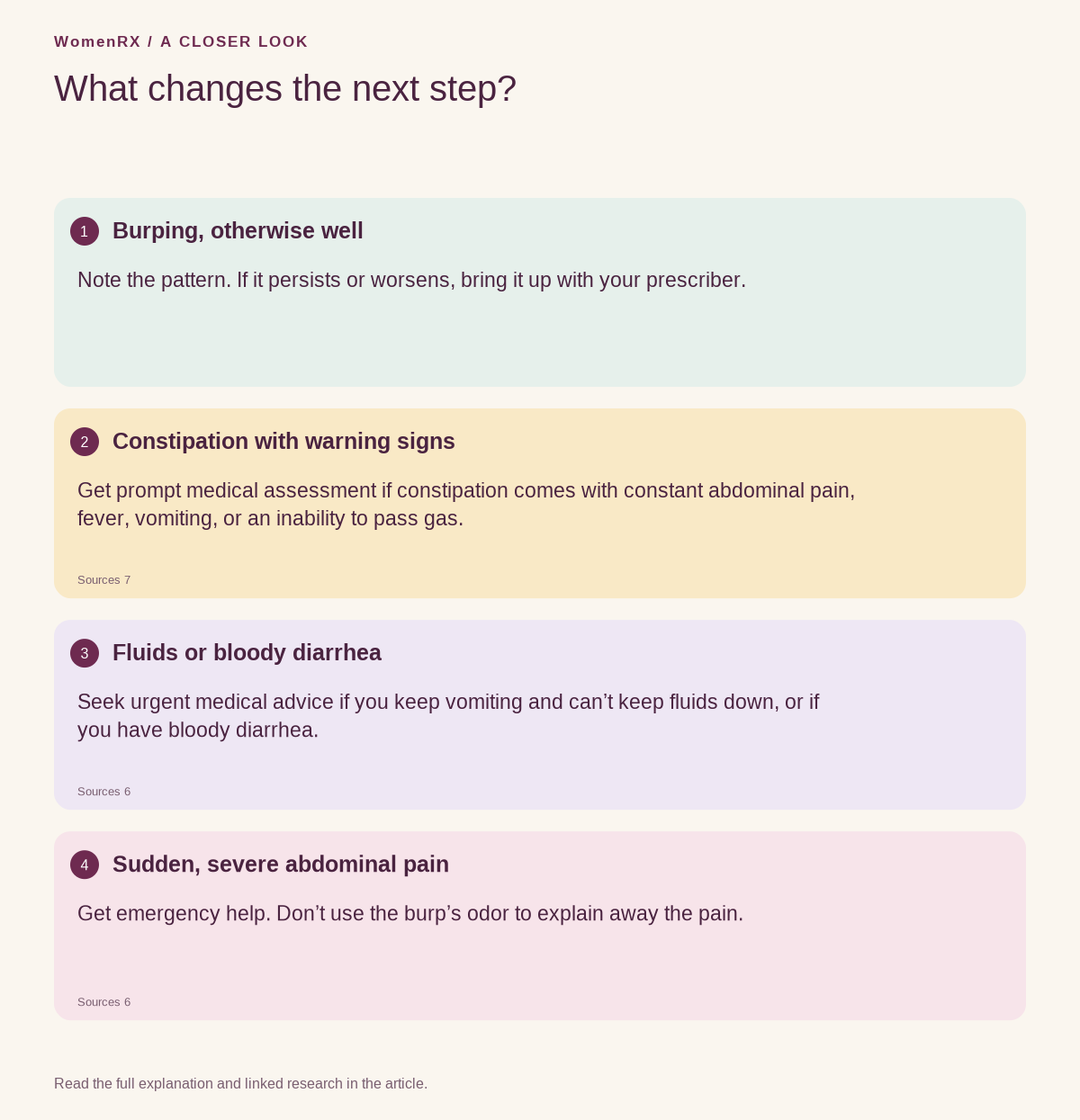
What changes the next step?
Burping, otherwise well: Note the pattern. If it persists or worsens, bring it up with your prescriber.
Constipation with warning signs: Get prompt medical assessment if constipation comes with constant abdominal pain, fever, vomiting, or an inability to pass gas.7
Fluids or bloody diarrhea: Seek urgent medical advice if you keep vomiting and can’t keep fluids down, or if you have bloody diarrhea.6
Sudden, severe abdominal pain: Get emergency help. Don’t use the burp’s odor to explain away the pain.6
Read the figure as text
Start with what’s happening alongside the burps. The smell alone can’t set the level of concern.- Burping, otherwise well: Note the pattern. If it persists or worsens, bring it up with your prescriber.
- Constipation with warning signs: Get prompt medical assessment if constipation comes with constant abdominal pain, fever, vomiting, or an inability to pass gas.7
- Fluids or bloody diarrhea: Seek urgent medical advice if you keep vomiting and can’t keep fluids down, or if you have bloody diarrhea.6
- Sudden, severe abdominal pain: Get emergency help. Don’t use the burp’s odor to explain away the pain.6
More questions, answered
Does sulfur-tasting belching happen more to women?
The studies don’t report sulfur-smelling burps by sex. One semaglutide reporting study found no association between sex and the severity of reported gastrointestinal events, but that doesn’t answer whether this specific kind of belching differs by sex. 5
Sources you can check
- ZEPBOUND (TIRZEPATIDE) INJECTION, SOLUTION ZEPBOUND (TIRZEPATIDE) INJECTION, SOLUTION ZEPBOUND KWIKPEN (TIRZEPATIDE) INJECTION, SOLUTION [ELI LILLY AND COMPANY] | US prescribing information and patient instructionsAccessed 2026-09-25Return to first citation
- MOUNJARO (TIRZEPATIDE) INJECTION, SOLUTION MOUNJARO KWIKPEN (TIRZEPATIDE) INJECTION, SOLUTION [ELI LILLY AND COMPANY] | US prescribing information and patient instructionsAccessed 2026-09-25Return to first citation
- Safety Profile of Tirzepatide in Real-World Clinical Practice: A Pharmacovigilance Study Using the FAERS Database.Guo X, Zhang J, Li Q, Ye Z, Yuan S. · Diabetes, obesity & metabolism · 2026Return to first citation
- Gastrointestinal adverse events associated with tirzepatide: A bibliometric and pharmacovigilance analysis.Shen P, Peng MS, Kim SJ, Joung KI, Kim KJ. · PloS one · 2026Return to first citation
- Gastrointestinal adverse events associated with semaglutide: A pharmacovigilance study based on FDA adverse event reporting system.Shu Y, He X, Wu P, Liu Y, Ding Y, Zhang Q. · Frontiers in public health · 2022Return to first citation
- Diarrhoea and vomiting - NHSAccessed 2026-09-25Return to first citation
- Symptoms & Causes of Constipation - NIDDKAccessed 2026-09-25Return to first citation