Sulfur Burps on GLP-1 Medicines: What the Evidence Says
Burping is reported with some GLP-1 medicines, but the cited studies don’t describe whether the burps smell like sulfur.
Burping has been reported by people taking GLP-1 medicines, including in a small observational study of liraglutide and in adverse-event reports involving semaglutide. Those reports don’t describe the smell, so they can’t establish whether sulfur-smelling burps are a medication effect. If the burps keep happening or come with persistent digestive symptoms, tell your prescriber. Severe or persistent abdominal pain needs prompt attention. 2 5 1
What’s known about the burping, and what isn’t
Burping, also called eructation, has been reported during treatment with GLP-1 medicines. In a small observational study of adults with type 2 diabetes taking liraglutide, burping and eructation were among the commonly reported side effects. A separate analysis of adverse-event reports for oral semaglutide found a reporting signal for eructation. These findings support a link worth discussing, but neither study describes sulfur-smelling burps specifically. 5 2
That distinction matters: a report of burping isn’t proof that a medicine caused the smell, and a signal in adverse-event reports doesn’t tell us how often a symptom occurs among all people taking a drug. Those reports also can’t establish the cause of an individual person’s symptom. The cited studies tell us about burping, but not whether sulfur odor is a distinct medication effect. 2 5
Why digestive symptoms can happen
GLP-1 medicines can affect how the stomach empties. A tirzepatide research analysis describes delayed gastric emptying and reports gastrointestinal symptoms such as nausea, vomiting, and diarrhea. Liraglutide prescribing information also recognizes gastrointestinal reactions, sometimes severe. Changes in stomach movement may help explain why digestive symptoms occur, but these findings do not establish why a burp smells sulfurous or show that delayed emptying causes that smell. 3 1
So, if the smell is the only symptom and it passes, note when it happened and whether it returns. If it repeatedly comes with nausea, vomiting, diarrhea, or other ongoing digestive problems, contact your prescriber to discuss it. Severe or persistent gastrointestinal symptoms merit a call rather than waiting for them to pass. 1
When pain changes the picture
Sulfur-smelling burps alone don’t establish pancreatitis or another serious condition. But persistent or severe abdominal pain, sometimes spreading to the back and with or without nausea or vomiting, is a warning sign described in liraglutide prescribing information. If you develop that pattern, seek prompt medical advice. 1
The same prescribing information warns that severe gastrointestinal reactions can occur and advises reporting severe or persistent symptoms. The practical distinction is not the odor by itself, but whether symptoms persist, worsen, or include significant pain. 1
What to tell your prescriber
A short, specific description is more useful than trying to diagnose the smell. You might say: “I’ve had sulfur-smelling burps since starting or changing this medicine; they happen after meals and sometimes come with nausea.” Include when the symptom started, whether it repeats, and what else you’re experiencing. This gives your prescriber a clearer account of the timing and symptom pattern without assuming the medicine is the cause.
Evidence about differences by sex is limited for this specific symptom. One tirzepatide adverse-event analysis reported that women made up 62.3% of reports, but that is a share of reports, not the rate of symptoms among women taking the medicine; it does not show whether women are more or less likely to have sulfur-smelling burps. 4
Burping Evidence vs. Sulfur Odor
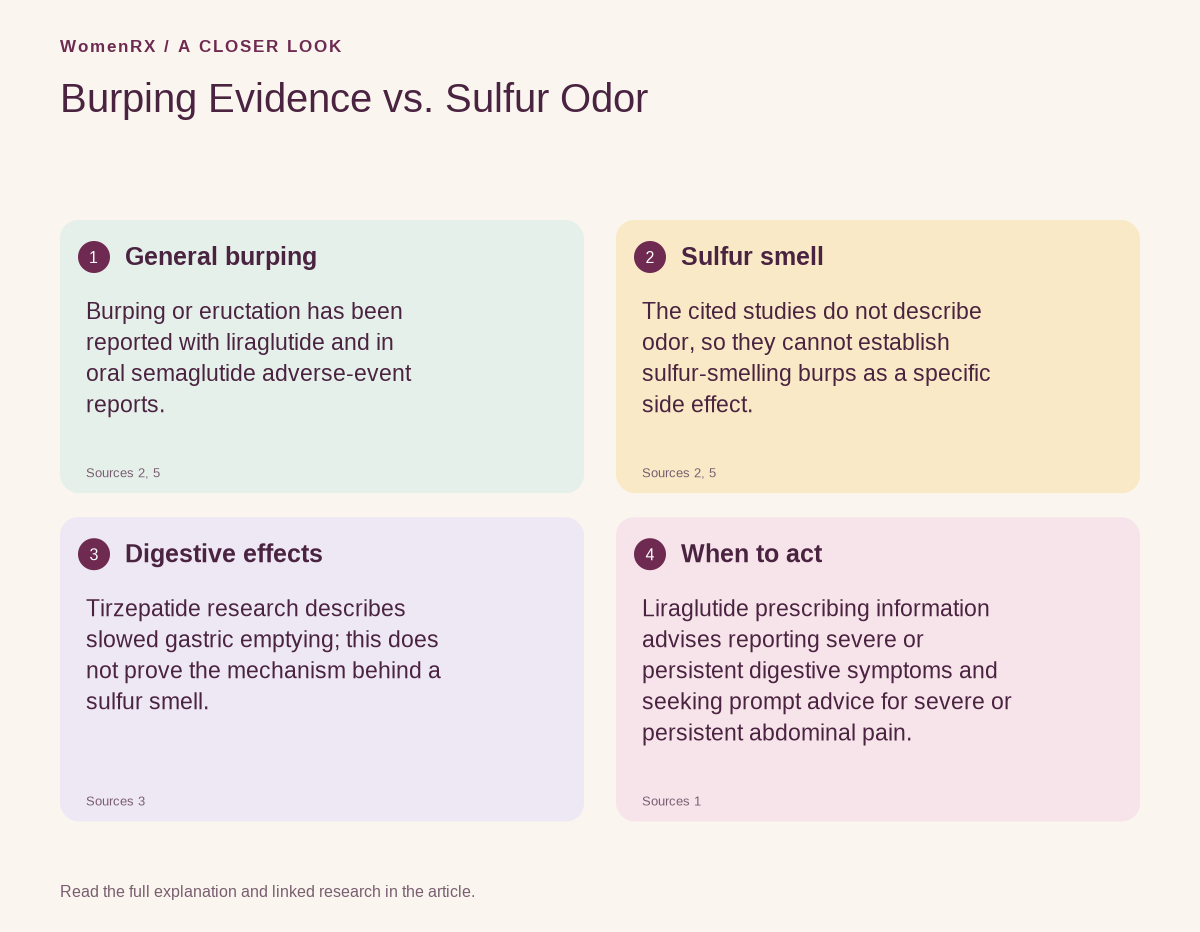
General burping: Burping or eructation has been reported with liraglutide and in oral semaglutide adverse-event reports.25
Sulfur smell: The cited studies do not describe odor, so they cannot establish sulfur-smelling burps as a specific side effect.25
Digestive effects: Tirzepatide research describes slowed gastric emptying; this does not prove the mechanism behind a sulfur smell.3
When to act: Liraglutide prescribing information advises reporting severe or persistent digestive symptoms and seeking prompt advice for severe or persistent abdominal pain.1
Read the figure as text
These distinctions show what studies report about digestive symptoms and where their findings stop.- General burping: Burping or eructation has been reported with liraglutide and in oral semaglutide adverse-event reports.25
- Sulfur smell: The cited studies do not describe odor, so they cannot establish sulfur-smelling burps as a specific side effect.25
- Digestive effects: Tirzepatide research describes slowed gastric emptying; this does not prove the mechanism behind a sulfur smell.3
- When to act: Liraglutide prescribing information advises reporting severe or persistent digestive symptoms and seeking prompt advice for severe or persistent abdominal pain.1
More questions, answered
Does a sulfur smell prove the medicine caused the burps?
No. Burping has been reported with some GLP-1 medicines, but the cited studies don’t identify sulfur odor or establish what caused it in any individual person. 2 5
Should I report burping if it keeps happening?
Yes. Describe when it started, whether it returns, and any accompanying symptoms. Liraglutide prescribing information advises reporting severe or persistent digestive symptoms and seeking prompt medical advice for severe or persistent abdominal pain. 1
Sources you can check
- SAXENDA (LIRAGLUTIDE) INJECTION, SOLUTION [NOVO NORDISK PHARMACEUTICAL INDUSTRIES, LP] | US prescribing information and patient instructionsAccessed 2026-09-25Return to first citation
- Adverse Events of Oral GLP-1 Receptor Agonist (Semaglutide Tablets): A Real-World Study Based on FAERS from 2019 to 2023.Xiong S, Gou R, Liang X, Wu H, Qin S, Li B, Luo C, Chen J. · Diabetes therapy : research, treatment and education of diabetes and related disorders · 2024Return to first citation
- Gastrointestinal adverse events associated with tirzepatide: A bibliometric and pharmacovigilance analysis.Shen P, Peng MS, Kim SJ, Joung KI, Kim KJ. · PloS one · 2026Return to first citation
- Safety Profile of Tirzepatide in Real-World Clinical Practice: A Pharmacovigilance Study Using the FAERS Database.Guo X, Zhang J, Li Q, Ye Z, Yuan S. · Diabetes, obesity & metabolism · 2026Return to first citation
- Clinical experience with Liraglutide in 196 patients with type 2 diabetes from a tertiary care center in India.Kaur P, Mishra SK, Mithal A, Saxena M, Makkar A, Sharma P. · Indian journal of endocrinology and metabolism · 2014Return to first citation