GLP-1 Medicines and Migraine: What the Evidence Says
Headache reports and a possible change in migraine treatment use are not the same as proof that these medicines prevent or worsen migraine.
GLP-1 medicines have been linked to headache and migraine reports, but those reports can’t show that the medicines caused them. A large Danish study found a modest drop in triptan consumption after semaglutide initiation, including among women, but it didn’t measure migraine days. These findings don’t establish that GLP-1 medicines prevent or reliably trigger migraine, or whether a particular migraine medicine interacts with them. 3 4
Headache reports aren’t proof of a migraine effect
If a headache starts or changes after beginning semaglutide, liraglutide, tirzepatide, or another GLP-1 medicine, it’s reasonable to notice the timing. But a headache is not automatically a migraine, and a report of a headache after taking a medicine doesn’t prove the medicine caused it.
An analysis of FDA adverse-event reports found a reporting signal for both headache and migraine with GLP-1 medicines. These reports can point researchers toward a possible safety question, but they can’t tell how often an event occurs among all users or establish cause and effect. 3
Other evidence doesn’t give a simple answer. In a US electronic-record study of people with type 2 diabetes, semaglutide wasn’t associated with an overall increase in the neurological outcomes studied compared with three other diabetes medicines. However, one comparison found a higher rate of migraine diagnoses with semaglutide than with glipizide. That isolated result sits within a study of recorded diagnoses, not a trial measuring headache days, and it doesn’t prove semaglutide caused migraine. 5
Triptan use may shift, but migraine days weren’t measured
A Danish nationwide study followed adults who started semaglutide for weight management. Triptan dispensing decreased gradually after initiation, with a 7% relative reduction at 12 months overall. In the sex-specific analysis, women had an 8% reduction; men had no statistically significant change. This was an observational study of medication dispensing, not a trial of migraine prevention. Lower triptan consumption could reflect fewer attacks, but the study can’t confirm that explanation or show what happened to each person’s migraine frequency. 4
So far, the useful distinction is this: studies offer signals about reported headaches and a possible change in acute migraine medicine use, but they don’t establish a predictable effect on migraine frequency for an individual woman. The women-specific finding concerns triptan use, not a demonstrated biological difference in migraine response. 3 4
Keep your migraine pattern visible during a change
Migraine can already vary with menstrual timing and across life stages. Attacks just before or during a period are recognized as menstrual migraine; migraine may also change during pregnancy or after menopause. Those patterns can make it harder to tell whether a change followed a medication, a cycle shift, or both. 1 2
If you’re starting or changing a GLP-1 medicine for an approved indication, a simple diary can help you and the person prescribing your migraine care compare patterns. Note:
- Headache and migraine days: Record each day, and whether the symptoms felt like your usual migraine.
- Medicine changes: Note the GLP-1 medicine and when its dose changed, without changing the dose to test a theory.
- Nausea and fluids: Record nausea and whether you managed your usual fluid intake. These details can help describe what else changed alongside a headache; they don’t establish a cause.
- Acute migraine treatment: Record which medicines you used and whether they seemed to help.
- Cycle or life-stage context: If relevant, note menstrual timing, pregnancy, or menopause.
Bring the pattern, rather than just a single difficult day, to the clinician managing the GLP-1 medicine or your migraine treatment. If a migraine medicine seems to work differently after a treatment change, describe what happened and ask whether your plan needs review. The headache-report and triptan-consumption findings can’t answer whether your particular migraine medicine interacts with a GLP-1 medicine. 3 4
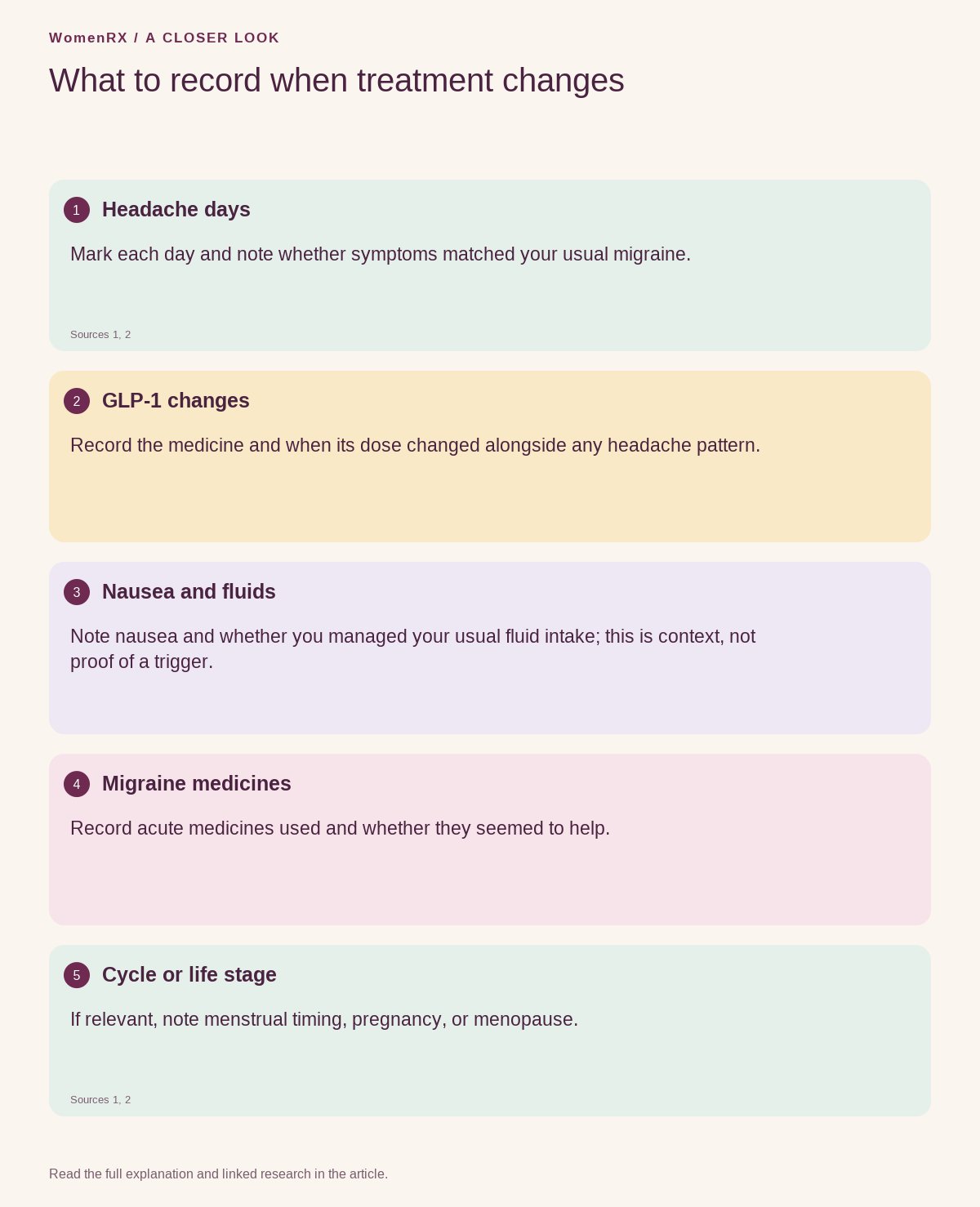
What to record when treatment changes
Headache days: Mark each day and note whether symptoms matched your usual migraine.12
GLP-1 changes: Record the medicine and when its dose changed alongside any headache pattern.
Nausea and fluids: Note nausea and whether you managed your usual fluid intake; this is context, not proof of a trigger.
Migraine medicines: Record acute medicines used and whether they seemed to help.
Cycle or life stage: If relevant, note menstrual timing, pregnancy, or menopause.12
Read the figure as text
Use these notes to compare migraine patterns with medication changes and other context. A diary can describe timing, but it cannot prove what caused a headache.- Headache days: Mark each day and note whether symptoms matched your usual migraine.12
- GLP-1 changes: Record the medicine and when its dose changed alongside any headache pattern.
- Nausea and fluids: Note nausea and whether you managed your usual fluid intake; this is context, not proof of a trigger.
- Migraine medicines: Record acute medicines used and whether they seemed to help.
- Cycle or life stage: If relevant, note menstrual timing, pregnancy, or menopause.12
More questions, answered
Does semaglutide prevent menstrual migraine?
That hasn’t been established. The semaglutide study found lower triptan dispensing after treatment began, including in women, but it did not measure menstrual migraine or migraine days. Menstrual timing is still useful to record because attacks may cluster around a period. 2 4
Should I stop a GLP-1 medicine if I get a migraine?
The studies summarized here don’t show that one migraine means the GLP-1 medicine caused it, and they don’t provide a basis for changing a prescribed treatment on your own. Record when the headache occurred and discuss a recurring or noticeable pattern with the clinician managing the medicine and your migraine care. 3 4
Sources you can check
- Migraine | MedlinePlusAccessed 2026-09-25Return to first citation
- Migraine - NHSAccessed 2026-09-25Return to first citation
- Neuropsychiatric adverse events associated with Glucagon-like peptide-1 receptor agonists: a pharmacovigilance analysis of the FDA Adverse Event Reporting System database.Lu W, Wang S, Tang H, Yuan T, Zuo W, Liu Y. · European psychiatry : the journal of the Association of European Psychiatrists · 2025Return to first citation
- Impact of semaglutide introduction on the use of triptans: an interrupted-time series.Roland N, Sonne H, Pellesi L, Bramming M, Cardél LG, Pottegård A, Kildegaard H. · The journal of headache and pain · 2026Return to first citation
- 12-month neurological and psychiatric outcomes of semaglutide use for type 2 diabetes: a propensity-score matched cohort study.De Giorgi R, Koychev I, Adler AI, Cowen PJ, Harmer CJ, Harrison PJ, Taquet M. · EClinicalMedicine · 2024Return to first citation