GLP-1 Medicines and Endometriosis: What’s Known
GLP-1 medicines aren’t established endometriosis treatments, but digestive side effects and one contraceptive interaction can matter when you’re managing symptoms.
There’s no established evidence that GLP-1 medicines treat endometriosis or reliably change its pain. Research has raised possible biological links, but it hasn’t shown a treatment benefit. If you use tirzepatide and an oral hormonal contraceptive, there’s a specific interaction to plan around. New abdominal symptoms also deserve attention rather than being assumed to be endometriosis.462
A change in pain isn’t proof the medicine changed endometriosis
If you start a GLP-1 medicine and your pelvic pain changes, it’s reasonable to wonder whether the two are connected. The distinction is between noticing a change and knowing what caused it. A recent paper proposes ways tirzepatide might affect processes involved in endometriosis, but its authors describe that work as a hypothesis, not evidence that tirzepatide relieves pain or treats lesions. The paper also mentions preliminary self-reported pain improvements in people with endometriosis exposed to GLP-1 medicines. Those reports cannot establish that the medicine caused the improvement.4
One study described in that paper found lower levels of GLP-1 in fluid from the abdomen among 54 people with endometriosis than among 30 controls. That is a finding about a possible disease mechanism, not a study of what happens when someone takes semaglutide, liraglutide or tirzepatide. The paper notes that the finding has not been replicated.4
Weight change doesn’t settle the question, either. Liraglutide can lower body weight through reduced calorie intake, but a change in weight cannot, by itself, tell you whether endometriosis has improved.2 Studies of fertility or menstrual outcomes in people with polycystic ovary syndrome (PCOS) answer a different question; they shouldn’t be treated as evidence of an endometriosis benefit.5
Why new abdominal symptoms can be hard to sort out
Endometriosis can affect the bowel as well as pelvic structures. GLP-1 medicines can also cause gastrointestinal symptoms, sometimes severe, and liraglutide and tirzepatide delay stomach emptying.1236 That overlap matters if, for example, abdominal discomfort begins soon after you start a medicine while you also have a history of bowel-related endometriosis symptoms. Timing is a clue worth sharing, not a diagnosis.
A short record can make that conversation more useful: note where the pain occurs, whether it follows your menstrual cycle, whether bowel symptoms changed, and when you started or changed each medicine. Include changes to your endometriosis treatment, too. You don’t need to prove which condition is responsible before asking for help.
Get prompt medical attention for persistent or severe abdominal pain, particularly if it spreads toward your back or comes with nausea or vomiting. Liraglutide prescribing information identifies that pattern as a possible sign of pancreatitis. Don’t dismiss a markedly different or worsening pain pattern as your usual endometriosis pain.23
The treatment interaction to check: tirzepatide and the pill
If you take an oral hormonal contraceptive, check your plan before starting tirzepatide or increasing its dose. US prescribing information for Zepbound, a tirzepatide product, says delayed stomach emptying may reduce how well oral hormonal contraceptives prevent pregnancy. It advises switching to a non-oral contraceptive method or adding a barrier method for four weeks after starting and four weeks after each dose increase. The label says non-oral hormonal contraceptives should not be affected by this interaction.6
That can be especially relevant when a pill serves two purposes: contraception and endometriosis symptom management. Hormonal treatment, including a combined oral contraceptive or a progestogen, is an established option for reducing endometriosis pain.7 The tirzepatide warning specifically concerns contraceptive effectiveness. It does not establish that tirzepatide makes a pill less effective at controlling endometriosis pain. Tell the clinician who manages your endometriosis which pill you take and why, so the contraception plan and pain-treatment plan are considered together.67
Don’t assume the same interaction guidance applies identically to every GLP-1 medicine. The four-week advice above comes from tirzepatide’s prescribing information, not from an endometriosis study or a class-wide rule.6
Keep the two treatment goals separate
A GLP-1 medicine may be prescribed for a reason unrelated to endometriosis. Endometriosis care still needs its own plan, guided by your symptoms and whether pregnancy is a goal. Hormonal treatment can reduce pain; surgery is another option in some circumstances, including when other treatments aren’t working or endometriosis affects fertility.71 A GLP-1 medicine shouldn’t replace that discussion on the assumption that it will treat the disease.4
If you’re trying to become pregnant or planning to, raise that before starting or continuing a weight-loss medicine. Tirzepatide’s US patient information specifically asks people to tell their prescriber if they are pregnant or plan to become pregnant.6 For a planned endometriosis procedure involving general anesthesia or deep sedation, make sure the procedure team knows if you take liraglutide. Liraglutide prescribing information describes rare reports of aspiration during such procedures and says there isn’t enough evidence to determine whether changing fasting or temporarily stopping the medicine reduces that risk. Let the team give you instructions for your procedure rather than making that change yourself.23
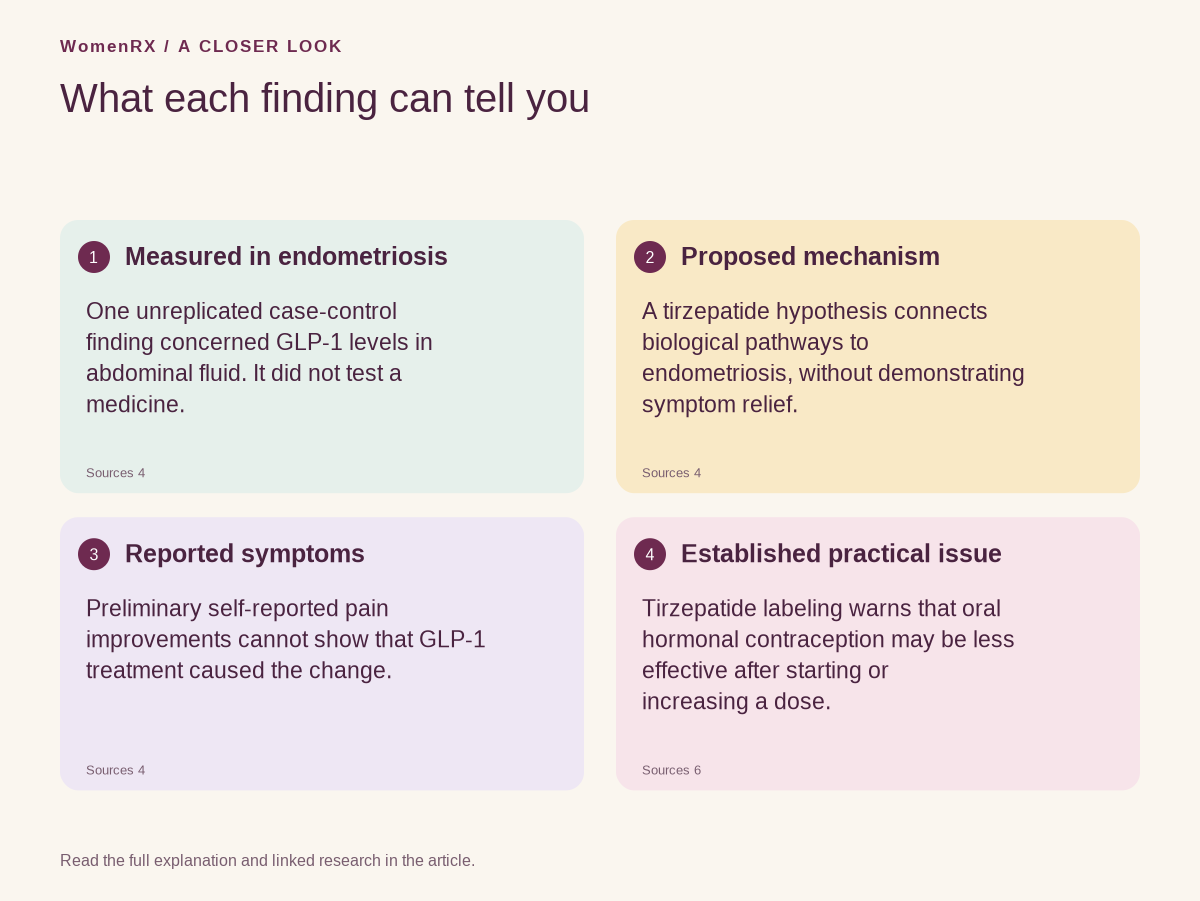
What each finding can tell you
Measured in endometriosis: One unreplicated case-control finding concerned GLP-1 levels in abdominal fluid. It did not test a medicine.4
Proposed mechanism: A tirzepatide hypothesis connects biological pathways to endometriosis, without demonstrating symptom relief.4
Reported symptoms: Preliminary self-reported pain improvements cannot show that GLP-1 treatment caused the change.4
Established practical issue: Tirzepatide labeling warns that oral hormonal contraception may be less effective after starting or increasing a dose.6
Read the figure as text
These are different kinds of information, and only some answer a practical treatment question.- Measured in endometriosis: One unreplicated case-control finding concerned GLP-1 levels in abdominal fluid. It did not test a medicine.4
- Proposed mechanism: A tirzepatide hypothesis connects biological pathways to endometriosis, without demonstrating symptom relief.4
- Reported symptoms: Preliminary self-reported pain improvements cannot show that GLP-1 treatment caused the change.4
- Established practical issue: Tirzepatide labeling warns that oral hormonal contraception may be less effective after starting or increasing a dose.6
Sources you can check
- Endometriosis - NHSAccessed 2026-09-25Return to first citation
- SAXENDA (LIRAGLUTIDE) INJECTION, SOLUTION [NOVO NORDISK PHARMACEUTICAL INDUSTRIES, LP] | US prescribing information and patient instructionsAccessed 2026-09-25Return to first citation
- VICTOZA (LIRAGLUTIDE) INJECTION [NOVO NORDISK] | US prescribing information and patient instructionsAccessed 2026-09-25Return to first citation
- Peritoneal Incretin Deficiency and Tirzepatide as a Multi-Axis Adjuvant Hypothesis in Treatment-Refractory Endometriosis: A Mechanistic Framework Linking Metabolism, Immunity, Fibrosis, and Nociception.Jacobsen L, Viana DPDC, Folador GM, Schor E, Invitti AL. · International journal of molecular sciences · 2026Return to first citation
- Medical therapy to treat obesity and optimize fertility in women of reproductive age: a narrative review.Duah J, Seifer DB. · Reproductive biology and endocrinology : RB&E · 2025Return to first citation
- ZEPBOUND (TIRZEPATIDE) INJECTION, SOLUTION ZEPBOUND (TIRZEPATIDE) INJECTION, SOLUTION ZEPBOUND KWIKPEN (TIRZEPATIDE) INJECTION, SOLUTION [ELI LILLY AND COMPANY] | US prescribing information and patient instructionsAccessed 2026-09-25Return to first citation
- Recommendations | Endometriosis: diagnosis and management | Guidance | NICEAccessed 2026-09-25Return to first citation