GLP-1 Medicines and Fibromyalgia: What We Know
GLP-1 medicines aren’t established treatments for fibromyalgia, and the limited human findings don’t show that they ease its pain or fatigue.
Clinical trials haven’t established that semaglutide, liraglutide, or tirzepatide treats fibromyalgia. A large observational study found differences in pain- and fatigue-related medical records among people with fibromyalgia taking GLP-1 medicines, but it can’t show that the medicines caused those differences. Digestive symptoms and reduced appetite may also complicate how you feel during treatment. 4
What the evidence says about fibromyalgia symptoms
Fibromyalgia commonly involves widespread pain, stiffness, fatigue, poor sleep, and trouble concentrating. Symptoms can vary over time, and digestive problems such as irritable bowel syndrome may occur too. That means a new symptom during treatment can be hard to interpret from the symptom alone. 1 2
The human evidence on GLP-1 medicines and fibromyalgia is limited. A review describes a large retrospective cohort in which GLP-1 medicine use was associated with lower odds of opioid prescriptions and pain and fatigue diagnostic codes. Disability codes weren’t significantly different. These are associations in medical records, not proof that the medicines relieved anyone’s symptoms; the review says direct clinical trials haven’t established benefit for fibromyalgia. 4
The review’s summary doesn’t provide sex-specific pain or side-effect results. Fibromyalgia is more common in women, but that fact doesn’t tell us whether women and men respond differently to these medicines. 1 4
Separate a symptom from a possible treatment effect
GLP-1 medicines can delay stomach emptying and reduce appetite. The review also flags gastrointestinal dysmotility and reduced food intake as potential treatment concerns. These effects could matter if you already have digestive symptoms, or if eating and drinking less leaves you feeling worse. Current findings don’t establish that a particular episode of fatigue or pain is caused by a medicine. 4
A practical distinction is to notice what changed and when. A familiar pattern of widespread pain, stiffness, poor sleep, or brain fog may fit your usual fibromyalgia fluctuations. New or noticeably worse digestive symptoms, a marked drop in appetite, or symptoms that began after starting or changing treatment are worth discussing with the prescriber. Timing can help frame the conversation, but it can’t prove the cause.
For example, if your pain is much like your usual flare but you’re also eating less because of new stomach symptoms, there may be two things to discuss: your fibromyalgia pattern and how treatment is affecting eating. Don’t assume one explains the other.
If you’re considering treatment for another reason
Keep the reason for treatment clear: these medicines may be considered for another indication, but fibromyalgia pain or fatigue isn’t an established reason to expect benefit. The review notes possible loss of lean mass as another concern that could offset functional benefits, but it doesn’t establish what that means for an individual with fibromyalgia. 4
Before treatment, it can help to describe your usual pain, fatigue, sleep, and digestive symptoms so changes are easier to recognize. During treatment, note whether a new issue began after starting or changing the medicine, whether it is continuing, and how it affects eating or daily activities. Bring those observations to the person prescribing the medicine, especially if symptoms are persistent or interfering with your usual routine.
Fibromyalgia treatments are aimed at easing symptoms and improving quality of life; no single treatment works for everyone. GLP-1 medicines shouldn’t replace a plan that is already helping you manage fibromyalgia. 3
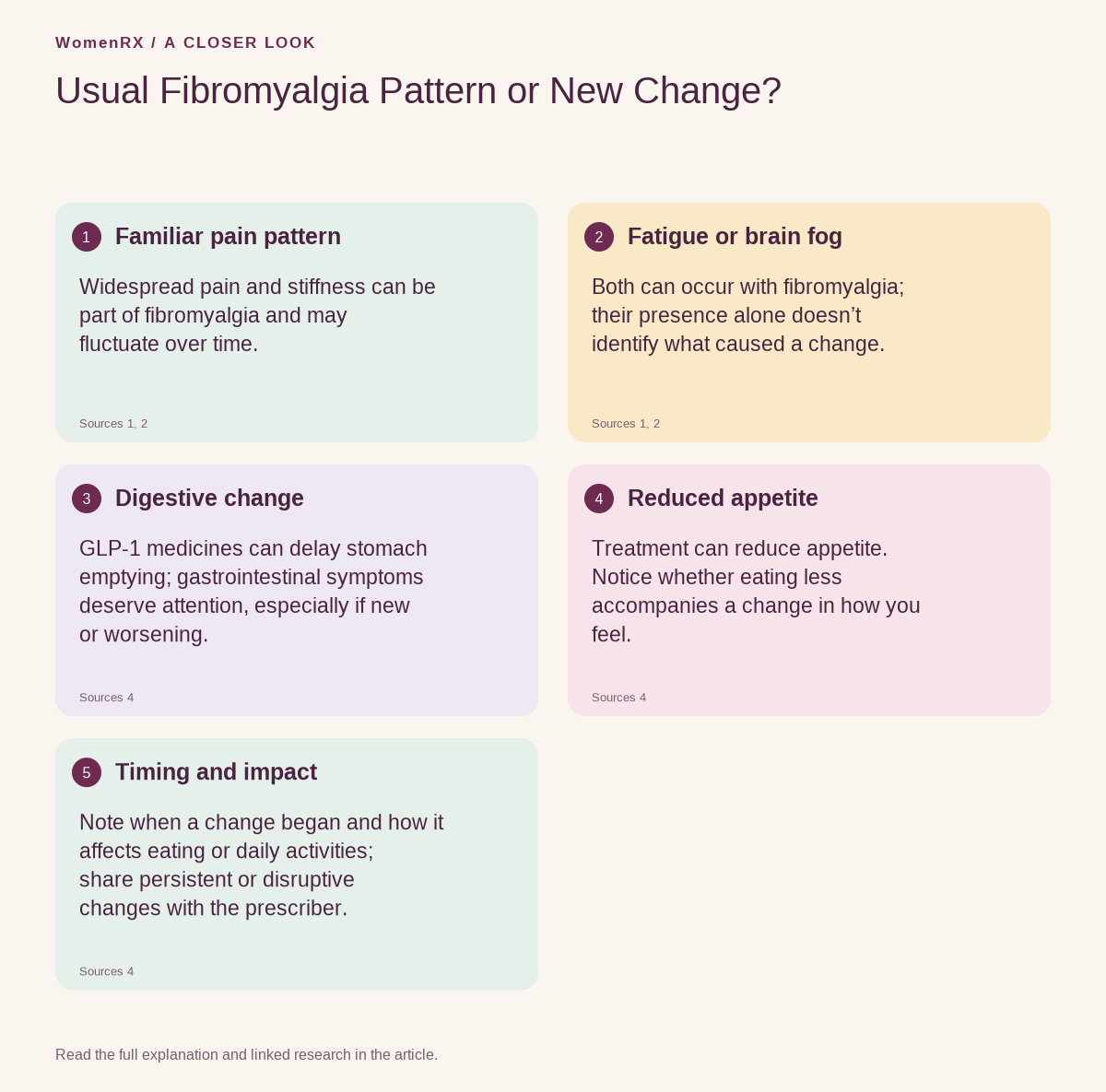
Usual Fibromyalgia Pattern or New Change?
Familiar pain pattern: Widespread pain and stiffness can be part of fibromyalgia and may fluctuate over time.12
Fatigue or brain fog: Both can occur with fibromyalgia; their presence alone doesn’t identify what caused a change.12
Digestive change: GLP-1 medicines can delay stomach emptying; gastrointestinal symptoms deserve attention, especially if new or worsening.4
Reduced appetite: Treatment can reduce appetite. Notice whether eating less accompanies a change in how you feel.4
Timing and impact: Note when a change began and how it affects eating or daily activities; share persistent or disruptive changes with the prescriber.4
Read the figure as text
Compare familiar fibromyalgia symptoms with changes that may be worth discussing during GLP-1 treatment. These clues can guide a conversation, but they do not diagnose the cause.- Familiar pain pattern: Widespread pain and stiffness can be part of fibromyalgia and may fluctuate over time.12
- Fatigue or brain fog: Both can occur with fibromyalgia; their presence alone doesn’t identify what caused a change.12
- Digestive change: GLP-1 medicines can delay stomach emptying; gastrointestinal symptoms deserve attention, especially if new or worsening.4
- Reduced appetite: Treatment can reduce appetite. Notice whether eating less accompanies a change in how you feel.4
- Timing and impact: Note when a change began and how it affects eating or daily activities; share persistent or disruptive changes with the prescriber.4
More questions, answered
Does an animal study mean semaglutide treats fibromyalgia in people?
No. One study found effects in male rats with experimentally induced fibromyalgia-like symptoms. Animal findings can suggest a research direction, but they don’t show that semaglutide treats fibromyalgia in women or other people. 5
Could a GLP-1 medicine make fibromyalgia fatigue harder to interpret?
Possibly. Fatigue is a fibromyalgia symptom, while GLP-1 medicines can reduce appetite and the review flags reduced intake as a potential concern. Current findings don’t establish that a specific episode of fatigue is medication-related, so the timing and any accompanying eating or digestive changes are useful context to discuss. 2 4
Sources you can check
- Fibromyalgia - NHSAccessed 2026-09-25Return to first citation
- Fibromyalgia - Symptoms - NHSAccessed 2026-09-25Return to first citation
- Fibromyalgia - Treatment - NHSAccessed 2026-09-25Return to first citation
- Glucagon-like Peptide-1 Receptor Agonists and Chronic Pain: Preclinical Antinociceptive Mechanisms, Indirect Metabolic-Functional Effects, and Clinical Considerations-A Narrative Review.Hyung SW, Park UJ, Ryu JH, Chung S. · Journal of clinical medicine · 2026Return to first citation
- Novel Trajectories Towards Possible Effects of Semaglutide for Amelioration of Reserpine-induced Fibromyalgia in Rats: Contribution of cAMP/PKA/p-CREB and M1/M2 Microglia Polarization.Shafiek MZ, Zaki HF, Mohamed AF, Ibrahim WW. · Journal of neuroimmune pharmacology : the official journal of the Society on NeuroImmune Pharmacology · 2025Return to first citation