GLP-1 Medicines and Reproductive Hormones: What We Know
Studies in women with PCOS or a related condition report some menstrual changes, but they don’t show that GLP-1 medicines reliably change cycles or act directly on reproductive hormones.
In two studies of women with excess weight and PCOS or a related condition the authors call PMOS, some participants had menstrual or ovulatory improvements during semaglutide treatment. One study also measured an improvement in testosterone. Weight and metabolic measures changed too, so the findings don’t establish a direct hormone effect or predict what will happen to your cycle. 1 2
What a cycle change can, and can’t, tell you
A menstrual change while taking a GLP-1 medicine doesn’t, by itself, show that the medicine directly changed your reproductive hormones. The two human studies discussed here involved women with excess weight and either PCOS or a related condition the authors called PMOS, not a broad group of women taking these medicines. They report changes in some reproductive outcomes, but weight and metabolic measures changed as well. That makes it hard to separate a direct drug effect from changes associated with weight or metabolic health. 1 2
It also means the findings shouldn’t be read as evidence that GLP-1 medicines “balance hormones,” restore fertility for everyone, or reliably change menstrual cycles.
What the PCOS-related studies actually found
In a 16-week randomized, open-label study, 100 women with overweight or obesity and PCOS were assigned to metformin alone or metformin plus semaglutide; 80 completed the study. The combination group had greater weight loss and greater improvement in testosterone than the metformin-only group, and the researchers reported higher rates of menstrual-cycle recovery. But this was a combination treatment, and the groups also differed in weight loss. The result can’t tell us whether semaglutide acted directly on reproductive hormones or whether changes in weight or metabolism contributed. 1
A separate six-month study followed 96 women with a condition the authors called polyendocrine metabolic ovarian syndrome and excess weight. Among the 80 who had irregular or anovulatory cycles before treatment, 42 had normalized cycles and ovulatory cycles afterward. This was a before-and-after study, not a comparison with an untreated group, so it shows an association during treatment rather than proving semaglutide caused the change. 2
Taken together, these studies offer a reason to take cycle changes seriously in women with the conditions studied. They don’t establish the same effect in women without those conditions, and they don’t tell us whether other GLP-1 medicines have the same reproductive effects.
Direct hormone effects versus changes that travel with weight
One distinction is easy to lose: a study can measure a hormone without showing that a medicine directly acts on the reproductive system. In the randomized study, testosterone improved more in the group receiving semaglutide with metformin, but that group also lost more weight. The study therefore can’t separate a direct effect from one associated with the accompanying weight and metabolic changes. 1
The other study measured cycle and ovulatory outcomes, but its before-and-after design also can’t isolate why they changed. These findings are meaningful for the specific women studied, but they aren’t proof of a general hormone effect. 2
If your cycles change, make the timeline useful
For a conversation with your prescriber, it may help to note when the change began relative to starting treatment or changing the dose, whether your weight was also changing, and what your cycles were like beforehand. Include any history of PCOS or irregular cycles and whether pregnancy is possible or planned. This timeline won’t establish a cause, but it can help distinguish a change that began with treatment from a longstanding pattern or another change happening at the same time.
If you’re in perimenopause or menopause, the studies described above don’t answer whether GLP-1 medicines affect that transition or help explain a midlife cycle change. These findings concern selected women with PCOS or PMOS and excess weight, not midlife hormone transitions. 1 2
Pregnancy planning is a separate question
In the six-month PMOS study, contraception was recommended because the authors said pregnancy-safety data for GLP-1 receptor agonists were lacking. The same study found ovulatory cycles in some participants who had been anovulatory. That doesn’t establish what will happen to any one person’s fertility, but it’s a reason to discuss pregnancy intentions and contraception with your prescriber rather than assuming irregular cycles mean pregnancy can’t occur. 2
The practical takeaway is modest: cycle or hormone-related changes are worth documenting and discussing, especially if you have PCOS, but current findings don’t show that GLP-1 medicines reliably alter reproductive hormones across women generally.
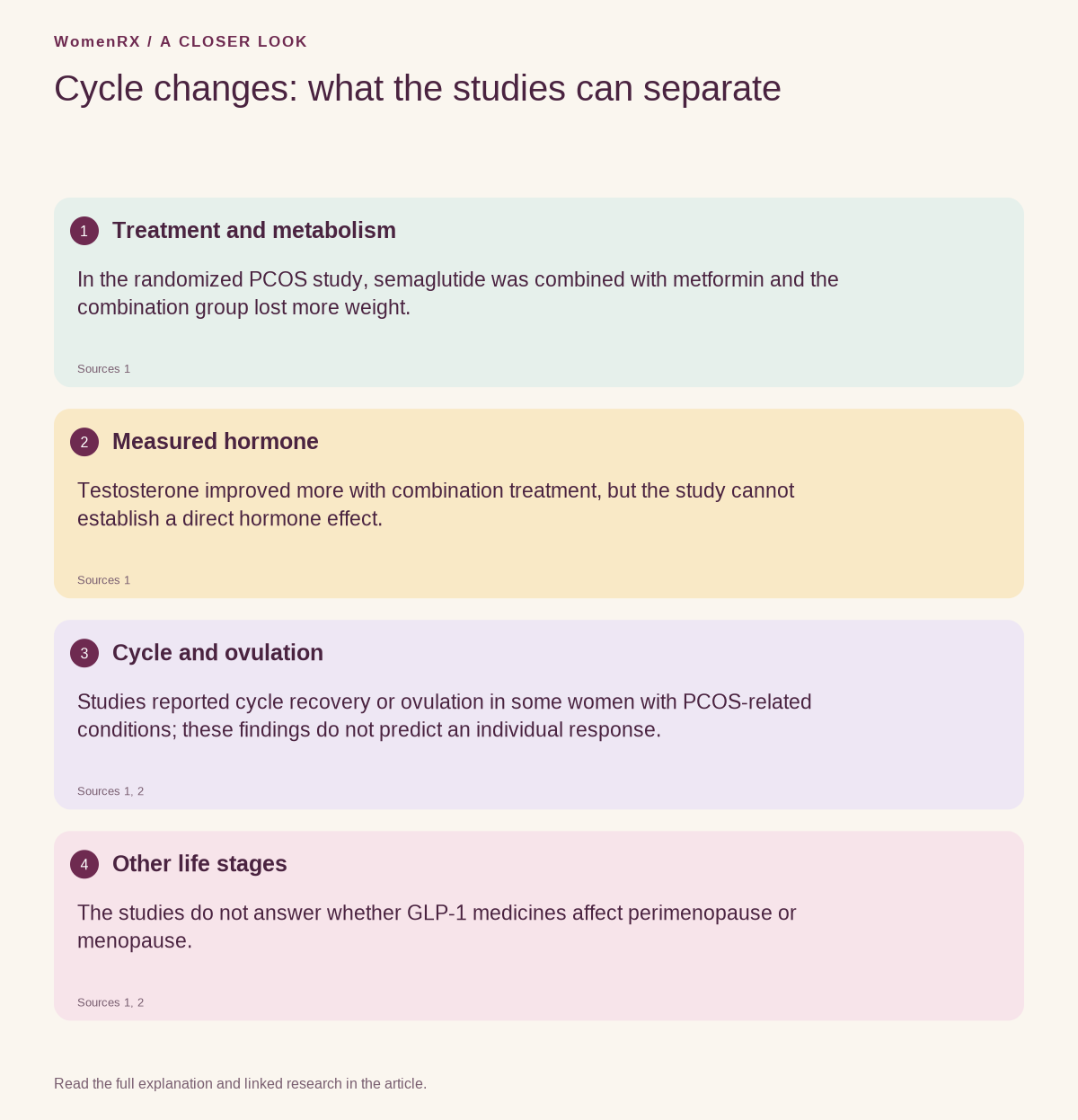
Cycle changes: what the studies can separate
Treatment and metabolism: In the randomized PCOS study, semaglutide was combined with metformin and the combination group lost more weight.1
Measured hormone: Testosterone improved more with combination treatment, but the study cannot establish a direct hormone effect.1
Cycle and ovulation: Studies reported cycle recovery or ovulation in some women with PCOS-related conditions; these findings do not predict an individual response.12
Other life stages: The studies do not answer whether GLP-1 medicines affect perimenopause or menopause.12
Read the figure as text
The two human studies reported reproductive changes in selected women with excess weight and PCOS or the related condition the authors call PMOS, but neither isolates a direct drug effect from changes in weight or metabolism.- Treatment and metabolism: In the randomized PCOS study, semaglutide was combined with metformin and the combination group lost more weight.1
- Measured hormone: Testosterone improved more with combination treatment, but the study cannot establish a direct hormone effect.1
- Cycle and ovulation: Studies reported cycle recovery or ovulation in some women with PCOS-related conditions; these findings do not predict an individual response.12
- Other life stages: The studies do not answer whether GLP-1 medicines affect perimenopause or menopause.12
Sources you can check
- Effects of combined metformin and semaglutide therapy on body weight, metabolic parameters, and reproductive outcomes in overweight/obese women with polycystic ovary syndrome: a prospective, randomized, controlled, open-label clinical trial.Chen H, Lei X, Yang Z, Xu Y, Liu D, Wang C, Du H. · Reproductive biology and endocrinology : RB&E · 2025Return to first citation
- Evidence That Semaglutide Represents an Important Tool for Treatment of Irregular Menses and Chronic Anovulation in Women with Polyendocrine Metabolic Ovarian Syndrome.Carmina E, Longo RA. · Journal of clinical medicine · 2026Return to first citation