GLP-1 Weight-Management Medicines After 50
Age alone doesn’t settle whether a GLP-1 medicine fits; the conversation should include health goals, daily function, strength, nutrition, and the specific product.
A GLP-1 medicine may be worth discussing when weight is affecting your health or daily life, but being over 50 doesn’t by itself determine whether it’s a good fit. Ask how a specific medicine could support your goals, what conditions and current medicines need review, and how you’ll protect strength and nutrition. For older adults, guidance emphasizes function and muscle and bone health alongside weight. 4
Start with the change you want, not a number
Before discussing a prescription, name what you hope will improve. Your goal might be easier movement, better control of a weight-related condition, or less strain on your joints. Those goals help make the conversation more useful than focusing on pounds alone. Clinical guidance for obesity care recommends considering health conditions, daily function, and quality of life, not weight by itself. It also emphasizes preserving muscle and bone health when planning care for older adults. 4
Age 50 isn’t a stand-alone measure of health, and a BMI number has limits. BMI doesn’t distinguish fat from muscle or bone, and it may underestimate body fat in older people or in others who have lost muscle. Your health history, waist measurement, body composition where appropriate, and what you can comfortably do day to day can add context. 2 4 Being in your 50s, being postmenopausal, and being an older adult with existing concerns about strength are not interchangeable descriptions. Bring the concerns that apply to you rather than assuming your age or menopause status predicts your response.
Questions to bring: What health or functional change are we aiming for? How will we tell whether the medicine is helping beyond changes on the scale? Does my weight measurement tell the whole story about my health?
Make the discussion specific to you and the medicine
“GLP-1 medicine” can refer to different products and uses. Ask which exact medicine is being considered and what it is intended to treat in your situation. For example, Saxenda’s label says taking it with another GLP-1 receptor agonist or another liraglutide-containing product isn’t recommended. That warning is specific to Saxenda; it’s a reason to identify anything you already take in this class before discussing that product. 1
Bring a current list of medicines and supplements, and talk through your health conditions and treatment history. Certain medicines and medical conditions can affect weight, so that history matters when weighing a proposed treatment. 2 Then connect the decision to your goal: if you hope to improve a weight-related condition, ask which measure of that condition you’ll review; if daily movement is the priority, ask what change in movement would count as useful to you. A smaller number on the scale needn’t be the only measure of benefit. 4
Questions to bring: Which product are you recommending, and what is its purpose for me? Could any of my conditions or current medicines change the plan? If I already take a medicine in this class, how will you avoid overlap?
Put strength and nutrition on the plan
Saxenda’s prescribing information says liraglutide lowers body weight through decreased calorie intake. That makes it sensible to ask how you’ll maintain nourishing meals and support strength while your weight changes. 1 Guidance for older adults specifically highlights preserving muscle mass and bone health; it describes nutrition and individualized physical activity, including resistance training, as parts of a broader care plan. 4
Ask what kind of support would fit your routine and abilities. For example, you might discuss whether a nutrition professional or a tailored strength plan could help you meet your goals. If eating enough or maintaining strength is already a concern, say so before deciding what progress should look like. These are planning questions, not a one-size-fits-all exercise or eating prescription. 4
Questions to bring: How will we check that I’m maintaining strength and eating well? What support is available if reduced appetite makes meals difficult? Should my plan include movement or resistance exercise suited to my health and abilities?
Ask what will be reviewed, and when
A useful plan names the outcomes that matter to you and when you’ll revisit them. Depending on your goals, that could include weight alongside mobility, strength, nutrition, or the health condition you’re hoping to improve. Ask what would lead you and the prescriber to adjust or stop treatment. Also ask which symptoms need prompt attention rather than waiting for a routine review. Saxenda’s prescribing information warns about acute pancreatitis: persistent or severe abdominal pain, sometimes spreading to the back and with or without nausea or vomiting, calls for prompt medical assessment. 1
A small pilot study offers one limited piece of information about bone measures. It randomized 20 older adults with overweight or obesity and prediabetes or diabetes, average age 72.7, half of them women, to semaglutide plus lifestyle counseling or lifestyle counseling alone for 20 weeks. Weight change was −5.3% versus −0.89%, respectively. The post-hoc analysis found no significant between-group differences in whole-body bone mineral density or bone-turnover markers over that period. The results described here aren’t broken down by menopause status or enough to establish what to expect for women in their 50s. 3
That small, short study isn’t a reason to expect a particular outcome. It’s a reason to make strength and bone health part of an individualized discussion, especially if those are already concerns for you. Turning 50 alone doesn’t settle the decision: the useful next step is to weigh the specific medicine against your goals, health history, and a plan for reviewing what matters to you.
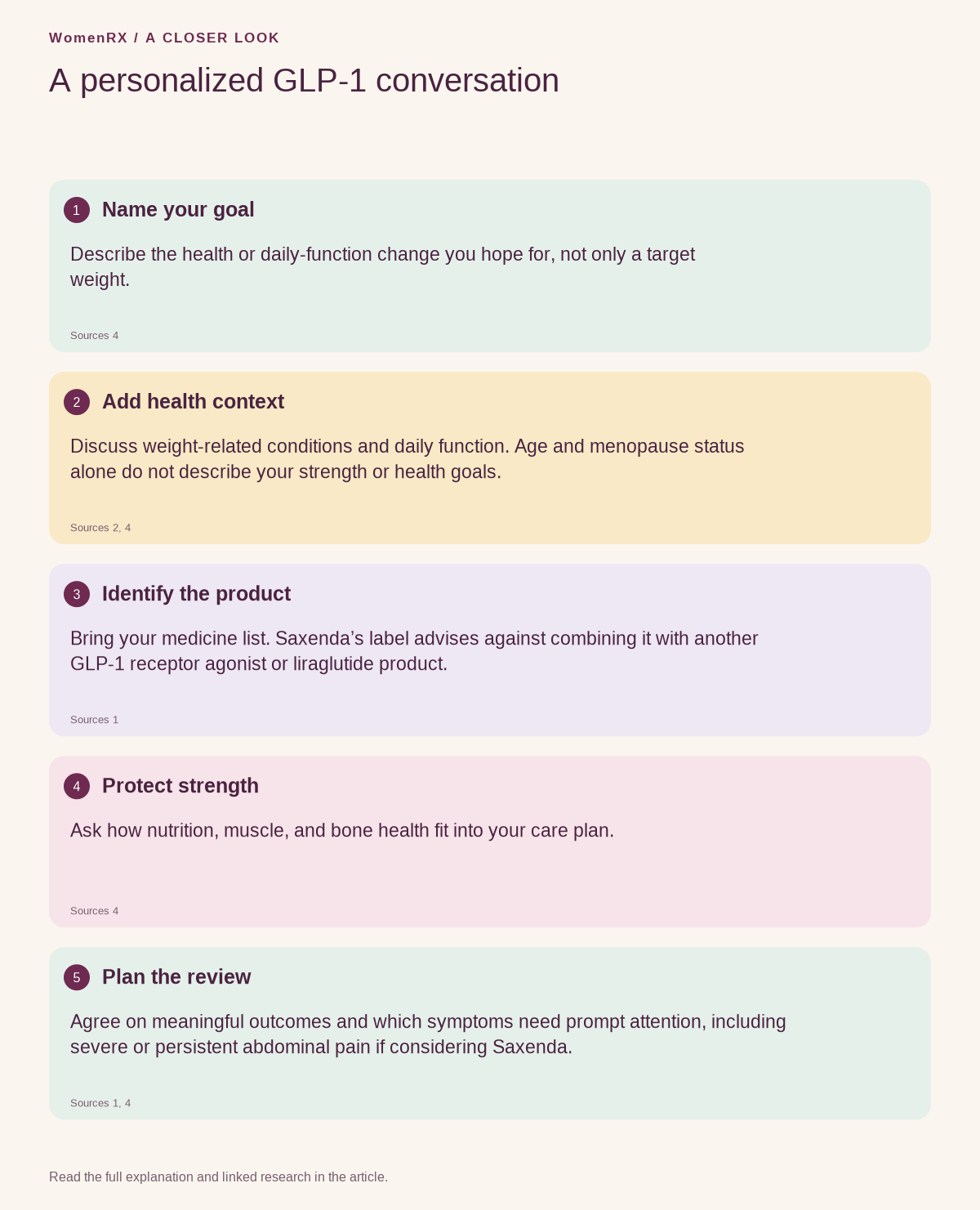
A personalized GLP-1 conversation
Name your goal: Describe the health or daily-function change you hope for, not only a target weight.4
Add health context: Discuss weight-related conditions and daily function. Age and menopause status alone do not describe your strength or health goals.24
Identify the product: Bring your medicine list. Saxenda’s label advises against combining it with another GLP-1 receptor agonist or liraglutide product.1
Protect strength: Ask how nutrition, muscle, and bone health fit into your care plan.4
Plan the review: Agree on meaningful outcomes and which symptoms need prompt attention, including severe or persistent abdominal pain if considering Saxenda.14
Read the figure as text
Use these prompts to connect a proposed medicine with your goals, existing care, and what you’ll review over time.- Name your goal: Describe the health or daily-function change you hope for, not only a target weight.4
- Add health context: Discuss weight-related conditions and daily function. Age and menopause status alone do not describe your strength or health goals.24
- Identify the product: Bring your medicine list. Saxenda’s label advises against combining it with another GLP-1 receptor agonist or liraglutide product.1
- Protect strength: Ask how nutrition, muscle, and bone health fit into your care plan.4
- Plan the review: Agree on meaningful outcomes and which symptoms need prompt attention, including severe or persistent abdominal pain if considering Saxenda.14
More questions, answered
Does menopause status predict how well a GLP-1 medicine will work?
That isn’t established by the small semaglutide pilot described here. The results described here are for older adults overall, not broken down by menopause status, so they cannot tell you whether menopause predicts an individual response. 3
Should the scale be the only way to judge whether treatment is helping?
No. Obesity-care guidance recommends looking at overall health, related conditions, daily function, and quality of life as well as weight. You can agree on which outcomes matter for your own goals. 4
Sources you can check
- SAXENDA (LIRAGLUTIDE) INJECTION, SOLUTION [NOVO NORDISK PHARMACEUTICAL INDUSTRIES, LP] | US prescribing information and patient instructionsAccessed 2026-09-25Return to first citation
- Obesity: MedlinePlusAccessed 2026-09-25Return to first citation
- Bone mineral density and turnover response to GLP-1 receptor agonists in older adults with overweight/obesity and prediabetes/type 2 diabetes: a 20-week pilot trial post hoc analysis.Dinkla L, Beavers KM, Robbins R, Akpalu D, Wherry SJ, Miller G, Beavers DP, Espinoza S, Trejo J, Stepanenko A, Cortes TM. · Frontiers in aging · 2025Return to first citation
- Swiss obesity clinical practice guidance.Gerber PA, Collet TH, Favre L, Bueter M, Ruiz Arana I, Durrer D, Seelig E, Schultes B, Pasi P, Konrad D, Bally L. · Swiss medical weekly · 2026Return to first citation