Considering a GLP-1? Questions to Ask Before You Start
A thoughtful conversation starts with your health goals and circumstances, not a judgment about how hard you’ve tried.
Ask which eligibility criteria apply to the specific weight-management medicine you’re considering, and how your health history affects that decision. Then compare its likely benefits and side effects with other options, including the cost and follow-up you can realistically manage. An obesity assessment may include BMI, waist size, related conditions, and your weight history, but BMI doesn’t tell the whole story. 3
You don’t have to prove you’ve tried hard enough
A GLP-1 medicine isn’t a prize for exhausting every other approach, and considering one doesn’t mean you’ve failed. The useful question is whether a particular treatment fits your health needs, preferences, and day-to-day life. Weight-related care can also be affected by stigma; research reviews describe weight bias in healthcare and its potential to discourage people from seeking care. You deserve a conversation focused on your goals, not blame. 5
You can start by saying what matters most to you. For example, you might want to improve a weight-related health condition, feel more comfortable moving, or understand what options are available. You don’t have to make weight loss your only measure of progress.
Ask how the clinician will assess fit
A medical assessment may cover your health history, previous weight-loss efforts, physical activity, BMI, waist size, vital signs, and health conditions or tests relevant to you. BMI can help assess risk, but it doesn’t distinguish fat from muscle or bone and can misrepresent body fat for some people. So it’s reasonable to ask how the full picture, not one measurement, informs the recommendation. 3
Then get specific: “Which eligibility criteria apply to the weight-management medicine we’re considering, and do I meet them?” Ask how your related health conditions and medical history affect that answer. Eligibility for a particular medicine is a different question from whether you have a weight-related health concern worth addressing.
Try questions like:
- “What health outcomes could treatment help address in my situation?”
- “What factors make this specific medication a reasonable option for me?”
- “How are you accounting for my health history and other conditions?”
- “If medication isn’t the right fit, what other supports or treatments could we consider?”
Options for obesity care can include nutrition and activity support, counseling or support groups, medicines, and, for some people with severe obesity or serious related health problems, weight-loss procedures or surgery. Which options make sense depends on the person’s overall health and circumstances. 3
Ask what the evidence can, and can’t, promise
Semaglutide has been studied in randomized trials involving adults with overweight or obesity who did not have type 2 diabetes. A systematic review and meta-analysis of four trials found greater average weight reduction with semaglutide than with placebo. That’s evidence of an average effect in trial groups, not a promise about what you personally will lose. Ask what outcome would count as worthwhile for you and how you and your clinician would assess whether treatment is helping. 4
The appetite and stomach-emptying effects described for semaglutide can be part of the treatment’s intended action, but stomach-related side effects can also affect whether someone can continue. The review reported that gastrointestinal effects, including nausea, vomiting, diarrhea, and constipation, were more common with semaglutide; stopping treatment because of side effects was also more common than with placebo. 4
Side-effect information is medication-specific. For example, in Saxenda (liraglutide) clinical trials, severe gastrointestinal adverse reactions were reported in 4.8% of people receiving Saxenda and 1.4% receiving placebo. Those figures come from Saxenda trials; they shouldn’t be treated as rates for every medicine in the GLP-1 category. Ask about the exact medicine being considered, the side effects to watch for, and what to do if they occur. 2
A medicine-specific safety review matters, too. For example, Saxenda is not recommended for people with severe gastroparesis, a condition in which the stomach empties slowly, and its prescribing information does not recommend taking it alongside another GLP-1 receptor agonist. If either issue might apply to you, bring it up when discussing that medicine. 2
Make the practical plan part of the decision
A treatment can look suitable on paper but still be difficult to fit into real life. Before deciding, ask about the medication’s routine, expected follow-up, how side effects will be handled, and what the plan is if you can’t keep taking it. If cost, coverage, or availability could affect your decision, raise that early and ask what alternatives are realistic for you. These are reasons to compare options, not reasons to feel you’ve done something wrong.
Ask what ongoing treatment might look like, as well as what support or alternatives you’d consider if treatment changes or stops. The semaglutide review found a benefit during the trials it analyzed, but its authors called for further long-term randomized trials to assess how durable weight loss is. That makes a maintenance plan worth discussing rather than assuming the first treatment decision settles it. 4
If pregnancy is on your horizon, ask how weight treatment fits into preconception care; that care can include discussing health conditions and weight goals before pregnancy. 1 If you’re breastfeeding, bring that up when discussing the specific medicine, too.
It may help to agree on what you’ll review at follow-up. That could include whether the treatment is helping with the health goal you chose, how you’re feeling, side effects, and whether the plan still works for you. There’s no need to settle every future question at the first conversation. The aim is to understand the next step and how you’ll decide together whether it remains a good fit.
If the conversation becomes focused on blame or assumptions about your effort, you can bring it back to your priorities: “I’d like to discuss the options for my health and what a sustainable plan could look like.” Weight stigma is a documented concern in healthcare, so asking for a respectful, goal-focused discussion is reasonable. 5
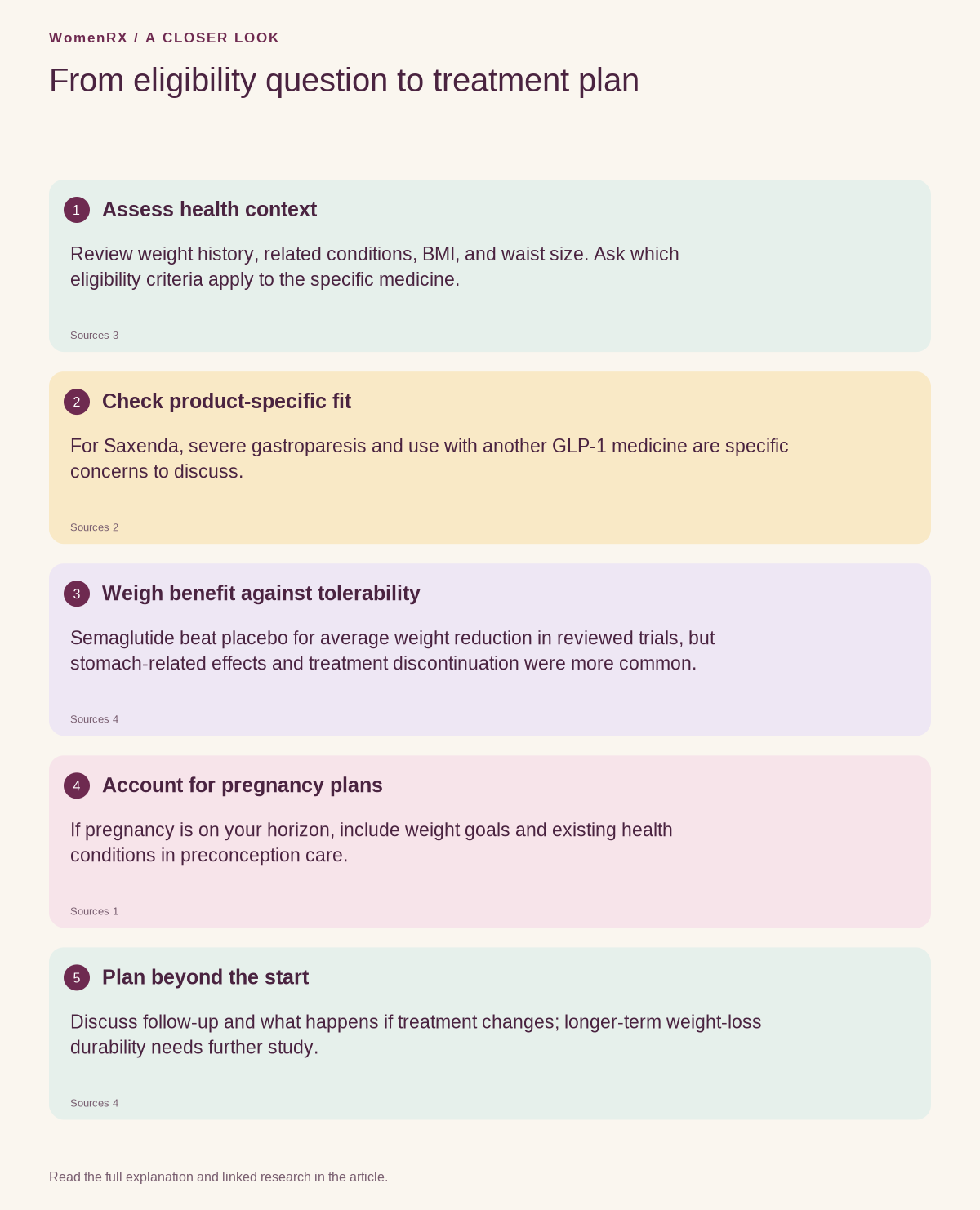
From eligibility question to treatment plan
Assess health context: Review weight history, related conditions, BMI, and waist size. Ask which eligibility criteria apply to the specific medicine.3
Check product-specific fit: For Saxenda, severe gastroparesis and use with another GLP-1 medicine are specific concerns to discuss.2
Weigh benefit against tolerability: Semaglutide beat placebo for average weight reduction in reviewed trials, but stomach-related effects and treatment discontinuation were more common.4
Account for pregnancy plans: If pregnancy is on your horizon, include weight goals and existing health conditions in preconception care.1
Plan beyond the start: Discuss follow-up and what happens if treatment changes; longer-term weight-loss durability needs further study.4
Read the figure as text
Use these distinctions to keep a GLP-1 discussion focused on the medicine being considered, not just the number on a scale.- Assess health context: Review weight history, related conditions, BMI, and waist size. Ask which eligibility criteria apply to the specific medicine.3
- Check product-specific fit: For Saxenda, severe gastroparesis and use with another GLP-1 medicine are specific concerns to discuss.2
- Weigh benefit against tolerability: Semaglutide beat placebo for average weight reduction in reviewed trials, but stomach-related effects and treatment discontinuation were more common.4
- Account for pregnancy plans: If pregnancy is on your horizon, include weight goals and existing health conditions in preconception care.1
- Plan beyond the start: Discuss follow-up and what happens if treatment changes; longer-term weight-loss durability needs further study.4
More questions, answered
Do I need to try every other approach before asking about medication?
You can ask which criteria apply to the specific medicine and how your previous approaches factor into the recommendation. Obesity care includes several possible options, from nutrition and activity support to medicines and, for some people, procedures or surgery. Your past efforts are useful health history, not a reason to avoid asking about the options. 3
Does BMI alone determine whether a medicine is right for me?
BMI is one measure used in assessing weight-related risk, but it doesn’t distinguish fat from muscle or bone and may not reflect body fat accurately for everyone. Ask how your health history, waist size, related conditions, and goals factor into the discussion, as well as which criteria apply to the specific medicine. 3
Sources you can check
- Preconception Care: MedlinePlusAccessed 2026-09-25Return to first citation
- SAXENDA (LIRAGLUTIDE) INJECTION, SOLUTION [NOVO NORDISK PHARMACEUTICAL INDUSTRIES, LP] | US prescribing information and patient instructionsAccessed 2026-09-25Return to first citation
- Obesity: MedlinePlusAccessed 2026-09-25Return to first citation
- Effectiveness & safety of semaglutide in weight reduction in obese nondiabetic patients: A systematic review and meta-analysis.Naz F, Qaiser F, Mumtaz A, Din SU, Mustafa A, Ullah A, Perveen A, Malik J. · Medicine · 2026Return to first citation
- Assessing Weight Stigma Interventions: A Systematic Review of Randomized Controlled Trials.Wang C, Murley WD, Panda S, Stiver CA, Garell CL, Moin T, Crandall AK, Tomiyama AJ. · Current obesity reports · 2025Return to first citation