GLP-1 Medicines Before IVF: Timing Questions to Ask
There isn’t one stop date that fits every GLP-1 medicine and every fertility procedure, so plan separately for retrieval or sedation and for a possible pregnancy.
Before ovarian stimulation or egg retrieval, ask your fertility team, the clinician who prescribes your GLP-1 medicine, and the anesthesia team (if your retrieval involves deep sedation or general anesthesia) to agree on a plan. Then ask separately how the medicine affects embryo transfer or when you can try to become pregnant. The right timing depends on the specific drug and your care plan, not a universal interval. 2 3 4
Two timing questions, not one
A fertility cycle can involve ovarian stimulation, egg retrieval, embryo transfer, and a possible pregnancy. These milestones raise two different medication questions. One is about the procedure, particularly if retrieval involves deep sedation or general anesthesia. The other is about pregnancy planning: whether the medicine should be stopped before transfer or trying to conceive, and how far in advance.
Don’t assume the answer to one question settles the other. A review of GLP-1 medicines notes that delayed stomach emptying can affect perioperative planning, while reproductive reviews describe preconception planning as a separate issue. 2 3 4
Before retrieval: include the anesthesia team
Tell your fertility clinic and anesthesia team the exact medicine you take, when you last took it, and whether you have nausea, vomiting, or other digestive symptoms. Ask the team to give you one coordinated plan for the retrieval procedure and to tell you whom to contact if the procedure date changes.
This is relevant even when pregnancy isn’t planned right after retrieval. For example, a cycle may involve retrieval and embryo freezing now, with transfer planned later. The U.S. liraglutide prescribing information includes a section on aspiration during general anesthesia or deep sedation; a review also identifies delayed gastric emptying as a perioperative consideration. These are reasons to raise the medicine with the people planning your procedure, not a reason to apply a stop interval from another patient or another medication. 2 3
Before transfer or trying to conceive: make a separate plan
Ask the prescribing clinician and fertility clinician when the medicine should be stopped, if stopping is recommended, in relation to your planned transfer or attempts to conceive. Make sure they know whether you take it for weight management, diabetes, or another reason. Don’t stop or restart a prescribed medicine on your own: medicines used for an existing health condition can have risks when changed, and the decision depends on the individual medicine and situation. 1
Reviews describe limited human pregnancy-safety data and the need for medication-specific preconception planning. They do not establish one washout period for every GLP-1 medicine. So ask the team to name the exact drug-specific interval they recommend for you, rather than treating “GLP-1” as one interchangeable medication. 4 5
What IVF evidence can, and can’t, tell you
The available fertility evidence doesn’t establish that GLP-1 medicines improve or impair IVF outcomes. A review describes a small, open-label IVF pretreatment study of 28 women comparing metformin with metformin plus liraglutide. The study is exploratory, not enough to confirm a fertility benefit or set routine timing for IVF care. 4
That distinction matters if you’re using a GLP-1 medicine to support weight or metabolic health before treatment. A possible benefit in those areas is not the same as proven improvement in egg, embryo, transfer, or live-birth outcomes. A review of gynecologic uses likewise describes infertility evidence as ongoing and further research as needed. 3 4
A short coordination list
Bring or send your team:
- The medicine’s generic and brand names, if known, and the reason you take it.
- Your most recent dose and the date of your next planned dose.
- Your expected stimulation, retrieval, and transfer dates, including whether embryos will be frozen for later.
- Any digestive symptoms and the name of the clinician who prescribes the medicine.
Then ask each team to answer its part: What is the procedure plan? What is the plan before transfer or trying to conceive? Who should you contact if dates move or pregnancy becomes possible sooner than expected? If you already took a dose close to a planned procedure or possible pregnancy, share that timing with your care team rather than making a change based on a general online interval. 1 2
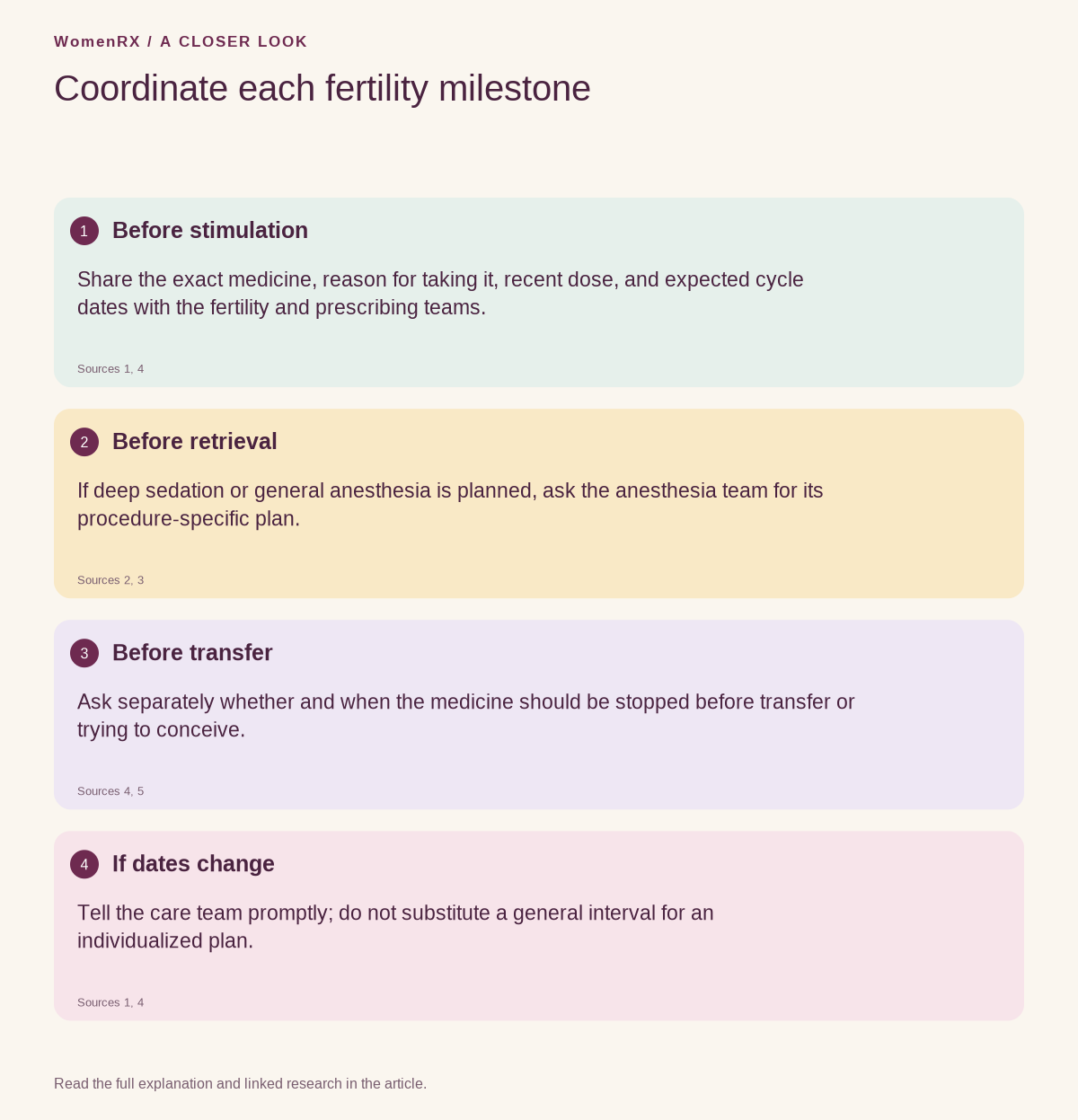
Coordinate each fertility milestone
Before stimulation: Share the exact medicine, reason for taking it, recent dose, and expected cycle dates with the fertility and prescribing teams.14
Before retrieval: If deep sedation or general anesthesia is planned, ask the anesthesia team for its procedure-specific plan.23
Before transfer: Ask separately whether and when the medicine should be stopped before transfer or trying to conceive.45
If dates change: Tell the care team promptly; do not substitute a general interval for an individualized plan.14
Read the figure as text
A sequence of conversations keeps procedure planning separate from the decision about a planned pregnancy; it does not prescribe a stop date.- Before stimulation: Share the exact medicine, reason for taking it, recent dose, and expected cycle dates with the fertility and prescribing teams.14
- Before retrieval: If deep sedation or general anesthesia is planned, ask the anesthesia team for its procedure-specific plan.23
- Before transfer: Ask separately whether and when the medicine should be stopped before transfer or trying to conceive.45
- If dates change: Tell the care team promptly; do not substitute a general interval for an individualized plan.14
More questions, answered
Does taking a GLP-1 medicine mean I need to cancel IVF?
The research doesn’t establish a general rule to cancel or proceed. Tell your fertility and prescribing teams what you take and when, and include the anesthesia team if your retrieval involves deep sedation or general anesthesia. They can make a plan around your procedure and pregnancy timeline. 1 2 3
Do GLP-1 medicines improve IVF success?
That hasn’t been established. A small, open-label study of 28 women is exploratory and can’t confirm that liraglutide improves IVF outcomes or show that the result applies to other medicines. 4
Sources you can check
- Pregnancy and Medicines | MedlinePlusAccessed 2026-09-25Return to first citation
- SAXENDA (LIRAGLUTIDE) INJECTION, SOLUTION [NOVO NORDISK PHARMACEUTICAL INDUSTRIES, LP] | US prescribing information and patient instructionsAccessed 2026-09-25Return to first citation
- The use of GLP-1: receptor agonist medications for benign gynecology.Howard MD, Allen SE. · Current opinion in obstetrics & gynecology · 2025Return to first citation
- Balancing metabolic optimization and reproductive safety in Polycystic Ovary Syndrome: a Bayesian-informed framework for GLP-1 receptor agonists.Song E, Fang Y, Li X, Fu W, He H, Gao Z, Tian X, Gao B. · Frontiers in nutrition · 2026Return to first citation
- The effects of glucagon-like peptide-1 receptor agonists on fertility, contraception, and pregnancy: clinical perspectives.Dilbaz B, Ateş Ç. · The European journal of contraception & reproductive health care : the official journal of the European Society of Contraception · 2026Return to first citation