Mounjaro Before Surgery: What Your Team Needs to Know
Tell your surgical and anesthesia teams you take tirzepatide, when you last took it, and whether your dose or stomach symptoms have changed.
Mounjaro (tirzepatide) slows stomach emptying, and rare aspiration reports have occurred during procedures with general anesthesia or deep sedation, even when patients followed fasting instructions. Tell your surgeon and anesthesia team your dose, last injection date, any recent dose increase, and any stomach symptoms. There isn’t a universal stop-or-continue rule in the prescribing information, so ask your team for a coordinated plan. 1
Make the medication handoff early
Tell both the surgical team and the anesthesia team that you use Mounjaro (tirzepatide). Share your current dose, the date of your last injection, when your next dose is due, and whether you recently started treatment or increased your dose. Mention nausea or other stomach symptoms, too. If you take tirzepatide for diabetes, say that as well so the team has the right context for planning.
The reason this handoff matters is that tirzepatide delays stomach emptying. The US prescribing information describes rare reports of food or liquid entering the lungs during procedures with general anesthesia or deep sedation, including cases where patients reported following pre-procedure fasting instructions. This is a concern to plan for, not a prediction that aspiration will happen to you. 1
If you don’t know what kind of anesthesia is planned, ask. General anesthesia, deep sedation, and lighter forms of sedation are distinct approaches; the procedure and your health help determine what is used. 2
Elective procedures: use the time to agree on a plan
For a scheduled procedure, share your medication details as soon as you can, especially if you’re in the dose-increase phase or having stomach symptoms. A review of GLP-1 medicines describes ultrasound studies in which residual stomach contents were more common, with particular concern during dose escalation or when gastrointestinal symptoms were present. These findings concern stomach contents; they don’t show that aspiration will occur, and they aren’t specific to tirzepatide alone. 3
Ask the anesthesia team and the clinician who prescribes Mounjaro to coordinate what to do about a dose that falls near your procedure. The prescribing information says available data are insufficient to determine whether temporarily stopping Mounjaro or changing fasting instructions reduces retained stomach contents or aspiration risk. It does not establish one hold interval for everyone. 1
Follow the fasting instructions your team gives you. Don’t change them or fast longer on your own to try to compensate for the medicine. Tell the team if you’ve eaten or drunk something that conflicts with the instructions, so they can decide how to proceed. 1
Urgent procedures: make the team aware right away
If a procedure can’t wait for a routine planning conversation, tell the surgical and anesthesia teams as soon as possible that you take tirzepatide. Give them the same dose, injection timing, dose-change, and symptom details. The decision about proceeding and anesthesia planning belongs to the team caring for you; don’t delay urgent care while trying to make a medication decision on your own.
Why teams may weigh the details differently
Studies have raised concern about residual stomach contents, but that doesn’t translate neatly into a known increase in aspiration events. A 2024 scoping review included 24 studies of several GLP-1 medicines. Of eight studies comparing users with nonusers, seven found significantly more residual stomach contents among users. In three retrospective studies that examined aspiration events, the review found no significant difference between groups. The studies had limitations and involved multiple medicines, so they don’t establish an individual’s tirzepatide-specific risk. 4
That gap is one reason not to treat a missed dose as a guaranteed solution or to assume that everyone should continue treatment unchanged. Make sure the people planning your procedure know the relevant details, then get one plan from the team for medication timing and fasting.
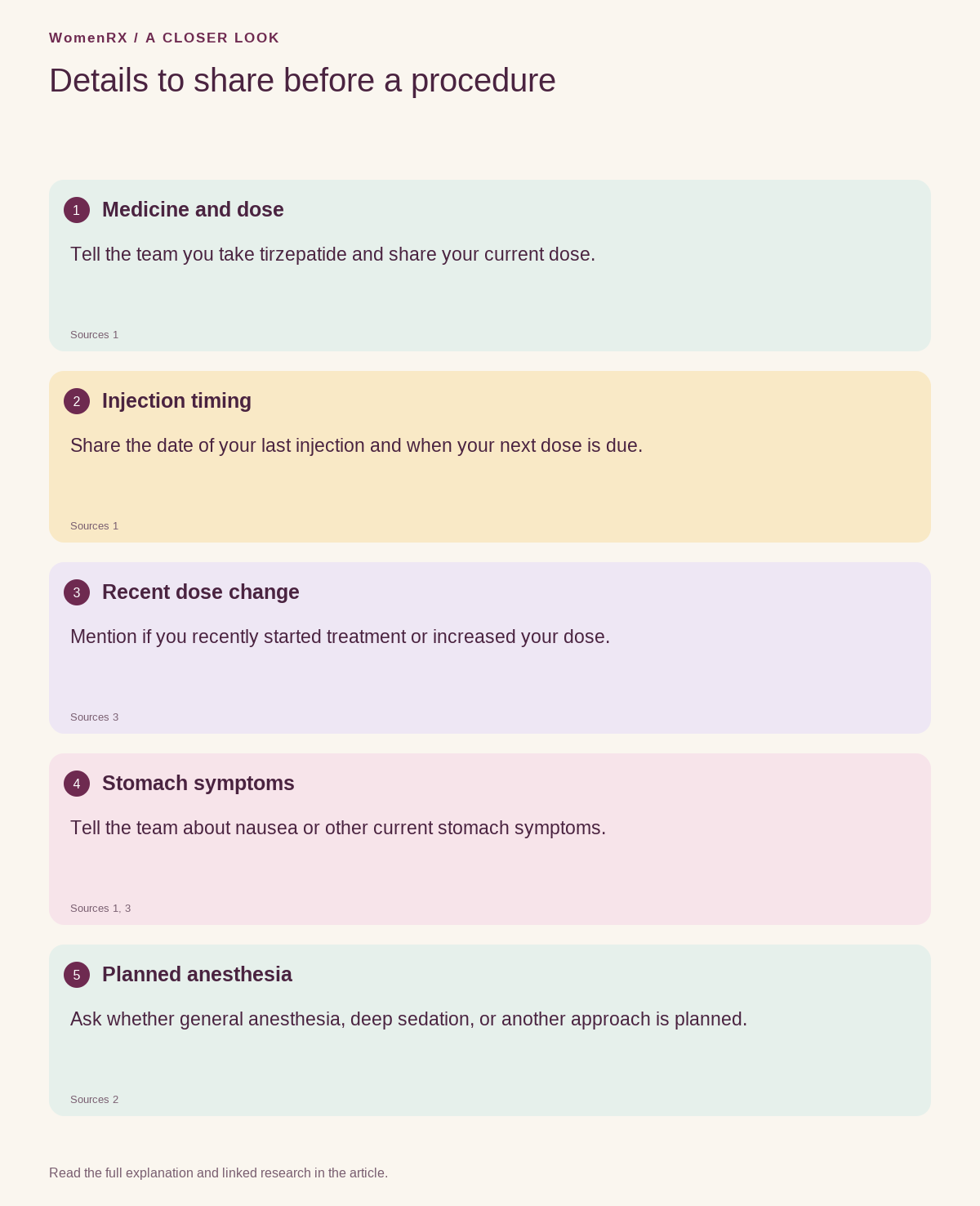
Details to share before a procedure
Medicine and dose: Tell the team you take tirzepatide and share your current dose.1
Injection timing: Share the date of your last injection and when your next dose is due.1
Recent dose change: Mention if you recently started treatment or increased your dose.3
Stomach symptoms: Tell the team about nausea or other current stomach symptoms.13
Planned anesthesia: Ask whether general anesthesia, deep sedation, or another approach is planned.2
Read the figure as text
Use these prompts to give the surgical and anesthesia teams a clear picture. They are not a self-assessment or a medication schedule.- Medicine and dose: Tell the team you take tirzepatide and share your current dose.1
- Injection timing: Share the date of your last injection and when your next dose is due.1
- Recent dose change: Mention if you recently started treatment or increased your dose.3
- Stomach symptoms: Tell the team about nausea or other current stomach symptoms.13
- Planned anesthesia: Ask whether general anesthesia, deep sedation, or another approach is planned.2
More questions, answered
Does following the fasting instructions remove the concern?
No. The prescribing information describes rare aspiration reports during general anesthesia or deep sedation despite reported adherence to fasting recommendations. Follow the instructions your team gives you and make sure they know you take tirzepatide. 1
Should I skip my next Mounjaro dose?
There isn’t a universal perioperative stop-or-continue rule in the prescribing information. It says there isn’t enough information to determine whether temporarily stopping reduces risk. Ask your procedure team and prescribing clinician to agree on what to do about a dose near your procedure. 1
Sources you can check
- MOUNJARO (TIRZEPATIDE) INJECTION, SOLUTION MOUNJARO KWIKPEN (TIRZEPATIDE) INJECTION, SOLUTION [ELI LILLY AND COMPANY] | US prescribing information and patient instructionsAccessed 2026-09-25Return to first citation
- Anesthesia: MedlinePlusAccessed 2026-09-25Return to first citation
- Glucagon-Like Peptide-1 Receptor Agonists in Plastic Surgery: Perioperative Considerations and Safety Protocols.Davila Diaz R, Campos Barrera E, Diaz Fosado LA, Reyes Esparza A, Perez Benitez OA. · Cureus · 2025Return to first citation
- A Scoping Review of GLP-1 Receptor Agonists: Are They Associated with Increased Gastric Contents, Regurgitation, and Aspiration Events?Chang MG, Ripoll JG, Lopez E, Krishnan K, Bittner EA. · Journal of clinical medicine · 2024Return to first citation