Ozempic Before Surgery: Make a Plan With Your Team
Tell your anesthesia team you use Ozempic, and make a plan together rather than relying on a universal rule about skipping a dose.
If you take Ozempic before a procedure, tell your surgeon and anesthesia team what dose you use, when you last took it, whether your dose is changing, and whether you have stomach symptoms. Semaglutide can delay stomach emptying, and fasting may not mean the stomach is empty. The product information does not set a hold schedule; your team should decide about dosing, fasting, and anesthesia for your specific procedure. 1 5

Why fasting may not settle the question
Ozempic slows stomach emptying. The product information describes rare reports of food or liquid entering the lungs during general anesthesia or deep sedation, including in people who followed fasting instructions. It also says there isn’t enough information to determine whether temporarily stopping Ozempic or changing fasting instructions reduces that risk. The label asks patients to tell their care team about the medication; it does not provide a complete plan for surgery. 1
A small prospective study helps explain why the decision can be more complicated than “skip one dose.” Among 43 semaglutide users having elective surgery, 21 had a “full stomach” on ultrasound, compared with 8 of 44 matched patients not taking semaglutide. The study assessed stomach contents, not aspiration events, and found that the difference persisted even after a dose had been withheld. That finding doesn’t prove aspiration will happen, or that holding a dose cannot help an individual. It does show that fasting or a missed dose can’t be treated as a guarantee. 5
Match the plan to your procedure and how you’re feeling
Start by telling the team the exact name and form of your medication, your usual dose, the date of your last dose, and whether you recently started treatment or increased your dose. Mention symptoms such as nausea, vomiting, constipation, or abdominal discomfort. The Ozempic information lists several of these as common side effects, and a review of perioperative evidence describes more residual stomach contents in patients during dose escalation or with gastrointestinal symptoms. 1 4
Then ask what kind of anesthesia is planned. The product warning specifically concerns general anesthesia and deep sedation. Other procedures may use local or regional anesthesia, sometimes with sedation; the anesthesia plan depends on the procedure and your health. Tell the team even if you expect only light sedation, since the plan should be based on what you’re actually scheduled to receive. 1 2
The procedure’s timing matters, too. For an elective procedure, there may be more room for the team to discuss medication timing or adjust the plan in advance. If a procedure is urgent or time-sensitive, tell the team promptly rather than making a medication decision or delaying care on your own. The people planning the procedure and anesthesia can weigh the urgency alongside your last dose and current symptoms.
Get one coordinated answer about doses and fasting
Tell your surgeon, anesthesia team, and the clinician who prescribes Ozempic about the procedure. Ask them to agree on who will make the medication decision and who will give you the final fasting instructions. If you take Ozempic for diabetes, include the prescribing clinician in a discussion about any proposed change to your usual medication plan.
Useful questions include:
- “Does my planned anesthesia involve general anesthesia or deep sedation?”
- “Given my last dose, recent dose changes, and any stomach symptoms, what should I do about my next dose?”
- “Should I follow any fasting instructions beyond the ones I’ve already received?”
- “If I have symptoms on the day of the procedure, whom should I tell before arriving or before anesthesia?”
- “Would an ultrasound of my stomach be useful and available for this decision?”
Gastric ultrasound is one possible way for an anesthesia team to assess stomach contents, but it isn’t a universal answer. In a small prospective pilot study of 25 patients taking weekly GLP-1 medicines, ultrasound found stomach contents in five; those procedures were rescheduled, while 20 patients with an empty stomach proceeded without complications. The study was small and does not establish a general protocol. It supports asking whether ultrasound is an option, not expecting it at every facility. 6
What the procedure studies can, and can’t, tell you
Actual aspiration events are rare enough that small studies cannot settle the risk for every procedure or type of anesthesia. For example, a retrospective review of 155 semaglutide users having elective eye surgery found no aspiration or respiratory complications. Nearly all received moderate sedation; only two received general anesthesia. Those results are reassuring for that specific setting, but they can’t establish the safety of continuing Ozempic for all surgeries or deeper anesthesia. 3
The practical takeaway is to share the details early and get a plan that fits your procedure, anesthesia, dose history, and symptoms. Don’t assume that everyone taking Ozempic should stop it, or that fasting alone removes the concern. Your anesthesia team and prescriber should help decide what happens next.
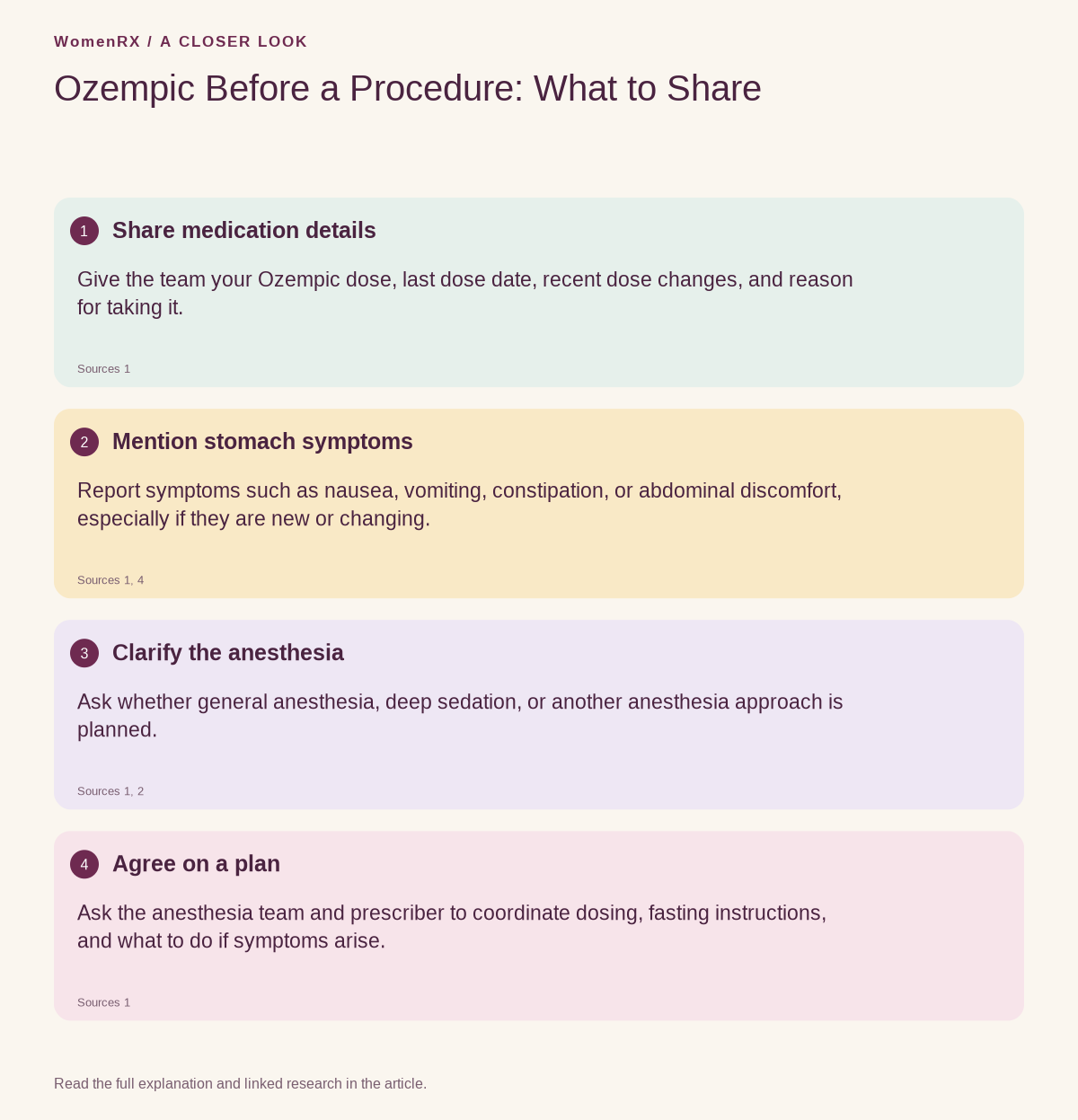
Ozempic Before a Procedure: What to Share
Share medication details: Give the team your Ozempic dose, last dose date, recent dose changes, and reason for taking it.1
Mention stomach symptoms: Report symptoms such as nausea, vomiting, constipation, or abdominal discomfort, especially if they are new or changing.14
Clarify the anesthesia: Ask whether general anesthesia, deep sedation, or another anesthesia approach is planned.12
Agree on a plan: Ask the anesthesia team and prescriber to coordinate dosing, fasting instructions, and what to do if symptoms arise.1
Read the figure as text
Use these steps to organize the details your care team needs. They help frame the discussion; they do not determine whether to hold a dose or proceed.- Share medication details: Give the team your Ozempic dose, last dose date, recent dose changes, and reason for taking it.1
- Mention stomach symptoms: Report symptoms such as nausea, vomiting, constipation, or abdominal discomfort, especially if they are new or changing.14
- Clarify the anesthesia: Ask whether general anesthesia, deep sedation, or another anesthesia approach is planned.12
- Agree on a plan: Ask the anesthesia team and prescriber to coordinate dosing, fasting instructions, and what to do if symptoms arise.1
Sources you can check
- OZEMPIC (SEMAGLUTIDE) INJECTION, SOLUTION [A-S MEDICATION SOLUTIONS] | US prescribing information and patient instructionsAccessed 2026-09-25Return to first citation
- Anesthesia: MedlinePlusAccessed 2026-09-25Return to first citation
- The Risk of Aspiration Is Low With Continuing Semaglutide During Elective Eye Surgery When Patients Receive Only Moderate Sedation.Zapp C, Downer Ii DM, Levine A, Parker N, Zapp M, Downer D, Levine L. · Cureus · 2026Return to first citation
- Glucagon-Like Peptide-1 Receptor Agonists in Plastic Surgery: Perioperative Considerations and Safety Protocols.Davila Diaz R, Campos Barrera E, Diaz Fosado LA, Reyes Esparza A, Perez Benitez OA. · Cureus · 2025Return to first citation
- Gastric ultrasound in patients receiving semaglutide: a prospective, multicentre, matched control study.Vlaeminck N, Van de Putte P, Dekeyser M, Baert N, Wallyn A, Vernieuwe L, Smitz C, Wouters K, Van Cauwenberghe J, Saldien V. · Anaesthesia · 2026Return to first citation
- Role of Gastric Point-of-Care Ultrasound in Perioperative Management of Semaglutide.Muranaka MO, Nguyen TH, Wang AT, Cordero J, Yang SJ, Felix J, Nguyen JL, Carré AL, Chu MW. · Cureus · 2025Return to first citation