Zepbound Before Surgery: What Your Anesthesia Team Needs to Know
Tell your procedure team you take Zepbound so they can coordinate an anesthesia and medication plan with your prescriber.
Zepbound slows stomach emptying. Rare postmarketing reports describe food or liquid remaining in the stomach and entering the lungs during procedures with general anesthesia or deep sedation, even when patients reported following fasting instructions. Tell your surgical or procedure team, anesthesia team, and prescriber you take it. Don’t change or stop it on your own. 1
Why Zepbound comes up in anesthesia planning
Tirzepatide, the medicine in Zepbound, slows how quickly the stomach empties. During general anesthesia or deep sedation, food or liquid remaining in the stomach can create a concern about material entering the lungs. The Zepbound prescribing information describes rare postmarketing reports of pulmonary aspiration during procedures involving general anesthesia or deep sedation, including in people who reported following pre-procedure fasting instructions. 1
That does not tell you your individual risk, or mean that fasting instructions should be ignored. The prescribing information says there isn’t enough evidence to know whether changing fasting recommendations or temporarily stopping Zepbound reduces the risk. Keep following the instructions your team gives you, and don’t change your medication without an agreed plan. 1
Make one clear handoff
Tell the office arranging your procedure that you use Zepbound, and ask how that information will reach the anesthesia team and the clinician who prescribes it. Anesthesia may include general anesthesia, local or regional anesthesia, or sedation at different levels. The type planned depends on the procedure and your overall health, so ask if you aren’t sure what your procedure will involve. 2
Share these details so the teams can consider your situation together:
- Your current Zepbound dose and when you last took it.
- Whether your dose has changed recently or is being increased.
- Any current digestive symptoms, such as nausea.
- What procedure you’re having and what you’ve been told about anesthesia or sedation.
- Other medicines you take. If pregnancy is possible or confirmed, mention that during the pre-procedure medication review too.
These are details to share, not a checklist that determines whether you should take or skip a dose. The available Zepbound information does not establish a universal medication-holding rule or a specific symptom-based decision rule. Your procedure team and prescriber can coordinate a plan for you. 1
What the research can tell you
A single-center retrospective study looked at 83 people taking GLP-1 medicines before elective total joint replacement. It found no cases of aspiration during surgery, but only one person in the study was taking tirzepatide. Stomach contents also weren’t routinely assessed. Those results are useful context, but they can’t establish the risk for someone taking Zepbound or settle what to do before a different procedure. 4
A review of evidence in hand and orthopedic surgery also described the literature as limited, with unresolved questions about perioperative medication management. Taken together, the evidence supports sharing your medication details and making an individualized plan, not assuming that every patient should stop Zepbound or that there is no concern. 31
If your procedure is coming up and you haven’t discussed Zepbound with anyone on the care team, contact the office arranging it. Ask them to coordinate with anesthesia and your prescriber before you make a medication change.
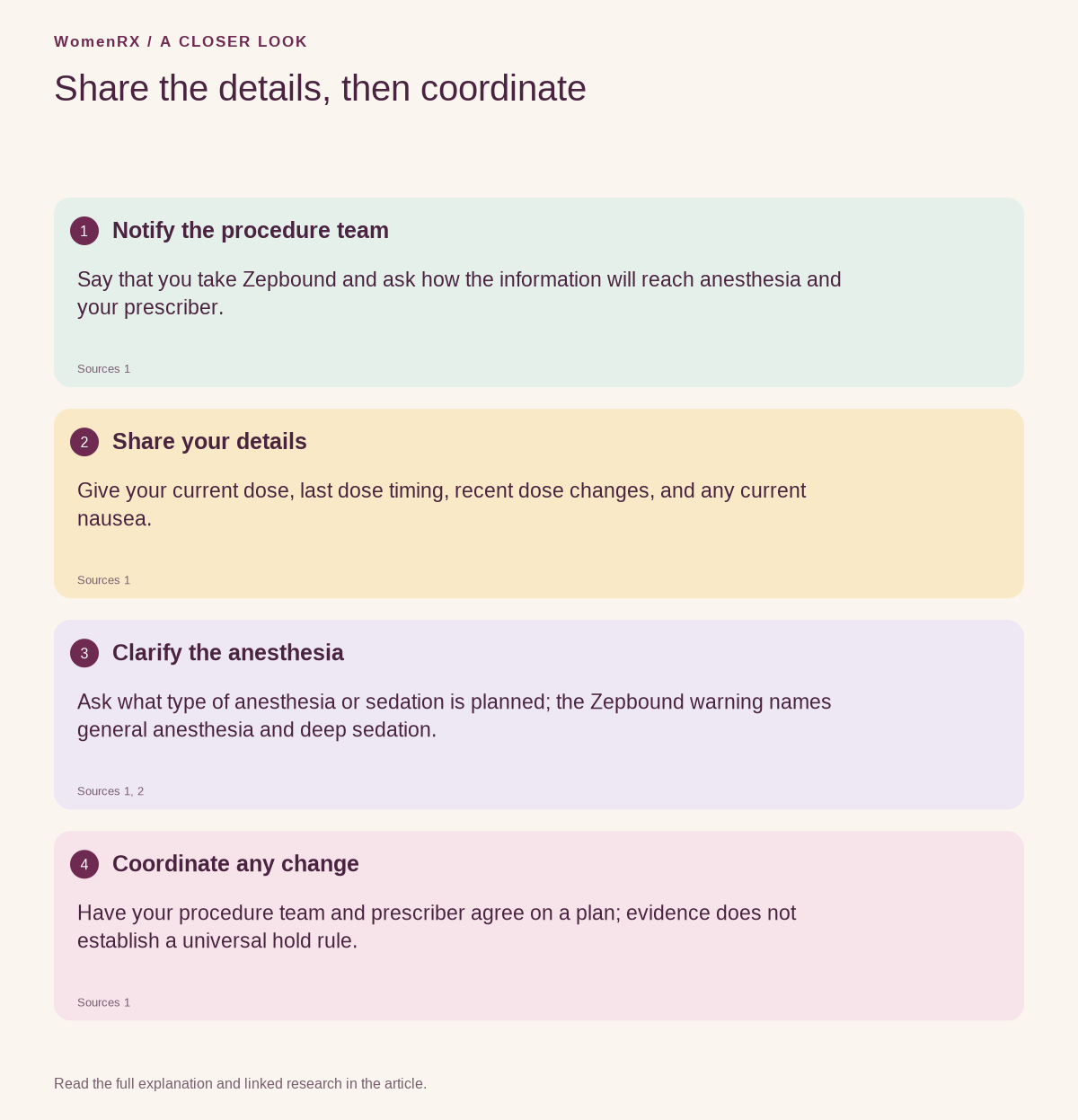
Share the details, then coordinate
Notify the procedure team: Say that you take Zepbound and ask how the information will reach anesthesia and your prescriber.1
Share your details: Give your current dose, last dose timing, recent dose changes, and any current nausea.1
Clarify the anesthesia: Ask what type of anesthesia or sedation is planned; the Zepbound warning names general anesthesia and deep sedation.12
Coordinate any change: Have your procedure team and prescriber agree on a plan; evidence does not establish a universal hold rule.1
Read the figure as text
A simple handoff sequence for telling the procedure and anesthesia teams about Zepbound without deciding on a medication change alone.- Notify the procedure team: Say that you take Zepbound and ask how the information will reach anesthesia and your prescriber.1
- Share your details: Give your current dose, last dose timing, recent dose changes, and any current nausea.1
- Clarify the anesthesia: Ask what type of anesthesia or sedation is planned; the Zepbound warning names general anesthesia and deep sedation.12
- Coordinate any change: Have your procedure team and prescriber agree on a plan; evidence does not establish a universal hold rule.1
More questions, answered
Should I skip a dose before my procedure?
Don’t decide on your own. The prescribing information says evidence is insufficient to determine whether temporarily stopping Zepbound reduces aspiration risk. Ask your procedure team and prescriber to coordinate a plan for your procedure. 1
Does following fasting instructions remove the concern?
Not necessarily. The prescribing information describes rare aspiration reports during procedures involving general anesthesia or deep sedation, including cases where patients reported following pre-procedure fasting instructions. Follow the instructions your team gives you and make sure they know you take Zepbound. 1
Sources you can check
- ZEPBOUND (TIRZEPATIDE) INJECTION, SOLUTION ZEPBOUND (TIRZEPATIDE) INJECTION, SOLUTION ZEPBOUND KWIKPEN (TIRZEPATIDE) INJECTION, SOLUTION [ELI LILLY AND COMPANY] | US prescribing information and patient instructionsAccessed 2026-09-25Return to first citation
- Anesthesia: MedlinePlusAccessed 2026-09-25Return to first citation
- Current Concepts in Perioperative Guidance and Outcomes in Hand Surgery Patients Taking Glucagon-Like Peptide-1 Receptor Agonists.Song EY, Melton MS, Hammert W, Li NY, Saltzman EB. · The Journal of hand surgery · 2026Return to first citation
- GLP-1 receptor agonist utilization is associated with a low risk of Anesthesia-related complications prior to total joint arthroplasty.C Palmer R, Telang SS, Kistler NM, Mayfield CK, Hong K, Gucev G, Lieberman JR, Heckmann ND. · European journal of orthopaedic surgery & traumatology : orthopedie traumatologie · 2025Return to first citation