Wegovy Before Surgery: Make a Plan With Your Team
Tell your surgical and anesthesia teams about Wegovy early enough to make a plan that fits your procedure.
You may be able to have a procedure while taking Wegovy, but don’t assume you should either stop or continue it without a plan. Wegovy carries a warning about food or liquid entering the lungs during anesthesia or deep sedation. Tell your surgical and anesthesia teams that you take it, then ask for instructions specific to your procedure. 14
Why your anesthesia team needs to know
Semaglutide can slow the movement of food out of the stomach. If stomach contents remain during general anesthesia or deep sedation, food or liquid could enter the lungs. Wegovy’s prescribing information warns about this possibility and asks patients to tell their health care providers about the medication before surgery or other procedures. 16
The concern isn’t identical for every procedure. Local anesthesia numbs an area while you’re awake; sedation and general anesthesia affect awareness differently. The type of anesthesia used depends partly on the procedure, your health, and your medical history. Even if you expect a minor procedure, ask what kind of anesthesia or sedation is planned rather than guessing from the word surgery. 2
Why there isn’t one rule about the next dose
Finding food in the stomach and having food enter the lungs are different outcomes. A review describes a small endoscopy study in which retained stomach contents were found more often among people taking semaglutide than among those not taking it, despite reported fasting. That finding helps explain the concern, but it doesn’t tell an individual patient whether stopping a dose would prevent aspiration. 6
Studies of surgical outcomes have also been narrow. In a retrospective review of 155 people taking semaglutide who had elective eye surgery, researchers identified no aspiration or respiratory complications. Most procedures were cataract operations, 151 people received moderate sedation, and the study examined Ozempic rather than Wegovy. It cannot establish the plan for someone having a different procedure or general anesthesia. 3
In another retrospective series, 83 people taking GLP-1 medicines underwent joint replacement; 63 were taking semaglutide. Researchers identified no acute aspiration. One person was found to have a full stomach during surgery and was increasing their semaglutide dose. That single case is a reason to mention recent dose changes, not proof that dose escalation predicts what will happen to you. 5
Perioperative research remains limited, and the best medication plan isn’t settled for every situation. Depending on the procedure and the team’s assessment, possible responses to concern about retained stomach contents include evaluating the stomach, changing the anesthesia approach, or delaying an elective procedure. Those are team decisions, not steps to arrange or medication changes to make on your own. 46
Make the handoff before procedure day
Tell the office coordinating your procedure that you take Wegovy, and make sure the anesthesia team and your Wegovy prescriber have that information too. 1 A short, specific handoff is more useful than asking, “Is Wegovy okay before surgery?” Include:
- The procedure and planned anesthesia. Ask whether you’ll have local anesthesia, sedation, deep sedation, or general anesthesia if you haven’t been told. 2
- Your Wegovy details. Share your current dose, when you last took it, and whether you’ve recently started or increased it. Studies have recorded last-dose timing, and a joint-replacement series noted a full stomach in one person during dose escalation, but neither finding supplies a dosing rule for you. 35
- What your stomach has been doing. Mention nausea, vomiting, or feeling unusually full, and say whether it’s new or ongoing. These details help describe your situation; symptoms alone aren’t a test that determines whether your stomach is empty.
- Pregnancy possibility, if relevant. Tell the pre-op team if you might be pregnant and ask whether pregnancy testing is part of your procedure preparation. That’s a separate planning question, not a way to assess Wegovy-related aspiration risk. If the procedure is related to pregnancy or childbirth, make the medication discussion with your obstetric and anesthesia teams rather than applying a routine elective-surgery plan; anesthesia options can differ in childbirth. 2
Then ask for a clear answer to: “What should I do about my next Wegovy dose, and do any of my procedure instructions change?” If your dose, symptoms, or anesthesia plan changes after that conversation, update the team so the plan still matches your situation.
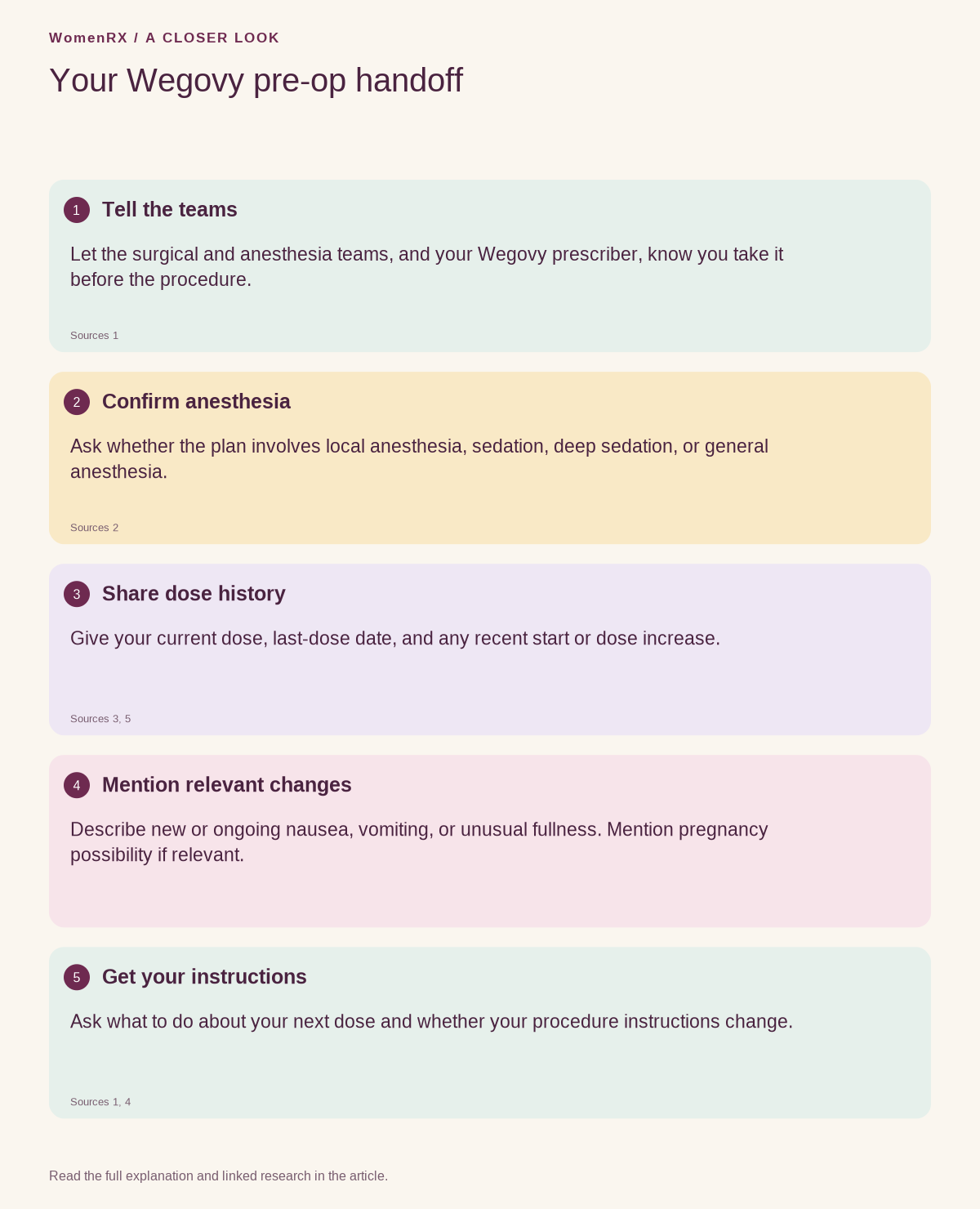
Your Wegovy pre-op handoff
Tell the teams: Let the surgical and anesthesia teams, and your Wegovy prescriber, know you take it before the procedure.1
Confirm anesthesia: Ask whether the plan involves local anesthesia, sedation, deep sedation, or general anesthesia.2
Share dose history: Give your current dose, last-dose date, and any recent start or dose increase.35
Mention relevant changes: Describe new or ongoing nausea, vomiting, or unusual fullness. Mention pregnancy possibility if relevant.
Get your instructions: Ask what to do about your next dose and whether your procedure instructions change.14
Read the figure as text
Use these steps to get a plan for your specific procedure rather than relying on a general rule.- Tell the teams: Let the surgical and anesthesia teams, and your Wegovy prescriber, know you take it before the procedure.1
- Confirm anesthesia: Ask whether the plan involves local anesthesia, sedation, deep sedation, or general anesthesia.2
- Share dose history: Give your current dose, last-dose date, and any recent start or dose increase.35
- Mention relevant changes: Describe new or ongoing nausea, vomiting, or unusual fullness. Mention pregnancy possibility if relevant.
- Get your instructions: Ask what to do about your next dose and whether your procedure instructions change.14
More questions, answered
What if my procedure uses only local anesthesia?
Local anesthesia numbs a small area while you’re awake, which differs from deep sedation or general anesthesia. Confirm that no sedation is planned, and still tell the team you take Wegovy so they can give you instructions for the procedure you’re actually having. 12
Sources you can check
- WEGOVY (SEMAGLUTIDE) INJECTION, SOLUTION WEGOVY (SEMAGLUTIDE) TABLET [NOVO NORDISK PHARMACEUTICAL INDUSTRIES, LP] | US prescribing information and patient instructionsAccessed 2026-09-25Return to first citation
- Anesthesia: MedlinePlusAccessed 2026-09-25Return to first citation
- The Risk of Aspiration Is Low With Continuing Semaglutide During Elective Eye Surgery When Patients Receive Only Moderate Sedation.Zapp C, Downer Ii DM, Levine A, Parker N, Zapp M, Downer D, Levine L. · Cureus · 2026Return to first citation
- Current Concepts in Perioperative Guidance and Outcomes in Hand Surgery Patients Taking Glucagon-Like Peptide-1 Receptor Agonists.Song EY, Melton MS, Hammert W, Li NY, Saltzman EB. · The Journal of hand surgery · 2026Return to first citation
- GLP-1 receptor agonist utilization is associated with a low risk of Anesthesia-related complications prior to total joint arthroplasty.C Palmer R, Telang SS, Kistler NM, Mayfield CK, Hong K, Gucev G, Lieberman JR, Heckmann ND. · European journal of orthopaedic surgery & traumatology : orthopedie traumatologie · 2025Return to first citation
- Glucose-Lowering Agents Developed in the Last Two Decades and Their Perioperative Implications.Goudra B, Merli GJ, Green M. · Pharmaceuticals (Basel, Switzerland) · 2024Return to first citation