Stopping Wegovy: Plan for Weight and Health Follow-Up
Weight regain is common after semaglutide is stopped, but study averages can’t predict what will happen to you.
Studies suggest that weight often increases after people stop semaglutide, but that isn’t an inevitable or precisely predictable outcome for any one person. A small meta-analysis modeled regain across semaglutide and tirzepatide studies; its longer-term estimates extend beyond the follow-up researchers observed. Before stopping, make a plan with your prescriber for continued weight-management support and follow-up that fits your reasons for stopping. 3
What research suggests after stopping
Weight regain is common in studies of people who stop semaglutide, but it doesn’t happen on one guaranteed schedule. One meta-analysis modeled results from six studies, including 1,776 participants across semaglutide and tirzepatide treatment arms. Its model estimated that participants would regain half of their initial weight loss in about 7.5 months and return to their starting weight in about 15 months. Those are estimates of group averages, not predictions for an individual or for women specifically. 3
There’s a key limitation behind those figures: the studies followed participants for 4 to 52 weeks after treatment ended. Estimates beyond the observed follow-up rely on a model that assumes a steady, linear rate of regain. That assumption may not describe what happens to you. 3
Other evidence illustrates why an average shouldn’t be treated as a personal forecast. In a health-network analysis of 4,182 people after their last recorded semaglutide or tirzepatide prescription, about two-thirds had stable weight or continued weight loss over the following six months. Among a smaller group of 119 people whose clinical notes documented treatment discontinuation around the time of their last prescription, 72% did not show weight regain. Because a last recorded prescription doesn’t necessarily confirm when or whether someone stopped taking a medicine, this observational study can’t establish what stopping caused. 4
Taken together, these findings point to a practical expectation, not a verdict: weight may rise after stopping, and the amount and timing vary. The research summarized here reports overall trajectories, not separate estimates for women. 3 4
Make the plan before the last dose
Start by naming why you’re considering stopping. Side effects, cost, a change in health priorities, and pregnancy planning can call for different conversations. You don’t need to settle every detail first; the goal is to avoid an unplanned gap in care.
Consider asking your prescriber:
- What are we hoping to protect or improve besides the number on the scale?
- What support or treatment options make sense if I stop Wegovy?
- What changes should I watch for, and when should we check in?
- If I’m stopping because of a side effect, what should we do about that concern?
- If I restart or change treatments later, what should we discuss first?
These are planning questions, not a validated monitoring checklist or a set schedule. Your next steps may depend on why you take Wegovy, your health history, and why you’re stopping. If you use it as part of care for another health condition, include a plan for that condition too.
Pregnancy and breastfeeding need their own conversation
If you’re planning a pregnancy, the U.S. Wegovy prescribing information says to stop the medicine two months before a planned pregnancy. Bring your timeline to your prescriber so you can discuss the transition and your health needs. 1
If you’re breastfeeding or planning to breastfeed, raise that specifically with your prescriber. It’s a separate situation from planning a pregnancy, so don’t assume that the same timing advice applies.
Follow the trend, not one number
If you and your prescriber decide that weight tracking is useful, agree on how you’ll use it and what would prompt a check-in. A single weigh-in can’t tell the whole story: body weight includes muscle, bone, fat, and water, and everyday factors can shift it. 2
A helpful follow-up plan has a purpose: it gives you a way to revisit whether the plan is working and what support you need. It doesn’t assume that regain is certain, or that a particular number means you’ve failed. The most useful question is not “How much will I regain?” but “If my weight or health changes, what’s our next step?”
Plan the transition
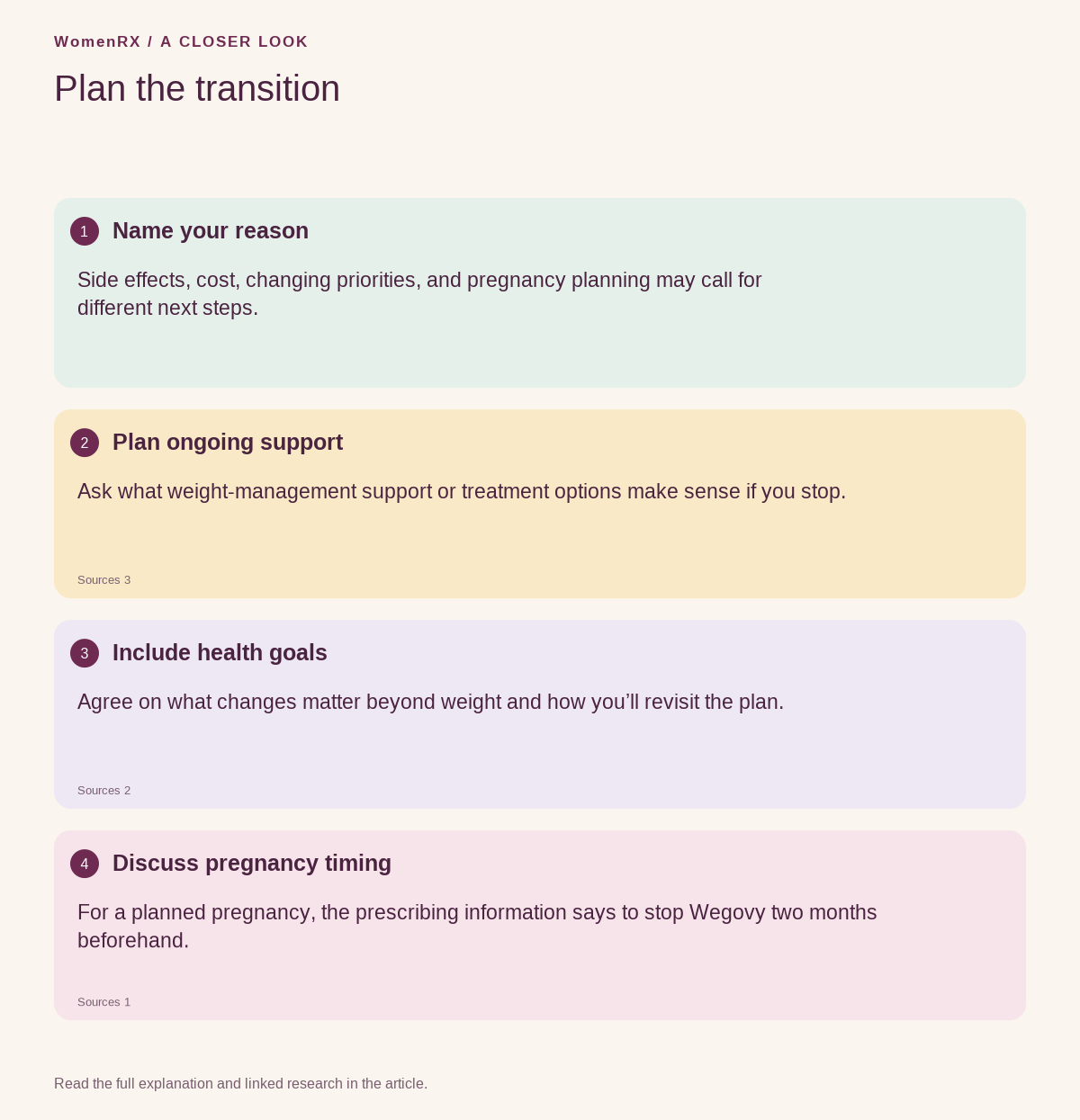
Name your reason: Side effects, cost, changing priorities, and pregnancy planning may call for different next steps.
Plan ongoing support: Ask what weight-management support or treatment options make sense if you stop.3
Include health goals: Agree on what changes matter beyond weight and how you’ll revisit the plan.2
Discuss pregnancy timing: For a planned pregnancy, the prescribing information says to stop Wegovy two months beforehand.1
Read the figure as text
Use these prompts to structure a conversation before stopping and decide what follow-up should address. They are planning prompts, not a validated protocol or prescribed schedule.- Name your reason: Side effects, cost, changing priorities, and pregnancy planning may call for different next steps.
- Plan ongoing support: Ask what weight-management support or treatment options make sense if you stop.3
- Include health goals: Agree on what changes matter beyond weight and how you’ll revisit the plan.2
- Discuss pregnancy timing: For a planned pregnancy, the prescribing information says to stop Wegovy two months beforehand.1
Sources you can check
- WEGOVY (SEMAGLUTIDE) INJECTION, SOLUTION WEGOVY (SEMAGLUTIDE) TABLET [NOVO NORDISK PHARMACEUTICAL INDUSTRIES, LP] | US prescribing information and patient instructionsAccessed 2026-09-25Return to first citation
- Body Weight: MedlinePlusAccessed 2026-09-25Return to first citation
- Weight Regain Trajectories After Discontinuation of Semaglutide or Tirzepatide: A Reconstructed Aggregate-Data Bayesian Longitudinal Meta-Analysis.Kow CS, Thiruchelvam K, Ramachandram DS, Zaihan AF. · Endocrinology, diabetes & metabolism · 2026Return to first citation
- Weight trajectories after last tirzepatide or semaglutide prescription across a federated health network.Murugadoss K, Varma G, Venkatakrishnan AJ, Gibson CM, Soundararajan V. · Biology methods & protocols · 2026Return to first citation