Stopping Zepbound: Plan Your Next Weight-Management Step
Weight changes after stopping tirzepatide vary, so plan the transition around why you’re stopping and what support comes next.
Some people regain weight after stopping Zepbound, but the amount varies. In a trial, adults who switched to placebo after a year on tirzepatide had less weight loss from their starting point a year later than those who continued treatment. 4 A separate real-world study followed a TZP-MJ cohort; it doesn’t directly show what happens after stopping Zepbound, and most participants transitioned to another obesity medication. 3 Discuss your next step with your prescriber.
Stopping can mean different things
A planned change gives you and your prescriber a chance to discuss what the medication has been doing, why it needs to change, and what will support your health next. A sudden gap, perhaps because of cost or trouble getting a prescription filled, can leave those questions unanswered. Neither situation has one universal outcome: weight may change, but individual results vary.
Zepbound is prescribed to help adults with obesity, or some adults with overweight and a weight-related health condition, lose weight and keep it off, alongside reduced-calorie eating and increased physical activity. That maintenance goal is one reason to think beyond a final injection and make a follow-up plan. 1
What the discontinuation evidence shows
In SURMOUNT-MAINTAIN, a phase 3 trial in the United States, adults with obesity or overweight with a weight-related comorbidity first took tirzepatide for 60 weeks. After that treatment period, 378 participants were assigned to a 52-week maintenance period. They were assigned to continue their maximum tolerated dose, reduce to 5 mg, or switch to placebo. At week 112, the estimated average change from the original starting weight was −21.9% for people continuing their maximum tolerated dose, −16.6% for those assigned to 5 mg, and −9.9% for those assigned to placebo. These are changes from the trial’s original starting point, not the amount regained after stopping. 4
This trial helps show why ongoing treatment and maintenance options are worth discussing. But it doesn’t predict what will happen to you: participants had completed a lengthy treatment period before randomization, and the study doesn’t establish a suitable plan for every person. Of the 441 people enrolled in the weight-loss period, 288 were female. The reported results don’t break outcomes down by women’s life stage. 4
A smaller, retrospective study gives a different kind of perspective. It followed 83 adults with a TZP-MJ prescription at one endocrinology and weight-management clinic. The average weight change 12 months after stopping was +1.9%, which was not statistically significant. Most participants transitioned to another obesity medication, and cost was the most common reason for stopping. This was one clinic’s experience, not a controlled comparison. It doesn’t directly establish what happens to people stopping Zepbound or whether a particular transition is right for you. The study also doesn’t say that participants’ medication transitions had been planned in advance. 3
Taken together, the trial and this single-clinic study don’t support a single expected amount of weight regain after stopping Zepbound. They do support making a plan for ongoing weight management rather than assuming stopping has no consequences or that one study’s average will predict your own course. 3 4
Make the plan fit the reason you’re stopping
If cost or access is the issue, say so plainly. In the real-world study, cost was the most common reason people stopped. Ask your prescriber’s office what options, if any, may fit your circumstances, and whether they can help coordinate a timely follow-up. The study found that many participants transitioned to another obesity medication, but it doesn’t establish which options are accessible, appropriate, or effective for you. 3
If side effects, a health concern, or a lack of desired results is behind the decision, describe what’s happening and how it affects you. Your prescriber can weigh that reason against the goals of treatment and discuss whether a different approach makes sense. Don’t restart, taper, or switch medications based only on someone else’s experience or a trial result; ask for a plan tailored to your situation.
If you’re pregnant, breastfeeding, or planning pregnancy, make that part of the conversation before deciding what to do next. The discontinuation studies described here don’t establish medication timing for these situations. Ask your prescriber for advice specific to your circumstances rather than applying a general stopping schedule.
If you take tirzepatide as Mounjaro for type 2 diabetes, say so clearly: Mounjaro is the tirzepatide brand indicated for type 2 diabetes, while Zepbound is indicated for weight management and certain adults with obesity and sleep apnea. Your plan should address the condition being treated, not only weight. 1 2
Leave the conversation with a next step
A useful plan can be simple and specific. Before ending the conversation, try to get clear answers to these questions:
- What is the reason for stopping, and is there a preferred timing for the change in my case?
- What should I do if the change is driven by a cost or supply gap?
- What follow-up will help us assess weight and other health goals?
- If I’m considering another treatment, who will help decide whether it fits my health needs?
- When should I get back in touch if my plan isn’t working or my circumstances change?
Ask for the plan in writing, including who to contact and when to follow up. That gives a planned change and an unexpected interruption a clearer next step, without assuming that everyone’s weight will respond the same way.
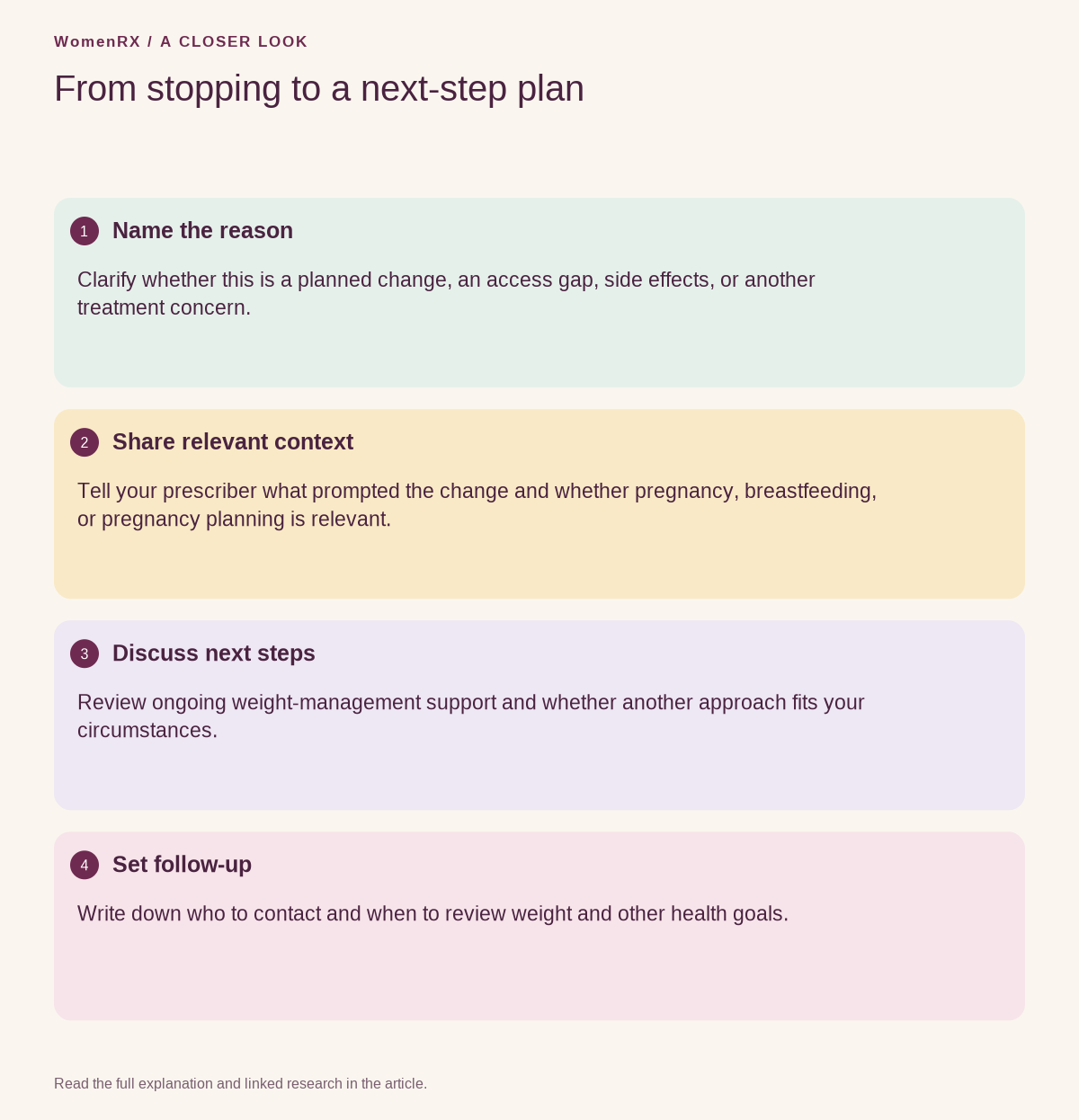
From stopping to a next-step plan
Name the reason: Clarify whether this is a planned change, an access gap, side effects, or another treatment concern.
Share relevant context: Tell your prescriber what prompted the change and whether pregnancy, breastfeeding, or pregnancy planning is relevant.
Discuss next steps: Review ongoing weight-management support and whether another approach fits your circumstances.
Set follow-up: Write down who to contact and when to review weight and other health goals.
Read the figure as text
Use the reason for stopping to shape a conversation about what comes next; the steps are a practical planning aid, not a prescribed medical protocol.- Name the reason: Clarify whether this is a planned change, an access gap, side effects, or another treatment concern.
- Share relevant context: Tell your prescriber what prompted the change and whether pregnancy, breastfeeding, or pregnancy planning is relevant.
- Discuss next steps: Review ongoing weight-management support and whether another approach fits your circumstances.
- Set follow-up: Write down who to contact and when to review weight and other health goals.
More questions, answered
If I’ve already stopped, is it too late to make a plan?
No. Contact your prescriber and explain when you stopped, why, and what has changed since. The real-world study followed people after discontinuation, but it doesn’t establish a single best next step for everyone. 3
Does the trial mean I should reduce my dose instead of stopping?
No. The trial compared assigned treatment groups in adults who had completed a 60-week tirzepatide period. Its results can inform a discussion, but they don’t determine which approach is suitable for you. 4
Sources you can check
- ZEPBOUND (TIRZEPATIDE) INJECTION, SOLUTION ZEPBOUND (TIRZEPATIDE) INJECTION, SOLUTION ZEPBOUND KWIKPEN (TIRZEPATIDE) INJECTION, SOLUTION [ELI LILLY AND COMPANY] | US prescribing information and patient instructionsAccessed 2026-09-25Return to first citation
- MOUNJARO (TIRZEPATIDE) INJECTION, SOLUTION MOUNJARO KWIKPEN (TIRZEPATIDE) INJECTION, SOLUTION [ELI LILLY AND COMPANY] | US prescribing information and patient instructionsAccessed 2026-09-25Return to first citation
- Real-world weight impact upon tirzepatide discontinuation at a single-center endocrinology clinic in patients with overweight or obesity.Huang L, Lee A, Kim D, Tungate Lopez S, Komé A, Yang A. · Journal of the American Pharmacists Association : JAPhA · 2026Return to first citation
- Tirzepatide for maintenance of bodyweight reduction in people with obesity in the USA (SURMOUNT-MAINTAIN): a multicentre, double-blind, randomised, placebo-controlled trial.Horn DB, Aronne LJ, Wharton S, Bays HE, le Roux CW, Srinath R, Gomez-Valderas E, Arad AD, Das S, Dunn JP, Ribeiro A, Glass LC, Lee CJ. · Lancet (London, England) · 2026Return to first citation