Stopping Semaglutide: Plan for What Comes Next
Studies of semaglutide and tirzepatide show differing weight patterns after treatment ends, so plan follow-up rather than relying on an average.
Studies combining people who stopped semaglutide or tirzepatide estimate average weight regain, but those estimates can’t predict your outcome or give a semaglutide-only forecast. 4 Before a pause or stop, agree with your prescriber on what you’ll monitor and when to check in. If pregnancy or breastfeeding is part of your plan, raise that before changing treatment. 1
Start with a plan, not a prediction
Stopping treatment doesn’t lead to the same outcome for everyone. In a real-world study of 4,182 people with a last documented prescription for semaglutide or tirzepatide, about two-thirds had stable weight or continued weight loss during the following six months. But a last prescription doesn’t prove that everyone stopped treatment. In a reviewed subset, discontinuation was documented for 119 people, and 72% of that group didn’t show weight regain during the study period. These findings describe one short-term real-world pattern, not a guarantee. 5
Other evidence shows average regain after discontinuation. A 2026 analysis combined six studies of semaglutide and tirzepatide, with 1,776 participants and observed follow-up ranging from 4 to 52 weeks. Its model estimated average regain of about 1.04 kg per month after stopping. The model projected that participants would regain half their initial loss by about 7.5 months. That is a pooled, model-based estimate, not an individual timeline or a semaglutide-only result. Projections beyond the studies’ observed follow-up are especially uncertain. 4
The real-world and pooled findings aren’t necessarily contradictory: they use different kinds of data, follow people for different periods, and don’t define treatment discontinuation in the same way. Together, they make a useful point for planning: regain is possible, but there’s no single outcome you should assume for yourself.
Decide what follow-up should cover
Before changing treatment, ask your prescriber to make the plan specific to why you take semaglutide and what matters to your health. If weight management is the main goal, discuss how you’ll notice meaningful changes without treating every fluctuation on the scale as a problem. Weight is only one part of health; a change can also reflect water, muscle, or other factors. 3
Agree on a way to check in about:
- Appetite and eating patterns: What changes are worth mentioning, and what support is available if hunger increases?
- Weight and function: Which overall trend matters to you, and are energy, strength, or daily activities changing too?
- Other health goals: If semaglutide is part of managing another condition, what should be monitored if treatment changes?
- Next steps: What will you do if weight or other health measures begin to shift, and when should you get back in touch?
Ask how often to follow up and what change should prompt an earlier conversation. The studies don’t establish one monitoring schedule for everyone. And although the pooled analysis found that lifestyle or behavioral support was directionally linked to slower regain, that estimate was imprecise. Support with eating, movement, sleep, or other routines may be useful, but it can’t be promised to prevent regain. 4
Make the reason for stopping part of the discussion
A pause or stop might be on your mind because of side effects, cost, changing health priorities, or pregnancy planning. Say what’s driving the decision. The next step may differ depending on whether you’re considering a temporary pause or a longer-term change. Don’t create your own taper or switch to another medicine based on a general weight-loss plan; ask your prescriber what, if anything, should change and how to follow up.
If you’re considering a supplement as a replacement, be cautious about assuming that a product marketed for weight loss is an effective substitute. NIH’s Office of Dietary Supplements says evidence for many weight-loss supplements is limited or inconsistent, and some products may cause harm or interact with medicines. 2
If pregnancy is part of the plan
Tell your prescriber if you’re trying to conceive or thinking about pregnancy. The U.S. Wegovy prescribing information says to discontinue Wegovy at least two months before a planned pregnancy because semaglutide has a long half-life. That instruction is specific to Wegovy’s prescribing information; ask how it applies to your own product and circumstances. 1
If you’re pregnant, planning to breastfeed, or breastfeeding, ask for a treatment plan that covers those stages. The information here doesn’t establish what to do during breastfeeding, so get advice specific to your situation rather than assuming that pregnancy and breastfeeding have the same guidance.
A useful starting question is: “If I stop or pause, what should we keep an eye on, and when should we revisit the plan?” If your weight changes unexpectedly, mention it rather than treating it as a personal failure. The point of follow-up is to respond to what’s actually happening and adjust the plan together. 3
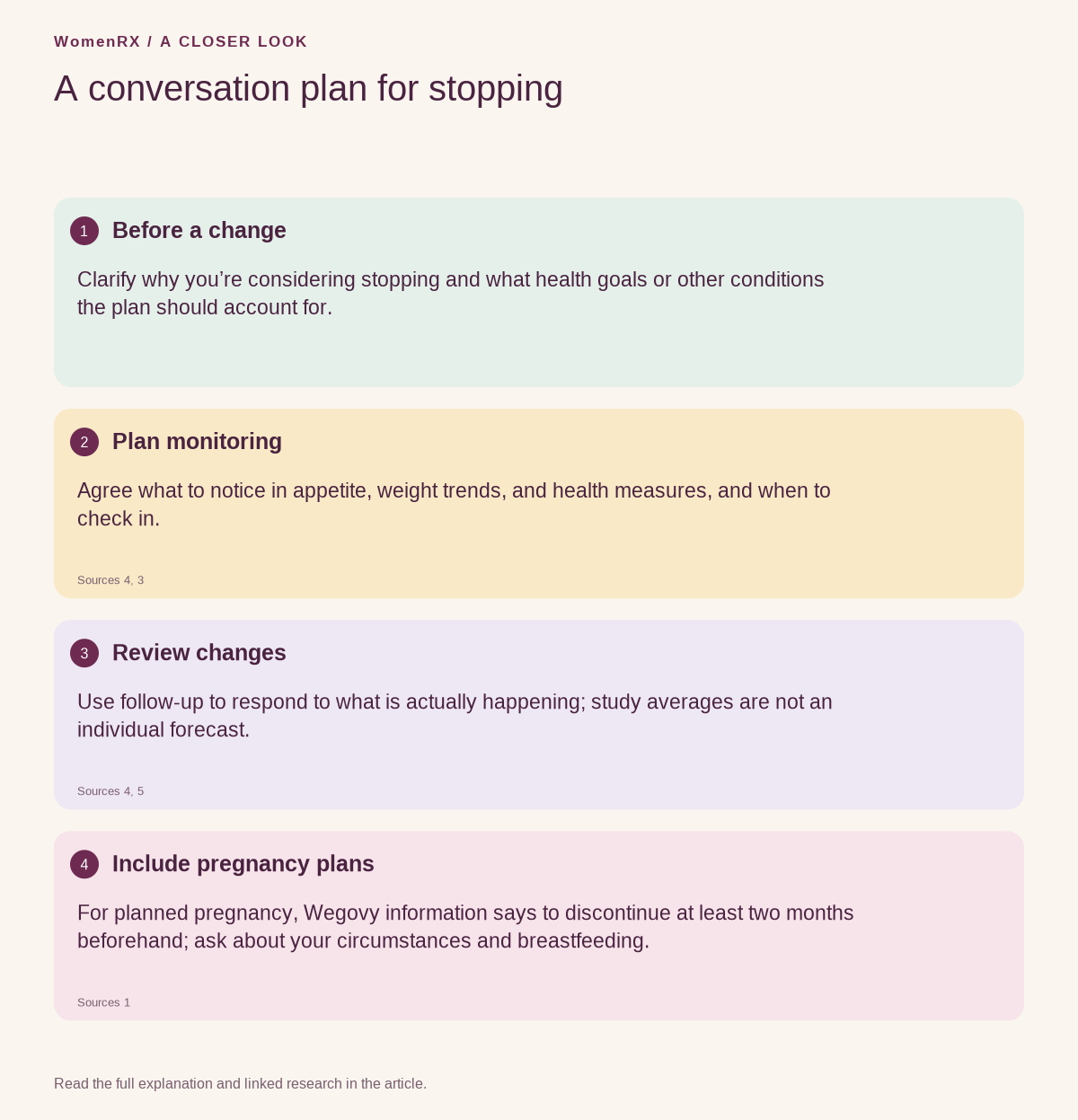
A conversation plan for stopping
Before a change: Clarify why you’re considering stopping and what health goals or other conditions the plan should account for.
Plan monitoring: Agree what to notice in appetite, weight trends, and health measures, and when to check in.43
Review changes: Use follow-up to respond to what is actually happening; study averages are not an individual forecast.45
Include pregnancy plans: For planned pregnancy, Wegovy information says to discontinue at least two months beforehand; ask about your circumstances and breastfeeding.1
Read the figure as text
A sequence of useful discussions around a possible pause or stop. It is a planning aid, not a prescribed taper or follow-up schedule.- Before a change: Clarify why you’re considering stopping and what health goals or other conditions the plan should account for.
- Plan monitoring: Agree what to notice in appetite, weight trends, and health measures, and when to check in.43
- Review changes: Use follow-up to respond to what is actually happening; study averages are not an individual forecast.45
- Include pregnancy plans: For planned pregnancy, Wegovy information says to discontinue at least two months beforehand; ask about your circumstances and breastfeeding.1
More questions, answered
Does everyone regain weight after stopping semaglutide?
Not necessarily. A pooled analysis estimated average weight regain after stopping semaglutide or tirzepatide, but an average doesn’t tell you how many individuals regained weight or establish a semaglutide-only outcome. 4 In a real-world study, many people had stable weight or continued losing weight in the six months after their last documented prescription. That study included both medicines and did not confirm discontinuation for everyone, so it can’t predict your outcome. 5
When should I stop Wegovy if I’m planning a pregnancy?
Wegovy’s U.S. prescribing information says to discontinue it at least two months before a planned pregnancy. Ask your prescriber to apply that guidance to your treatment and discuss a plan for pregnancy or breastfeeding. 1
Sources you can check
- WEGOVY (SEMAGLUTIDE) INJECTION, SOLUTION WEGOVY (SEMAGLUTIDE) TABLET [NOVO NORDISK PHARMACEUTICAL INDUSTRIES, LP] | US prescribing information and patient instructionsAccessed 2026-09-25Return to first citation
- Dietary Supplements for Weight Loss - Health Professional Fact SheetAccessed 2026-09-25Return to first citation
- Body Weight: MedlinePlusAccessed 2026-09-25Return to first citation
- Weight Regain Trajectories After Discontinuation of Semaglutide or Tirzepatide: A Reconstructed Aggregate-Data Bayesian Longitudinal Meta-Analysis.Kow CS, Thiruchelvam K, Ramachandram DS, Zaihan AF. · Endocrinology, diabetes & metabolism · 2026Return to first citation
- Weight trajectories after last tirzepatide or semaglutide prescription across a federated health network.Murugadoss K, Varma G, Venkatakrishnan AJ, Gibson CM, Soundararajan V. · Biology methods & protocols · 2026Return to first citation