Stopping Ozempic: Plan for Glucose, Weight, and Follow-Up
Weight-regain studies after stopping GLP-1 medicines don’t tell you exactly what your blood sugar will do.
Stopping Ozempic doesn’t have one predictable effect. If you take it for type 2 diabetes, weight changes reported after GLP-1 drug withdrawal don’t show what your glucose will do. Ask your prescriber what monitoring and treatment plan fit your reason for taking it, especially after an interruption or when planning pregnancy or breastfeeding. 125
Start with the reason you take it
Ozempic may be part of a plan for type 2 diabetes, and its prescribing information includes clinical trials focused on glycemic control. A plan for stopping or interrupting treatment should begin with the condition it’s treating and what you and your prescriber want to keep track of. If you take it for more than one reason, name each one. 1
You might be considering a change because of side effects, cost, access, pregnancy plans, or a change in your priorities. Those are different situations, and they may call for different follow-up questions. The useful next step is to tell your prescriber what has changed and ask what to monitor and when to check back.
If you’ve already had a gap in treatment, share when you last took a dose and ask what to do next. The label includes instructions for a missed dose, but those instructions aren’t a personalized plan for an extended interruption. 1
Keep weight and glucose evidence separate
A review of six trials involving 8,993 adults with overweight or obesity found weight regain after stopping GLP-1 medicines compared with continuing treatment. The analysis included more than one medication, including semaglutide and tirzepatide. Its results describe group-level weight outcomes, not a guaranteed outcome for an individual taking Ozempic. The review also reported substantial variation between studies and judged the evidence low to very low quality. 5
That evidence can help set realistic expectations about weight, but it doesn’t answer what will happen to your blood glucose after stopping. The withdrawal analysis reported weight outcomes, not a dependable estimate of post-treatment glucose change. Weight and glucose are related parts of health, but one study outcome shouldn’t be used as a stand-in for the other. 15
For follow-up, ask separately: “How should we check my blood sugar?” and “What should we watch for in my weight or other health goals?” If you take Ozempic for diabetes, ask whether your current treatment plan needs to change. The studies summarized here can’t determine the right plan for you.
Add pregnancy and breastfeeding to the conversation
If you’re planning a pregnancy, bring it up before changing treatment. A review focused on women with polycystic ovary syndrome says semaglutide should be discontinued before planned conception, while also describing the evidence as preliminary and drawn from varied, often small or observational studies. A broader systematic review likewise says evidence on pregnancy outcomes remains limited. Ask your prescriber to discuss timing for your circumstances rather than relying on a general interval. 34
If you’re breastfeeding, ask about both your treatment and your diabetes or weight-management plan. A systematic review reports that semaglutide was not detected in milk samples from mothers treated for at least three weeks, but this is limited transfer evidence, not a complete answer about infant safety. The same review describes clinical guidance as inconsistent and evidence as scarce. 2
These decisions aren’t identical for every woman. The reason for treatment, pregnancy plans, breastfeeding, and the rest of your health picture all belong in the discussion. There’s no need to assume that weight changes or glucose changes will follow the same pattern for everyone.
Questions that make follow-up more useful
You could ask:
- What is the main goal of this medicine in my treatment plan?
- If I stop or have already missed doses, what should I do next?
- What glucose checks or follow-up would make sense for me?
- If weight changes, how should we interpret them alongside my other health goals?
- How should pregnancy planning or breastfeeding affect the plan?
The aim isn’t to predict a particular result. It’s to make sure your next steps address the condition the medicine was treating and include follow-up that fits your situation.
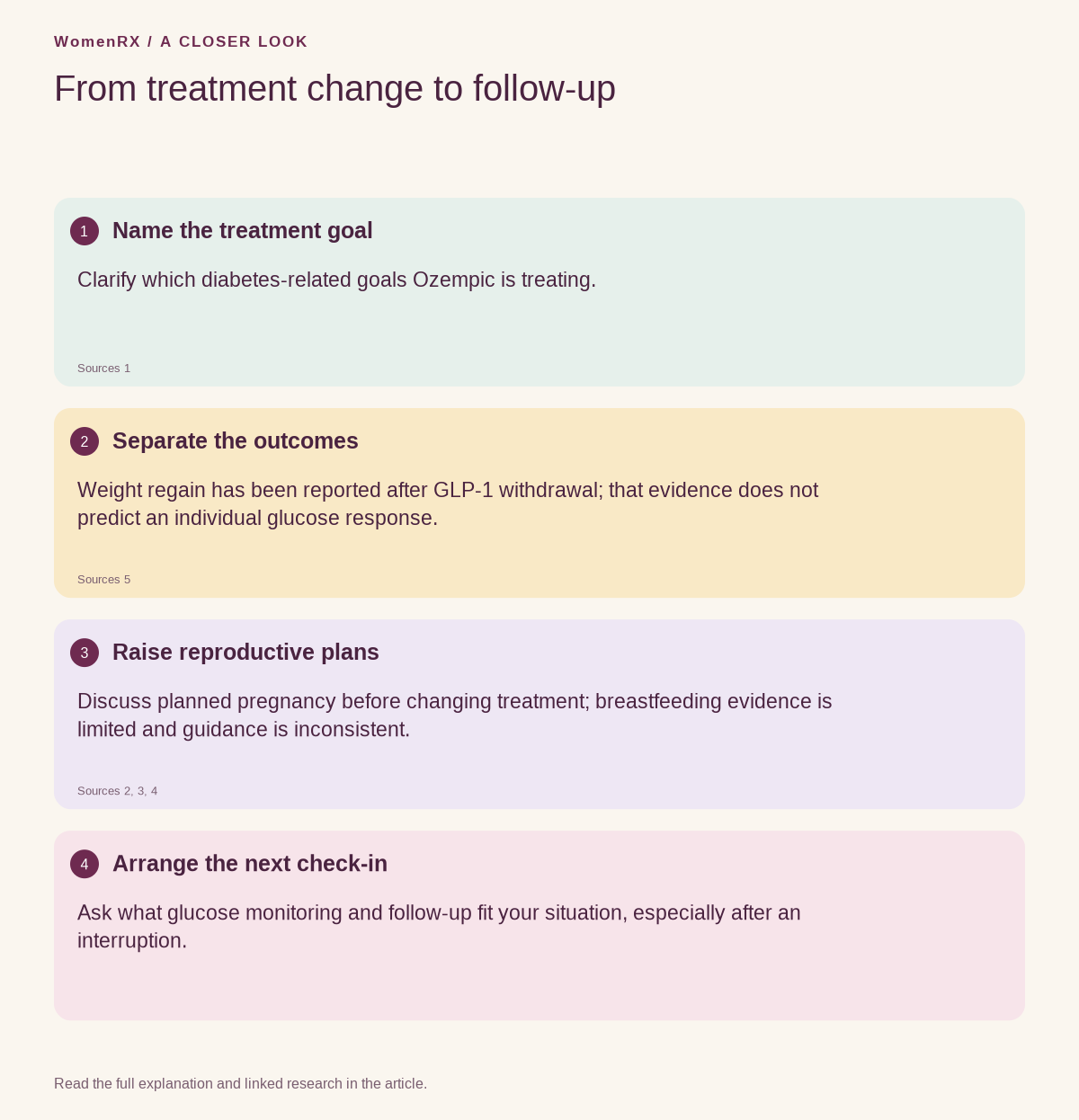
From treatment change to follow-up
Name the treatment goal: Clarify which diabetes-related goals Ozempic is treating.1
Separate the outcomes: Weight regain has been reported after GLP-1 withdrawal; that evidence does not predict an individual glucose response.5
Raise reproductive plans: Discuss planned pregnancy before changing treatment; breastfeeding evidence is limited and guidance is inconsistent.234
Arrange the next check-in: Ask what glucose monitoring and follow-up fit your situation, especially after an interruption.
Read the figure as text
Use the reason for the change to shape a prescriber discussion about the condition being treated, relevant monitoring, and reproductive plans.- Name the treatment goal: Clarify which diabetes-related goals Ozempic is treating.1
- Separate the outcomes: Weight regain has been reported after GLP-1 withdrawal; that evidence does not predict an individual glucose response.5
- Raise reproductive plans: Discuss planned pregnancy before changing treatment; breastfeeding evidence is limited and guidance is inconsistent.234
- Arrange the next check-in: Ask what glucose monitoring and follow-up fit your situation, especially after an interruption.
More questions, answered
Will my blood sugar definitely rise if I stop Ozempic?
That can’t be predicted from weight-regain findings. The withdrawal analysis reported weight outcomes, not a reliable estimate of blood-glucose changes after stopping. If you take Ozempic for diabetes, ask your prescriber what glucose monitoring and treatment follow-up fit your situation. 15
Sources you can check
- OZEMPIC (SEMAGLUTIDE) INJECTION, SOLUTION [A-S MEDICATION SOLUTIONS] | US prescribing information and patient instructionsAccessed 2026-09-25Return to first citation
- Maternal-to-Infant Transfer of Medications for Type 2 Diabetes Mellitus Via Breastmilk: A Systematic Review of Available Evidence and Clinical Guidelines.Richardson K, Kiptoo J, Mpora Odongkara B, Ojara FW, Waitt C. · Clinical pharmacology and therapeutics · 2026Return to first citation
- Efficacy and Safety of Semaglutide in Patients with Polycystic Ovary Syndrome: A Scoping Review.La Vignera S, Condorelli RA. · Biomedicines · 2026Return to first citation
- Safety of GLP-1 and Dual GLP-1/GIP Receptor Agonists in Preconception, Pregnancy, and Lactation: A Systematic Review of Maternal, Fetal, and Neonatal Outcomes.Ozbek L, Shah E, Al-Shiab R, Inal A, Guldan M, Afsar B, Covic A, Kanbay M. · Diabetes, obesity & metabolism · 2026Return to first citation
- Weight regain following discontinuation of glucagon-like peptide-1 receptor agonists in adults who are overweight or obese: a systematic review and meta-analysis.Qi H, Gao Q, Chen H, Du X, Pan B. · PeerJ · 2026Return to first citation