Stopping Mounjaro: Make a Plan for Diabetes Care
If Mounjaro is part of your type 2 diabetes treatment, plan what will replace its role and how you’ll check your glucose before changing course.
Stopping Mounjaro is a diabetes-care decision as well as a possible weight-management decision. If it’s helping manage your blood glucose, ask the prescriber what to do next, whether another treatment is needed, and how often to check your glucose. The cited 40-week trial reports glucose improvement during treatment, not what happens after stopping or on what timeline. 12
Start with the reason you’re considering a change
Your next step depends on why you’re thinking about stopping. Side effects, cost, difficulty getting the medication, a change in your treatment goals, and pregnancy or plans to conceive are different situations. Tell the prescriber what’s driving the decision and whether you’ve already stopped or missed doses. If you’re pregnant, breastfeeding, or planning to conceive, raise that before changing treatment and ask how it affects your care plan. MedlinePlus describes gestational diabetes as a distinct form of diabetes and advises discussing treatment options during pregnancy; it doesn’t provide tirzepatide-specific guidance or address breastfeeding or conception planning. 2
If Mounjaro is being used to help manage type 2 diabetes, don’t treat stopping as only a question about weight. In a 40-week trial in adults with type 2 diabetes whose blood glucose wasn’t adequately controlled with diet and exercise, Mounjaro lowered average A1C during treatment. That trial describes people taking it; it doesn’t predict what your glucose will do after you stop. 1
Agree on the next step, not just the stop date
Ask the prescriber to help you make a plan that covers three things:
- What’s the treatment plan now? Ask whether to continue, change, or replace the diabetes treatment, and who will help arrange that next step. Don’t start, stop, or restart based on weight-loss advice intended for a different situation.
- What glucose checks are needed? Checking blood glucose is part of diabetes management, but the right method and frequency depend on your care plan. Ask what to check, how often, and what readings should prompt you to get in touch. 2
- When should you follow up? Set a specific follow-up plan, including who to contact if you can’t reach the usual prescriber or if you’re having trouble obtaining the medication.
The 40-week trial described above measured improvement during treatment, not the course of glucose levels after discontinuation. Your clinician can tailor monitoring and next steps to your diabetes history and other medicines. 1
If you’ve missed a dose
A missed dose isn’t necessarily the same as deciding to stop. The Mounjaro Medication Guide says that if a dose is missed, it can be taken within four days (96 hours); after that, skip it and take the next dose on the regular day. It also says not to take two doses within three days (72 hours) of each other. If you’ve missed more than one dose, are unsure how long it’s been, or have already stopped, contact your prescriber or pharmacist for advice about your circumstances rather than guessing. 1
Keep weight goals in the conversation, too
If weight management is also part of your reason for using Mounjaro, say so. It can be a separate goal from blood-glucose control, and a plan that addresses one may not answer the other. Be clear about which outcomes matter to you, what has made treatment difficult, and what you’re hoping to change. The immediate priority is a coordinated plan for diabetes care, monitoring, and follow-up, not an assumption that weight is the only concern.
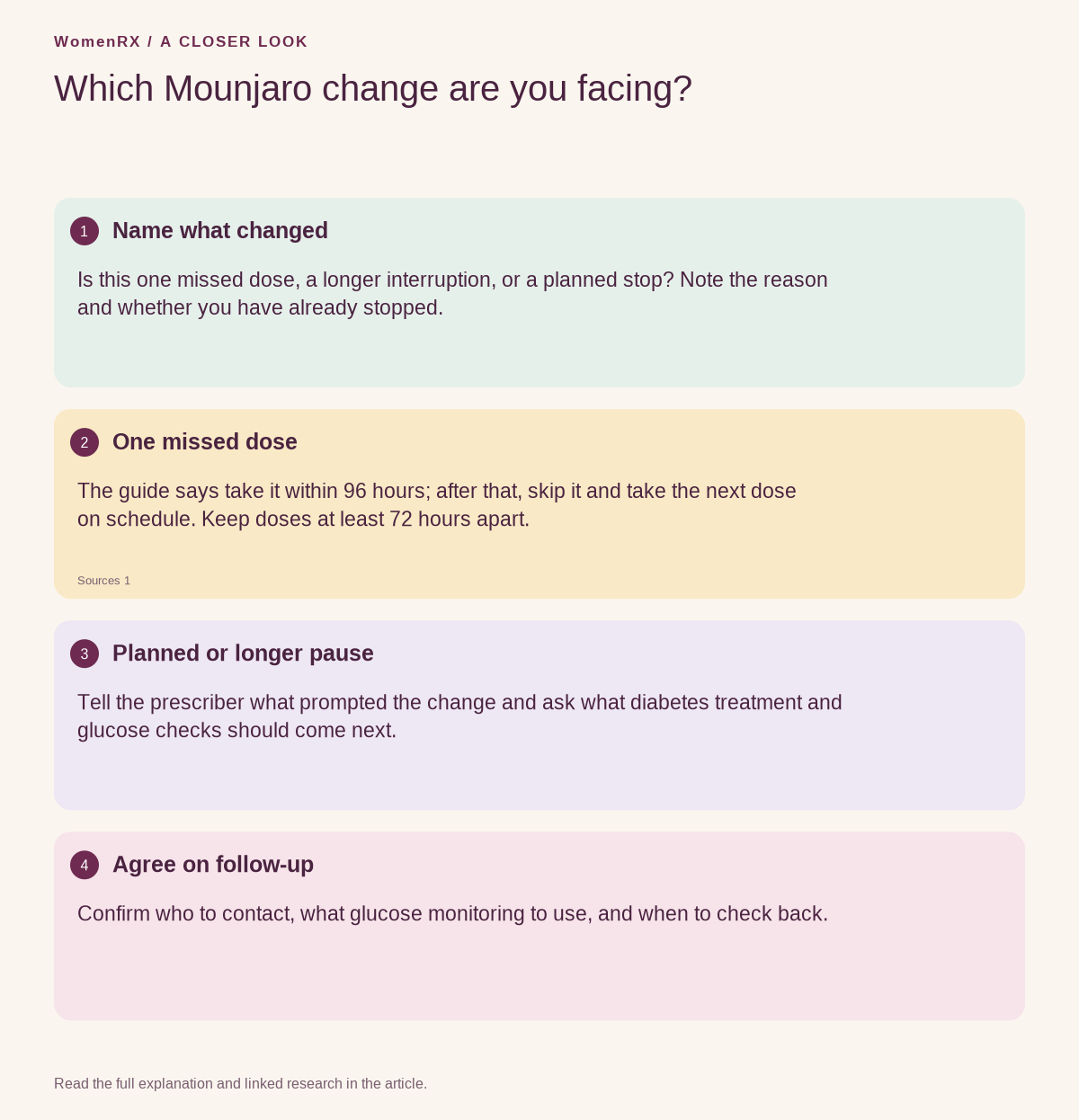
Which Mounjaro change are you facing?
Name what changed: Is this one missed dose, a longer interruption, or a planned stop? Note the reason and whether you have already stopped.
One missed dose: The guide says take it within 96 hours; after that, skip it and take the next dose on schedule. Keep doses at least 72 hours apart.1
Planned or longer pause: Tell the prescriber what prompted the change and ask what diabetes treatment and glucose checks should come next.
Agree on follow-up: Confirm who to contact, what glucose monitoring to use, and when to check back.
Read the figure as text
Start with what happened: a single missed dose follows the Medication Guide’s missed-dose instructions; a planned stop or longer interruption calls for a separate conversation about diabetes care and follow-up.- Name what changed: Is this one missed dose, a longer interruption, or a planned stop? Note the reason and whether you have already stopped.
- One missed dose: The guide says take it within 96 hours; after that, skip it and take the next dose on schedule. Keep doses at least 72 hours apart.1
- Planned or longer pause: Tell the prescriber what prompted the change and ask what diabetes treatment and glucose checks should come next.
- Agree on follow-up: Confirm who to contact, what glucose monitoring to use, and when to check back.
More questions, answered
What should I ask if I’m stopping because of side effects or access problems?
Explain what’s making treatment difficult and ask what the next diabetes-care step should be, including whether your glucose checks need to change. The cited 40-week trial reports glucose improvement during treatment, so it can’t predict what your readings will do after stopping. 1
Does a missed dose mean I should stop treatment?
Not necessarily. The Mounjaro Medication Guide says to take a missed dose within 96 hours; if more time has passed, skip it and take the next dose on the regular day. It also says not to take doses less than 72 hours apart. For a longer interruption or uncertainty, ask your prescriber or pharmacist what applies to you. 1