Exercising on Mounjaro: Let Symptoms Shape the Plan
Nausea, low intake, or a risk of low blood sugar can change how a workout feels, so plan around how you’re doing and which other medicines you take.
You can plan activity while taking Mounjaro, but let symptoms and your medication mix guide the day. If nausea, vomiting, or diarrhea makes eating or drinking difficult, consider easier movement or rest. Low blood sugar is a particular concern if you also use insulin or certain other diabetes medicines. If your glucose is low, stop exercising, take a quick source of sugar, and recheck it after 10 to 15 minutes. 1 2 3 5
Start with how you feel today
Mounjaro (tirzepatide) can cause nausea, vomiting, diarrhea, constipation, and reduced appetite. Those effects may matter when you’re deciding whether a planned workout feels manageable, especially if you’re eating or drinking much less than usual. 4 5
A cautious way to respond is to scale back, choose gentle movement, or rest if you feel unwell or aren’t keeping fluids down. For example, you might swap a demanding session for an easy walk if you feel comfortable walking, or skip the session if nausea or diarrhea is significant. These are practical ways to respond to symptoms, not exercise instructions tested specifically with Mounjaro. The medication’s prescribing information warns that gastrointestinal symptoms can lead to dehydration and advises promptly reporting persistent nausea, vomiting, or diarrhea. 3
The goal isn’t to force a workout through a rough day. If symptoms keep interfering with eating, drinking, or your usual activity, contact the clinician managing your medication to discuss what’s going on.
Check your other diabetes medicines
Mounjaro by itself doesn’t make low blood sugar inevitable. In placebo-controlled adult type 2 diabetes trials lasting 40 weeks, blood glucose below 54 mg/dL was reported by 0% of participants taking Mounjaro alone, compared with 1% taking placebo. In trial groups also taking basal insulin, the corresponding figures were 14% to 19% across Mounjaro doses and 13% with placebo. Severe episodes were reported in 0% to 2% of Mounjaro groups and 0% with placebo. These are trial results, not a prediction of what will happen during your workout. 3
Your personal low-glucose risk depends in part on your other diabetes medicines. Insulin is a clear example; the trial results show why it matters to consider the combination, rather than blaming Mounjaro alone. 2 3
Shaking, hunger, and confusion can be signs of low blood glucose. For many people with diabetes, a reading below 70 mg/dL is considered low, though your own threshold may differ. If these symptoms start during a workout, stop and check your glucose if you can. If it’s low, or you have diabetes and symptoms make you think it may be low, take something that raises glucose quickly, such as a small glass of fruit juice or glucose tablets. Recheck after 10 to 15 minutes. Once you feel better and your glucose has come back up, eat something that will help keep it up, such as a sandwich or your next meal if it’s due. Follow your own low-glucose plan if you have one. 1 2
If you use insulin or another medicine that can lower glucose, ask your diabetes care team how to handle glucose checks and low-glucose episodes around your usual activity. Your plan should reflect your medication combination and personal glucose targets, not a one-size-fits-all rule. 2 3
Strength and muscle: what the evidence can tell you
If you’re in midlife or later life and want to maintain strength, don’t assume that a change in body weight tells you whether you’ve maintained muscle. Weight-loss treatment can involve changes in body composition, and expert consensus on GLP-1-based therapies includes physical activity and body composition among its considerations. The consensus also notes that many practical recommendations rely on indirect evidence rather than direct studies. 5 6
A 72-week trial in Japanese adults with obesity disease studied tirzepatide alongside reduced-calorie eating and increased physical activity, and reported improvements in body composition. That result doesn’t isolate the effect of exercise, and the information reported doesn’t give a women-specific strength or muscle-preservation plan. 7
A separate 12-month observational program included people using tirzepatide or semaglutide, with women making up 82% of the combined group. Participants reported more weekly exercise over time, but the study doesn’t show that exercise prevented muscle loss or establish which routine works best on tirzepatide. 6
If preserving strength is a priority, consider fitting strength activity around days when eating, drinking, and symptoms are manageable. Make room for recovery when symptoms disrupt your usual activity, and raise nutrition with your care team if reduced appetite makes eating difficult. That’s a practical approach, not a proven Mounjaro-specific way to prevent muscle loss. 5 6
A quick check before you start
Use these questions as a flexible check, not a validated score:
- How do I feel? If nausea, vomiting, or diarrhea is affecting you, consider easing up or resting rather than forcing the planned session. 3 5
- Can I keep fluids down? Persistent gastrointestinal symptoms can contribute to dehydration; report symptoms that persist to the clinician managing your treatment. 3
- What else do I take? Insulin and other glucose-lowering medicines matter when thinking about low blood sugar. 2 3
- Do I feel low? Stop exercising if shaking, hunger, or confusion suggests low glucose. Check it if you can; if it’s low, take a quick source of sugar and recheck after 10 to 15 minutes. 1 2
There isn’t one exercise decision that fits every day. A useful plan accounts for symptoms, glucose risk, and your own goals for strength and function.
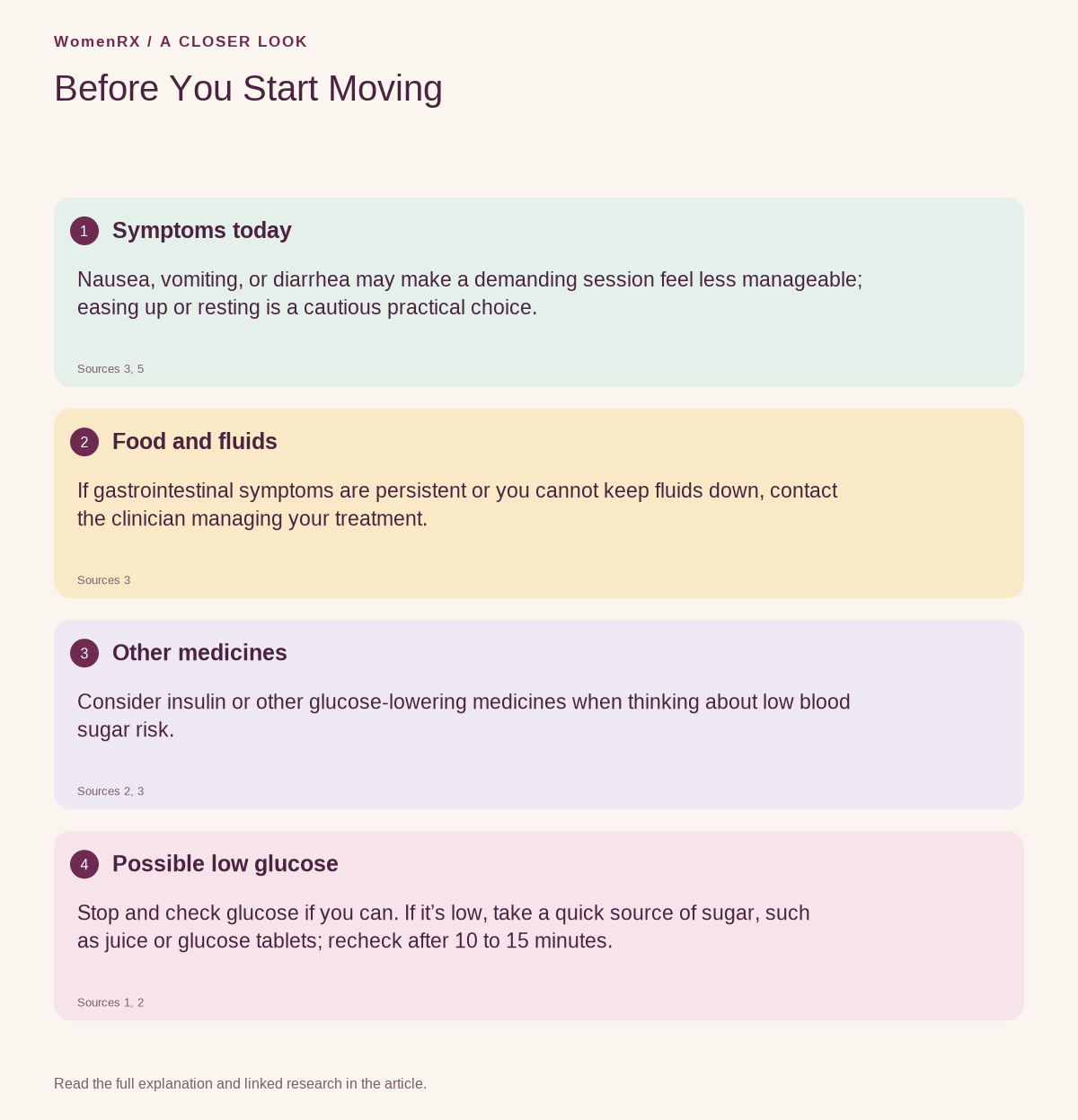
Before You Start Moving
Symptoms today: Nausea, vomiting, or diarrhea may make a demanding session feel less manageable; easing up or resting is a cautious practical choice.35
Food and fluids: If gastrointestinal symptoms are persistent or you cannot keep fluids down, contact the clinician managing your treatment.3
Other medicines: Consider insulin or other glucose-lowering medicines when thinking about low blood sugar risk.23
Possible low glucose: Stop and check glucose if you can. If it’s low, take a quick source of sugar, such as juice or glucose tablets; recheck after 10 to 15 minutes.12
Read the figure as text
A flexible symptom and medication check for deciding whether to follow, ease, or pause a planned activity session.- Symptoms today: Nausea, vomiting, or diarrhea may make a demanding session feel less manageable; easing up or resting is a cautious practical choice.35
- Food and fluids: If gastrointestinal symptoms are persistent or you cannot keep fluids down, contact the clinician managing your treatment.3
- Other medicines: Consider insulin or other glucose-lowering medicines when thinking about low blood sugar risk.23
- Possible low glucose: Stop and check glucose if you can. If it’s low, take a quick source of sugar, such as juice or glucose tablets; recheck after 10 to 15 minutes.12
More questions, answered
Should I work out on the day I take Mounjaro?
Let how you feel that day guide the decision. If gastrointestinal symptoms are making it hard to eat or drink, consider an easier session or rest. If you also take medicine that can lower glucose, use your individual plan for checking and managing it around activity. 2 3 5
Sources you can check
- Low blood sugar (hypoglycaemia) - NHSAccessed 2026-09-25Return to first citation
- Blood Glucose | Blood Sugar | Diabetes | MedlinePlusAccessed 2026-09-25Return to first citation
- MOUNJARO (TIRZEPATIDE) INJECTION, SOLUTION MOUNJARO KWIKPEN (TIRZEPATIDE) INJECTION, SOLUTION [ELI LILLY AND COMPANY] | US prescribing information and patient instructionsAccessed 2026-09-25Return to first citation
- Tirzepatide: A Review in Type 2 Diabetes.France NL, Syed YY. · Drugs · 2024Return to first citation
- Nutritional and lifestyle supportive care recommendations for management of obesity with GLP-1 - based therapies: An expert consensus statement using a modified Delphi approach.Sievenpiper JL, Ard J, Blüher M, Chen W, Dixon JB, Fitch A, Gigliotti L, Khunti K, Lecube A, Lean MEJ, Mittendorfer B, Pfeiffer AFH, Ryan DH, Vilsbøll T, Van Gaal LF. · Obesity pillars · 2026Return to first citation
- Semaglutide and Tirzepatide in a Remote Weight Management Program: 12-Month Retrospective Observational Study.Richards R, Lunt W, Whitman M, Spaltro G, Hall R. · JMIR formative research · 2025Return to first citation
- Experience with Tirzepatide and Weight Management During and After a Clinical Trial in Japanese Patients with Obesity Disease: A Qualitative Study.Kiyosue A, Sato M, Cai Z, Fukushima Y, Takai M, Takahashi T, Nagashima H, Suo S, Takeda R, Shimoura K, Shingaki T. · Advances in therapy · 2026Return to first citation