What Mounjaro’s Kidney Safety Evidence Shows
The clearest kidney concern is acute injury after fluid loss from ongoing nausea, vomiting, or diarrhea, though a network meta-analysis of clinical trials also found a small signal at higher doses.
Mounjaro (tirzepatide) is not established as directly toxic to the kidneys, but kidney injury has been reported, often alongside dehydration from gastrointestinal side effects. A 2026 analysis of clinical trials also found a small increase in acute kidney injury with higher-dose tirzepatide compared with controls. Persistent vomiting or diarrhea deserves prompt attention, especially if you have kidney disease or are losing fluids. 1 3
Two different kidney questions
When people ask whether Mounjaro harms the kidneys, they may mean two things: can the drug directly injure kidney tissue, or can side effects lead to dehydration that strains the kidneys? The clearest warning in U.S. prescribing information is about the second pathway. Postmarketing reports of acute kidney injury, including some cases requiring dialysis, have occurred with Mounjaro and other GLP-1 medicines. Most reported events involved nausea, vomiting, or diarrhea that led to dehydration. Reports like these raise a safety concern, but they do not by themselves prove what caused each injury. 1
A separate 2026 network meta-analysis of 67 randomized trials, involving 199,877 participants across several medicines, found a possible dose-specific signal: tirzepatide in the 10-15 mg-per-week range was associated with a 0.28-percentage-point higher risk of acute kidney injury than control treatments. This is a small absolute difference, and a finding from a combined analysis is not proof that tirzepatide directly damages kidneys. It does mean the evidence is more nuanced than “there’s no kidney risk.” 3
How stomach symptoms can affect the kidneys
Vomiting and diarrhea can drain more fluid than you’re able to replace. When fluid loss becomes significant, dehydration can affect how well the body functions, including kidney function. The medicine’s prescribing information specifically advises monitoring kidney function when side effects could cause fluid depletion, particularly when treatment is being started or increased. 1 2
This is why the pattern and persistence of symptoms matter more than assuming every brief bout of nausea signals kidney injury. Feeling very thirsty or dizzy can be a sign of dehydration. If nausea, vomiting, or diarrhea continues or makes it hard to keep up with fluids, contact your prescriber promptly rather than waiting for a routine follow-up. 1 2
What the evidence can and can’t tell you
Postmarketing reports help identify problems that may happen in real-world use, but they can’t reliably show how often an event occurs or whether the medicine caused it. Randomized trials offer a different kind of evidence. The 2026 analysis found a higher acute kidney injury signal only for higher-dose tirzepatide, but it combined many trials and medicines. That result is worth discussing, not a reason to assume every person taking Mounjaro will have kidney problems. 1 3
These findings also don’t establish a women-specific kidney effect or tell us how kidney safety differs during pregnancy or after childbirth. If you have a known kidney condition, tell your prescriber so monitoring can be tailored to your history. 1
When to seek advice
Call your prescriber promptly if you have persistent or extended nausea, vomiting, or diarrhea, particularly if you’re struggling to drink enough. Be clear about when the symptoms began and whether you can keep fluids down. The prescribing information calls for kidney-function monitoring when side effects may cause fluid depletion, especially during treatment initiation and dose increases. 1
Confusion or signs of shock alongside dehydration call for immediate medical help. 2 If you have known kidney disease, ask what monitoring makes sense for your history; the official warning specifically ties monitoring to fluid-depleting side effects rather than establishing one schedule for everyone. 1
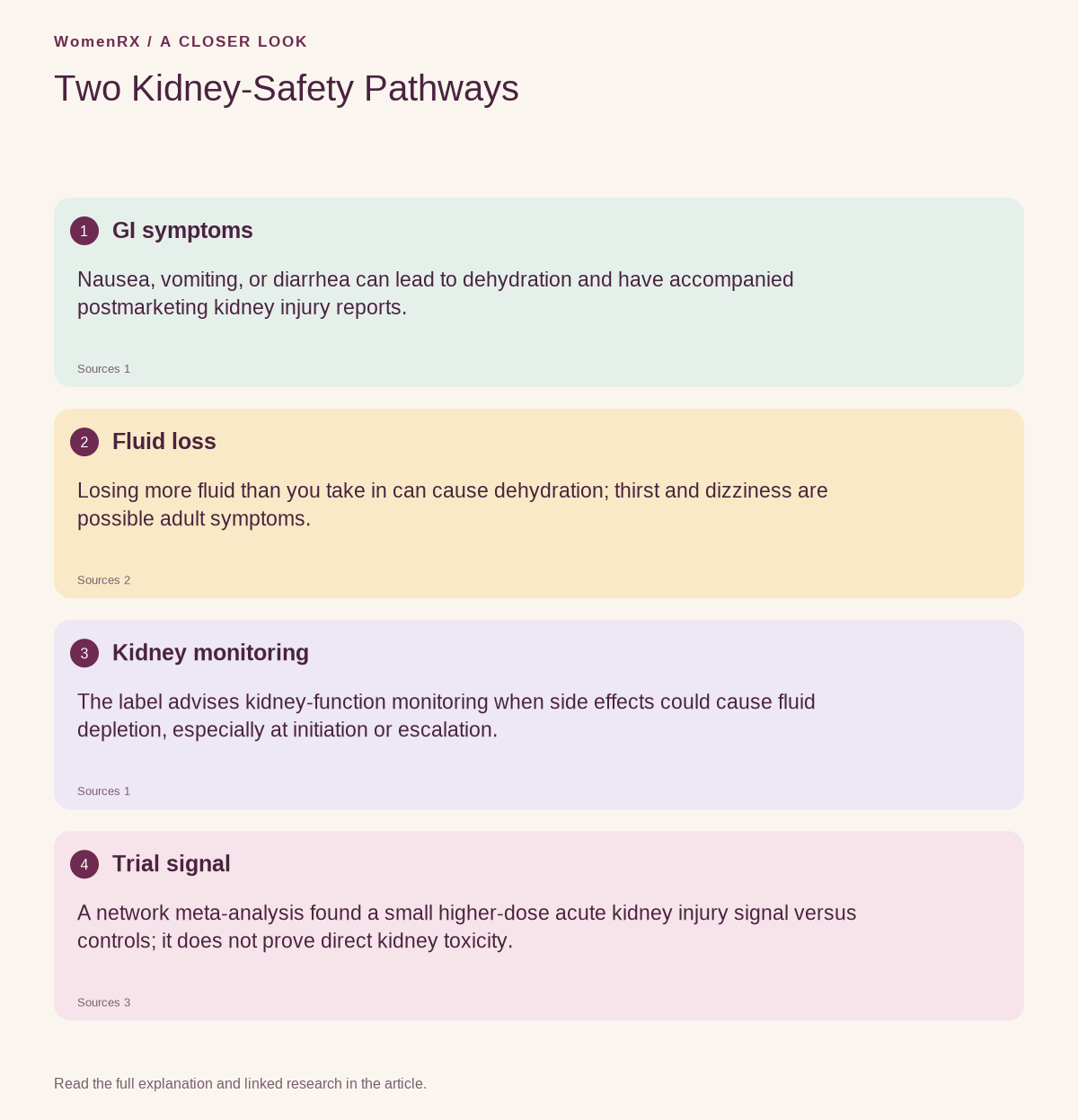
Two Kidney-Safety Pathways
GI symptoms: Nausea, vomiting, or diarrhea can lead to dehydration and have accompanied postmarketing kidney injury reports.1
Fluid loss: Losing more fluid than you take in can cause dehydration; thirst and dizziness are possible adult symptoms.2
Kidney monitoring: The label advises kidney-function monitoring when side effects could cause fluid depletion, especially at initiation or escalation.1
Trial signal: A network meta-analysis found a small higher-dose acute kidney injury signal versus controls; it does not prove direct kidney toxicity.3
Read the figure as text
This figure distinguishes the dehydration pathway described in the prescribing information from the dose-specific signal reported in a trial analysis.- GI symptoms: Nausea, vomiting, or diarrhea can lead to dehydration and have accompanied postmarketing kidney injury reports.1
- Fluid loss: Losing more fluid than you take in can cause dehydration; thirst and dizziness are possible adult symptoms.2
- Kidney monitoring: The label advises kidney-function monitoring when side effects could cause fluid depletion, especially at initiation or escalation.1
- Trial signal: A network meta-analysis found a small higher-dose acute kidney injury signal versus controls; it does not prove direct kidney toxicity.3
More questions, answered
Does kidney disease automatically rule out Mounjaro?
The findings don’t establish that kidney disease automatically rules it out. They do support telling your prescriber about your kidney history and promptly reporting ongoing symptoms that could dehydrate you, so monitoring can reflect your circumstances. 1
Does the higher-dose finding mean Mounjaro directly damages kidneys?
No. The trial analysis found a small increase in acute kidney injury with higher-dose tirzepatide versus controls, but it doesn’t prove a direct toxic effect or show that this will happen to an individual. 3
Sources you can check
- MOUNJARO (TIRZEPATIDE) INJECTION, SOLUTION MOUNJARO KWIKPEN (TIRZEPATIDE) INJECTION, SOLUTION [ELI LILLY AND COMPANY] | US prescribing information and patient instructionsAccessed 2026-09-25Return to first citation
- Dehydration: MedlinePlusAccessed 2026-09-25Return to first citation
- Differential Acute Kidney Injury Profiles of GLP-1RAs and SGLT2is: A Network Meta-Analysis.Liang CS, Hsu CW, Chen JJ, Hung CM, Zeng BY, Yang WC, Suen MW, Wang HY, Carvalho AF, Stubbs B, Chen YW, Chen TY, Lei WT, Hsu SP, Shiue YL, Li CT, Su KP, Zeng BS, Tseng PT. · International journal of molecular sciences · 2026Return to first citation