What We Know About Zepbound and Kidney Safety
The main established kidney concern is acute injury linked to fluid loss from ongoing nausea, vomiting, or diarrhea, while studies of kidney outcomes offer a more mixed, still-developing picture.
Zepbound’s prescribing information describes reports of acute kidney injury, most often in people whose nausea, vomiting, or diarrhea led to dehydration. Short-term trials pooled in a 2025 review did not find more acute kidney injury, but a separate 2026 analysis found a possible high-dose signal. These findings address different evidence sets and don’t guarantee safety for every person. 1 4 2
Two kidney questions, not one
“Kidney safety” can mean two different things: whether a treatment can contribute to a sudden episode of acute kidney injury (AKI), or whether it changes kidney measures and longer-term kidney outcomes. Those questions shouldn’t be collapsed into a single yes-or-no verdict.
For Zepbound, the clearest practical concern in the US prescribing information is fluid loss. The label reports cases of AKI after treatment with GLP-1 medicines, including Zepbound. Most reported cases involved nausea, vomiting, or diarrhea that led to dehydration. That pattern makes a fluid-loss pathway a key concern, but it doesn’t establish that every kidney injury has the same cause. 1
What kidney studies have found
A 2025 systematic review and meta-analysis combined 15 randomized trials with 14,471 participants across groups comparing tirzepatide with placebo or active treatments for different indications. Across the trials, which lasted 26 to 72 weeks, the review found no increased risk of reported AKI or other listed renal adverse events compared with placebo, insulin, or GLP-1 medicines. It also found lower urine albumin-to-creatinine ratios (UACR) in some comparisons. UACR is a measure of albumin in the urine; a change in this measure is not, by itself, proof that treatment prevents kidney failure or protects every person’s kidneys over the long term. 4
A separate 2026 network meta-analysis, which compared results across 67 randomized trials of GLP-1 medicines and SGLT2 inhibitors, reported a possible AKI signal for high-dose tirzepatide (10-15 mg per week) versus controls. Its estimated absolute risk difference was 0.28%. This finding differs from the 2025 review’s overall result. It should be read as a signal from an analysis combining trial comparisons, not as a settled estimate of an individual Zepbound user’s risk. The analyses differed in their included trials and methods, and more evidence is needed to clarify the signal. 2 4
There are also observational findings, which can show associations but can’t establish that the drug caused an outcome. In a US study of people with type 2 diabetes, tirzepatide use was associated with fewer AKI events than use of other GLP-1 medicines over a median follow-up of about 10.5 months. The study excluded people with stage 5 chronic kidney disease or kidney failure at the start. It therefore offers context for a diabetes population, not a guarantee about Zepbound for weight management or for people with advanced kidney disease. 3
Taken together, the evidence doesn’t support saying either “Zepbound damages kidneys” or “Zepbound is kidney-safe for everyone.” The studies examine different populations and outcomes, and the possible acute injury signal remains unsettled.
When fluid loss changes the conversation
Ongoing vomiting or diarrhea can make it harder to replace fluid losses. That matters because the Zepbound label specifically links many reported AKI cases to gastrointestinal symptoms and dehydration. It advises monitoring kidney function when someone has side effects that could cause fluid depletion, especially when starting treatment or increasing the dose. 1
If you’re having persistent nausea, vomiting, or diarrhea, contact the clinician managing your treatment promptly rather than waiting for symptoms to pass. If you already have kidney disease, ask in advance what symptoms should prompt a call and whether kidney-function checks are appropriate if you become ill or can’t keep up with fluid losses. The useful question isn’t only “Is this medicine safe for my kidneys?” It’s also “What’s our plan if I can’t keep fluids down?” 1
Questions to raise if kidney disease is part of your history
Consider asking:
- Does my kidney history change how you’ll monitor me if I have vomiting or diarrhea?
- Which symptoms should prompt me to contact you, and how quickly?
- If I’m sick or struggling to maintain fluids, what should I do about my next treatment dose?
- Does the evidence you’re using apply to my kidney condition and to treatment for weight management, rather than diabetes?
These questions are especially useful because a reassuring result in a trial or a diabetes cohort does not settle what is best for an individual with a particular kidney history. 3 4
Pregnancy and postpartum treatment plans deserve their own review. Zepbound’s prescribing information says weight loss offers no benefit during pregnancy, advises discontinuing the medicine when pregnancy is recognized, and notes that available human pregnancy data are insufficient to assess drug-related risks. After pregnancy, discuss whether and when treatment fits your situation with the clinician managing your care. These studies don’t establish a sex-specific kidney effect or a distinct postpartum kidney effect. 1
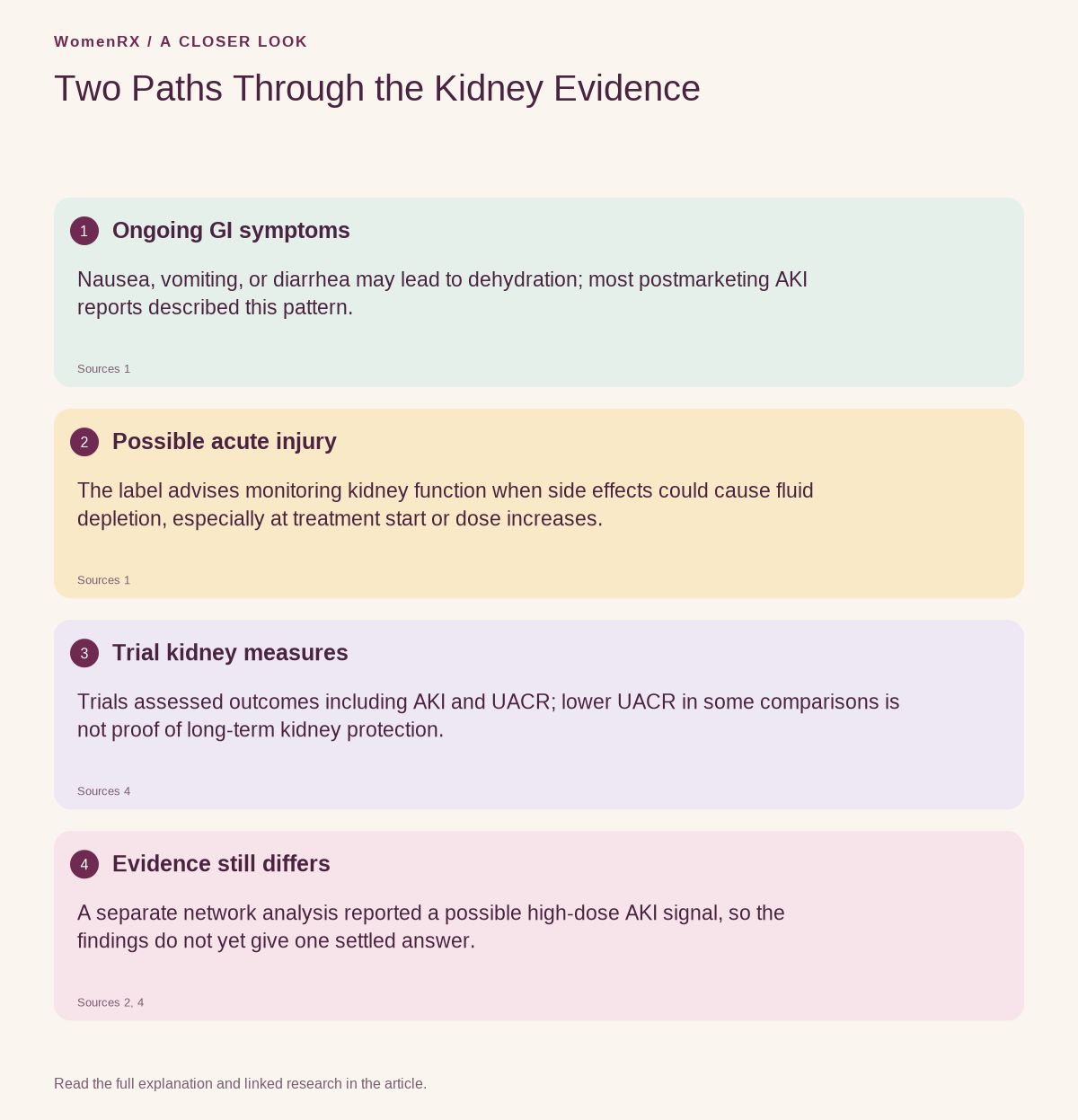
Two Paths Through the Kidney Evidence
Ongoing GI symptoms: Nausea, vomiting, or diarrhea may lead to dehydration; most postmarketing AKI reports described this pattern.1
Possible acute injury: The label advises monitoring kidney function when side effects could cause fluid depletion, especially at treatment start or dose increases.1
Trial kidney measures: Trials assessed outcomes including AKI and UACR; lower UACR in some comparisons is not proof of long-term kidney protection.4
Evidence still differs: A separate network analysis reported a possible high-dose AKI signal, so the findings do not yet give one settled answer.24
Read the figure as text
Separate the possible fluid-loss pathway behind reported acute injury from the kidney measures and outcomes studied in trials.- Ongoing GI symptoms: Nausea, vomiting, or diarrhea may lead to dehydration; most postmarketing AKI reports described this pattern.1
- Possible acute injury: The label advises monitoring kidney function when side effects could cause fluid depletion, especially at treatment start or dose increases.1
- Trial kidney measures: Trials assessed outcomes including AKI and UACR; lower UACR in some comparisons is not proof of long-term kidney protection.4
- Evidence still differs: A separate network analysis reported a possible high-dose AKI signal, so the findings do not yet give one settled answer.24
More questions, answered
Does having chronic kidney disease automatically mean I can’t use Zepbound?
Available studies don’t establish that every person with chronic kidney disease should avoid tirzepatide. However, the available studies don’t settle safety for every degree of kidney disease, and one major observational comparison excluded people with stage 5 disease or kidney failure. Discuss your kidney history and a plan for illness-related fluid loss with your prescriber. 3 4
Are lower urine albumin levels proof that tirzepatide protects kidneys?
No. A 2025 review found lower UACR in some comparisons, but that measure alone doesn’t prove that the medicine prevents kidney failure or long-term kidney decline. The review called for larger trials to clarify longer-term kidney benefits. 4
Sources you can check
- ZEPBOUND (TIRZEPATIDE) INJECTION, SOLUTION ZEPBOUND (TIRZEPATIDE) INJECTION, SOLUTION ZEPBOUND KWIKPEN (TIRZEPATIDE) INJECTION, SOLUTION [ELI LILLY AND COMPANY] | US prescribing information and patient instructionsAccessed 2026-09-25Return to first citation
- Differential Acute Kidney Injury Profiles of GLP-1RAs and SGLT2is: A Network Meta-Analysis.Liang CS, Hsu CW, Chen JJ, Hung CM, Zeng BY, Yang WC, Suen MW, Wang HY, Carvalho AF, Stubbs B, Chen YW, Chen TY, Lei WT, Hsu SP, Shiue YL, Li CT, Su KP, Zeng BS, Tseng PT. · International journal of molecular sciences · 2026Return to first citation
- Clinical Outcomes of Tirzepatide or GLP-1 Receptor Agonists in Individuals With Type 2 Diabetes.Chuang MH, Chen JY, Wang HY, Jiang ZH, Wu VC. · JAMA network open · 2024Return to first citation
- Renal effects and safety of tirzepatide in subjects with and without diabetes: A systematic review and meta-analysis.Kamrul-Hasan A, Patra S, Dutta D, Nagendra L, Muntahi-Reza A, Borozan S, Pappachan JM. · World journal of diabetes · 2025Return to first citation