Wegovy and Your Kidneys: What the Evidence Says
The main kidney concern with Wegovy is acute injury linked to dehydration, while evidence about longer-term kidney outcomes depends on who was studied.
Wegovy has been linked to acute kidney injury, most often in reports involving nausea, vomiting, or diarrhea that led to dehydration. In weight-loss trials, kidney injury was uncommon, but it occurred in both Wegovy and placebo groups. Separate research suggests kidney benefits in some people with type 2 diabetes and chronic kidney disease, but that does not establish a kidney benefit for everyone using Wegovy for weight management. 1 4
Two different kidney questions
When people ask whether Wegovy is safe for the kidneys, they may mean two different things: whether it can trigger a sudden kidney problem, or whether it changes the longer-term course of kidney disease. The evidence isn’t the same for both.
Acute kidney injury (AKI) is a sudden decline in kidney function. Wegovy’s US prescribing information describes postmarketing reports of AKI, including some cases requiring hemodialysis. Most reported events occurred after gastrointestinal effects such as nausea, vomiting, or diarrhea caused dehydration. In weight-reduction trials, AKI occurred in 7 adults taking Wegovy, or 0.4 cases per 100 patient-years, compared with 4 adults taking placebo, or 0.2 cases per 100 patient-years. These figures describe trial events, not a guarantee of what will happen to an individual. 1
Longer-term kidney outcomes are a separate question. A semaglutide trial in people who had both type 2 diabetes and chronic kidney disease found a lower risk of major kidney disease events. That result applies to a specific group with diabetes and kidney disease. It doesn’t show that Wegovy prevents kidney disease in everyone taking it for weight management. 4
A 2025 review of trials in people with overweight or obesity concluded that semaglutide’s effects on kidney outcomes in that population remained uncertain. So far, evidence of benefit in a particular kidney-disease population shouldn’t be treated as proof of a general kidney-protective effect. 3 4
How stomach symptoms can become a kidney concern
The practical concern is often the chain of events: gastrointestinal symptoms lead to fluid loss or make it hard to drink, the body becomes depleted of fluid, and AKI can follow. Wegovy’s prescribing information specifically calls out monitoring kidney function when symptoms could cause volume depletion, especially during treatment initiation and dose escalation. 1
If you have persistent nausea, vomiting, or diarrhea while taking Wegovy, contact your prescriber promptly rather than waiting for a routine check-in. Also tell them if you’re struggling to keep fluids down or feel unusually thirsty or dizzy. Thirst and dizziness can be signs of dehydration. Confusion or signs of shock require immediate medical attention. 1 2
This doesn’t mean every upset stomach causes kidney injury. It does mean that prolonged fluid loss deserves attention, particularly if you already have a history of kidney impairment. In Wegovy trials, renal adverse reactions occurred more often among adults with a history of renal impairment, and they were reported more frequently during dose titration. The trial information included 65 people with a history of moderate or severe renal impairment, so it doesn’t answer every question about every kidney condition. 1
Make monitoring specific to your situation
If you have chronic kidney disease, a prior episode of AKI, or a history of kidney impairment, ask your prescriber what symptoms should prompt a call and whether kidney-function testing is appropriate if you develop prolonged fluid loss. The prescribing information calls for monitoring renal function in patients reporting symptoms that could lead to volume depletion; it doesn’t say that every person taking Wegovy needs the same testing schedule. 1
You might ask: “Does my kidney history change how you’ll monitor me?” and “What should I do if I can’t keep fluids down?” If you’re pregnant, planning a pregnancy, or recently postpartum, include your current medications and any difficulty maintaining fluids in an individual medication review. That’s a reason to discuss your own circumstances, not evidence that kidney risks from Wegovy are inherently different for women.
The clearest takeaway is not that Wegovy is kidney-safe for everyone, or that it inevitably harms the kidneys. The acute concern is dehydration during significant gastrointestinal symptoms. Longer-term kidney findings depend on the population studied, and a result in people with diabetes and chronic kidney disease shouldn’t be generalized to every person using semaglutide for weight loss. 1 3 4
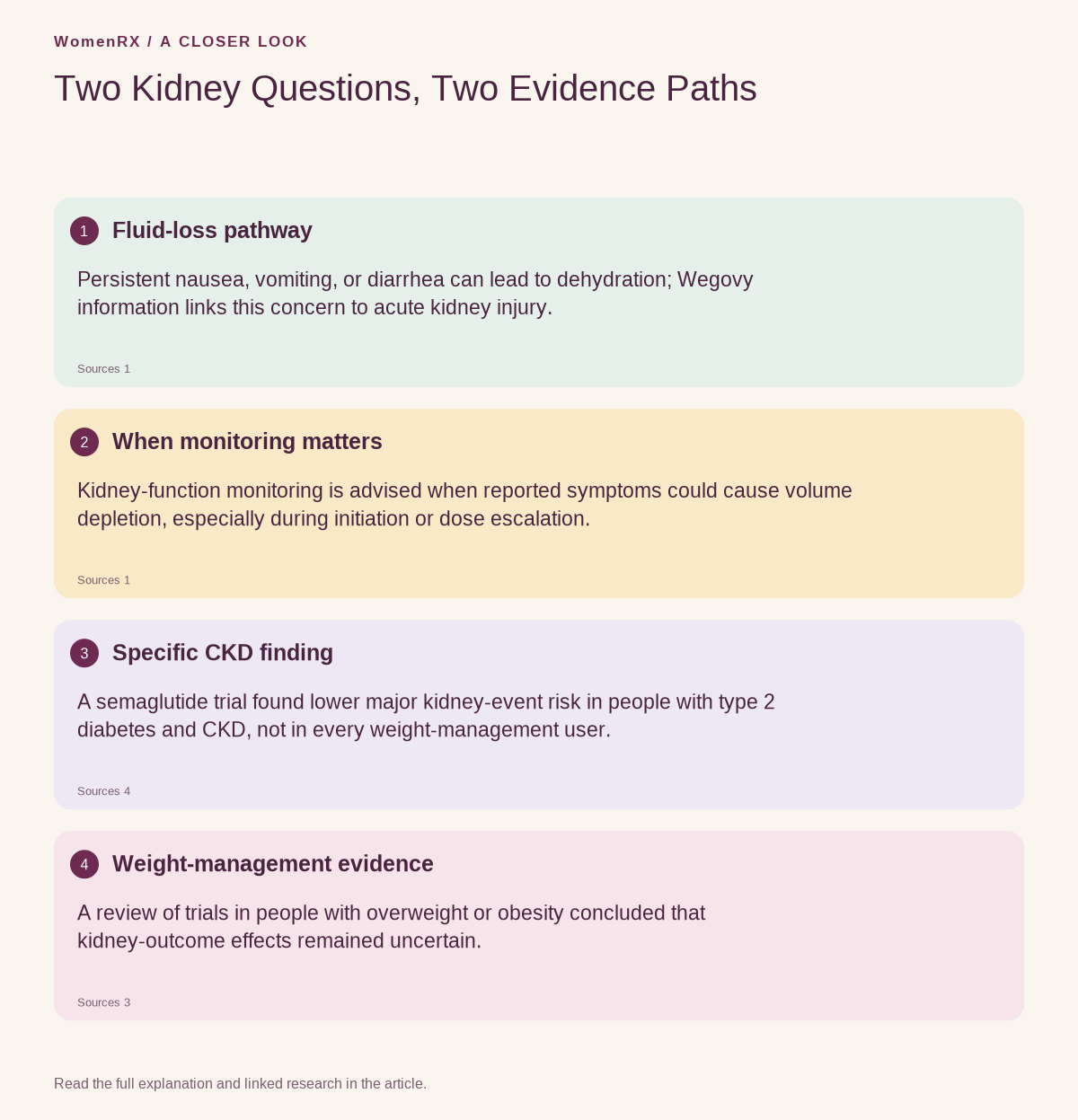
Two Kidney Questions, Two Evidence Paths
Fluid-loss pathway: Persistent nausea, vomiting, or diarrhea can lead to dehydration; Wegovy information links this concern to acute kidney injury.1
When monitoring matters: Kidney-function monitoring is advised when reported symptoms could cause volume depletion, especially during initiation or dose escalation.1
Specific CKD finding: A semaglutide trial found lower major kidney-event risk in people with type 2 diabetes and CKD, not in every weight-management user.4
Weight-management evidence: A review of trials in people with overweight or obesity concluded that kidney-outcome effects remained uncertain.3
Read the figure as text
This comparison separates sudden kidney concerns associated with fluid loss from longer-term outcomes studied in specific patient groups.- Fluid-loss pathway: Persistent nausea, vomiting, or diarrhea can lead to dehydration; Wegovy information links this concern to acute kidney injury.1
- When monitoring matters: Kidney-function monitoring is advised when reported symptoms could cause volume depletion, especially during initiation or dose escalation.1
- Specific CKD finding: A semaglutide trial found lower major kidney-event risk in people with type 2 diabetes and CKD, not in every weight-management user.4
- Weight-management evidence: A review of trials in people with overweight or obesity concluded that kidney-outcome effects remained uncertain.3
Sources you can check
- WEGOVY (SEMAGLUTIDE) INJECTION, SOLUTION WEGOVY (SEMAGLUTIDE) TABLET [NOVO NORDISK PHARMACEUTICAL INDUSTRIES, LP] | US prescribing information and patient instructionsAccessed 2026-09-25Return to first citation
- Dehydration: MedlinePlusAccessed 2026-09-25Return to first citation
- Effect of semaglutide on arrhythmic, major cardiovascular, and renal outcomes in patients with overweight or obesity: a systematic review and meta-analysis.Wu R, Xing B, Zhou Z, Yu L, Wang H. · European journal of medical research · 2025Return to first citation
- Association of semaglutide use with kidney outcomes in adults with ADPKD: A propensity score-matched real-world study.Chen TP, Tsai SF. · Science progress · 2026Return to first citation