Ozempic and Your Kidneys: What the Evidence Shows
Semaglutide has reduced kidney-related risks in a specific diabetes population, while severe fluid loss from stomach side effects can still threaten kidney function.
Ozempic (semaglutide) isn’t simply “good” or “bad” for your kidneys. In the FLOW trial, participants with type 2 diabetes and chronic kidney disease who received semaglutide had a lower risk of a combined kidney and cardiovascular outcome than those given placebo. Separately, postmarketing reports link acute kidney injury concerns mainly with dehydration from nausea, vomiting, or diarrhea. 4 1
Two different kidney questions
When people ask whether Ozempic is safe for the kidneys, they may mean either long-term kidney disease or a sudden kidney injury. Those aren’t the same outcome. Semaglutide has been studied for longer-term kidney outcomes in people with type 2 diabetes and chronic kidney disease. Separately, the US prescribing information warns about acute kidney injury associated with fluid loss during gastrointestinal side effects. 4 1
What the FLOW trial found
FLOW tested once-weekly semaglutide against placebo in participants with type 2 diabetes and chronic kidney disease. The trial’s combined primary outcome included kidney failure, a reduction in estimated kidney filtration (eGFR) of at least 50%, or death from kidney or cardiovascular causes. The risk of that combined outcome was 24% lower with semaglutide than with placebo. That is a relative reduction in a composite outcome, not a claim that every participant’s kidney function improved by 24%. 4
This is meaningful evidence for the population studied, but it doesn’t settle what semaglutide will do for every person with kidney disease. FLOW involved people with both type 2 diabetes and chronic kidney disease, so its result shouldn’t be treated as proof of the same kidney benefit in people without diabetes or in every specific kidney condition. 4 3
How stomach symptoms can affect kidney function
The other concern is more immediate. Nausea, vomiting, or diarrhea can cause you to lose fluid. If you lose more fluid than you take in, dehydration can affect how your body functions, including kidney function. The Ozempic prescribing information describes postmarketing reports of acute kidney injury, sometimes requiring dialysis; most reported cases involved gastrointestinal symptoms leading to dehydration. These reports do not tell us how often this happens among all users or establish an individual person’s risk. 1 2
The prescribing information recommends monitoring kidney function when someone reports side effects that could cause volume depletion, particularly during treatment initiation or dose increases. It also advises promptly reporting persistent nausea, vomiting, or diarrhea. If you have kidney disease, ask what symptoms should prompt a call for you, and what fluid plan fits your medical history. If you already have a prescribed fluid limit, ask how to handle stomach symptoms without assuming that general advice to drink more is right for you. 1
What to bring into a medication review
Your kidney history and the reason semaglutide was prescribed both matter. A useful conversation is not just “Is this safe for my kidneys?” You might ask: “Does the kidney-outcome evidence apply to my type of kidney disease?” and “If I have ongoing vomiting or diarrhea, when should my kidney function be checked?” The product information specifically highlights kidney-function monitoring when side effects could lead to fluid depletion; it doesn’t set out a routine testing schedule for every person taking Ozempic. 1 4
Also mention medicines and health conditions that affect your fluid plan or kidney care. If you’re pregnant, planning a pregnancy, or postpartum, include that context in your medication review, particularly if nausea or fluid intake is an issue. The kidney findings described here don’t establish pregnancy-specific effects or whether kidney outcomes differ by sex.
The practical takeaway
For people with type 2 diabetes and chronic kidney disease, a large randomized trial found a lower risk of a combined kidney and cardiovascular outcome with semaglutide. That benefit doesn’t erase the separate risk of kidney injury during significant fluid loss. Your indication, kidney diagnosis, symptoms, and ability to maintain fluids help determine what monitoring makes sense for you. 4 1
Two kidney questions, two kinds of evidence
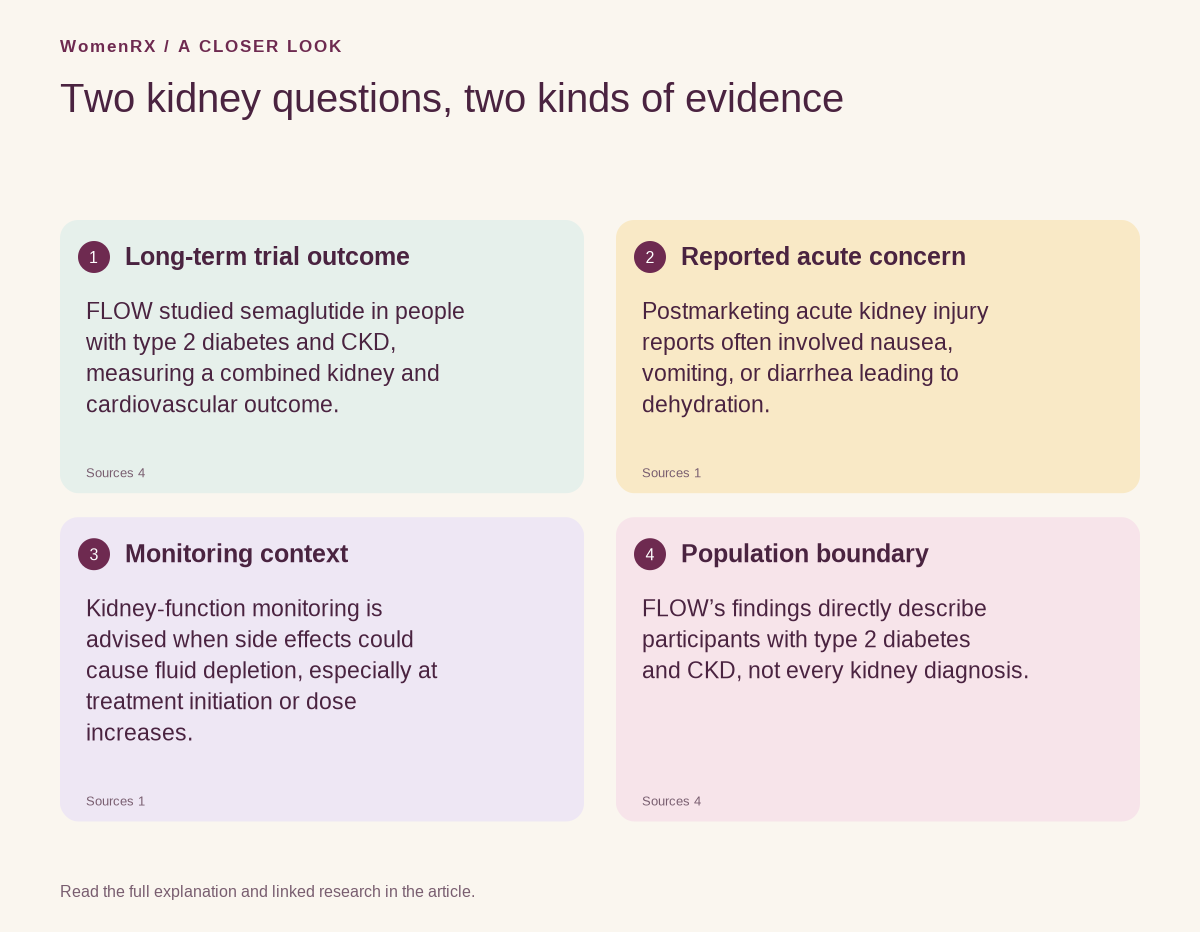
Long-term trial outcome: FLOW studied semaglutide in people with type 2 diabetes and CKD, measuring a combined kidney and cardiovascular outcome.4
Reported acute concern: Postmarketing acute kidney injury reports often involved nausea, vomiting, or diarrhea leading to dehydration.1
Monitoring context: Kidney-function monitoring is advised when side effects could cause fluid depletion, especially at treatment initiation or dose increases.1
Population boundary: FLOW’s findings directly describe participants with type 2 diabetes and CKD, not every kidney diagnosis.4
Read the figure as text
This comparison separates longer-term trial outcomes from the acute kidney injury concern associated with fluid loss.- Long-term trial outcome: FLOW studied semaglutide in people with type 2 diabetes and CKD, measuring a combined kidney and cardiovascular outcome.4
- Reported acute concern: Postmarketing acute kidney injury reports often involved nausea, vomiting, or diarrhea leading to dehydration.1
- Monitoring context: Kidney-function monitoring is advised when side effects could cause fluid depletion, especially at treatment initiation or dose increases.1
- Population boundary: FLOW’s findings directly describe participants with type 2 diabetes and CKD, not every kidney diagnosis.4
More questions, answered
Does having chronic kidney disease automatically rule out Ozempic?
Chronic kidney disease alone doesn’t answer that for every kidney condition. FLOW studied people with both type 2 diabetes and chronic kidney disease, so ask whether its findings fit your diagnosis and treatment goals. 4
When should I raise kidney monitoring with my prescriber?
Ask about it if you have persistent nausea, vomiting, or diarrhea, especially around starting treatment or increasing a dose. The prescribing information calls for kidney-function monitoring when reported side effects could cause fluid depletion. 1
Sources you can check
- OZEMPIC (SEMAGLUTIDE) INJECTION, SOLUTION [A-S MEDICATION SOLUTIONS] | US prescribing information and patient instructionsAccessed 2026-09-25Return to first citation
- Dehydration: MedlinePlusAccessed 2026-09-25Return to first citation
- Association of semaglutide use with kidney outcomes in adults with ADPKD: A propensity score-matched real-world study.Chen TP, Tsai SF. · Science progress · 2026Return to first citation
- Effects of semaglutide with and without concomitant SGLT2 inhibitor use in participants with type 2 diabetes and chronic kidney disease in the FLOW trial.Mann JFE, Rossing P, Bakris G, Belmar N, Bosch-Traberg H, Busch R, Charytan DM, Hadjadj S, Gillard P, Górriz JL, Idorn T, Ji L, Mahaffey KW, Perkovic V, Rasmussen S, Schmieder RE, ... · Nature medicine · 2024Return to first citation