What “Ozempic Face” Means, and What We Know
The label describes visible changes that can accompany weight loss, but current research can’t show that semaglutide changes the face independently of the weight lost.
“Ozempic face” isn’t a medical diagnosis. People use it for facial changes such as reduced fullness, looser skin, or more noticeable wrinkles after weight loss. A small imaging study found facial volume loss among people prescribed GLP-1 medicines, but it can’t show that semaglutide itself, rather than weight loss, caused the change. Cosmetic options exist, though evidence about their results in this setting is limited. 2 3 5
What the label describes
“Ozempic face” is a social-media phrase, not a diagnosis. It usually refers to less facial fullness, looser-looking skin, or more visible wrinkles after weight loss. Those changes can happen as facial fat decreases; the label doesn’t establish that a medicine has directly damaged your skin or face. 2 3
That distinction matters because Ozempic is a brand of semaglutide, while weight loss can happen with many approaches. Seeing a facial change while taking the medicine doesn’t, on its own, tell you whether the drug, the amount or pace of weight loss, or other changes over time explain it.
What the facial-volume research can tell us
One small retrospective study compared head and neck scans taken before and after GLP-1 prescriptions for 20 people. Their average weight loss was 11 kg over an average of 321 days. The median decrease in total midface volume was 9%. The study also found a relationship between weight loss and loss of superficial midface volume, but not deep volume. 3
That is evidence that facial volume can change during treatment with GLP-1 medicines. It is not a forecast for an individual: the study was small, came from one medical center, and did not include a comparison group not taking the medicines. It also can’t separate the effect of the medicine from the effect of losing weight. The 9% figure describes the study group, not what every person taking Ozempic should expect. 3
Weight loss, age, and menopause aren’t disentangled
A face can look different for more than one reason, and changes associated with weight loss may overlap with changes over time. The imaging study’s median participant age was 54, but its abstract doesn’t report menopause status or test whether menopause or age changed the results. So it can’t tell you whether menopause makes these facial changes more likely, or whether a change you notice is due to weight loss, aging, or both. 3
If the change is bothering you, a clinician who knows your health and treatment can help put it in context, including whether your weight loss is happening as expected. If you’re losing weight without trying, that deserves assessment rather than being assumed to be a cosmetic effect. 1
What you can realistically consider
If you’re thinking about treatment for facial changes, a cosmetic consultation can help clarify what concern you want addressed and what tradeoffs different approaches involve. Reviews discuss options such as fillers, devices intended to tighten skin, and surgery, but the evidence for effectiveness and safety specifically for post-weight-loss facial changes is limited. There isn’t a proven one-size-fits-all treatment or a reliable result that can be promised from the available research. 4 5
A useful consultation is one that distinguishes volume loss from skin laxity and explains what a proposed treatment can and can’t address. The research also hasn’t established an ideal time to intervene. If you’re considering a change to your semaglutide treatment because of your appearance, discuss it with the clinician managing that treatment rather than relying on the social-media label alone.
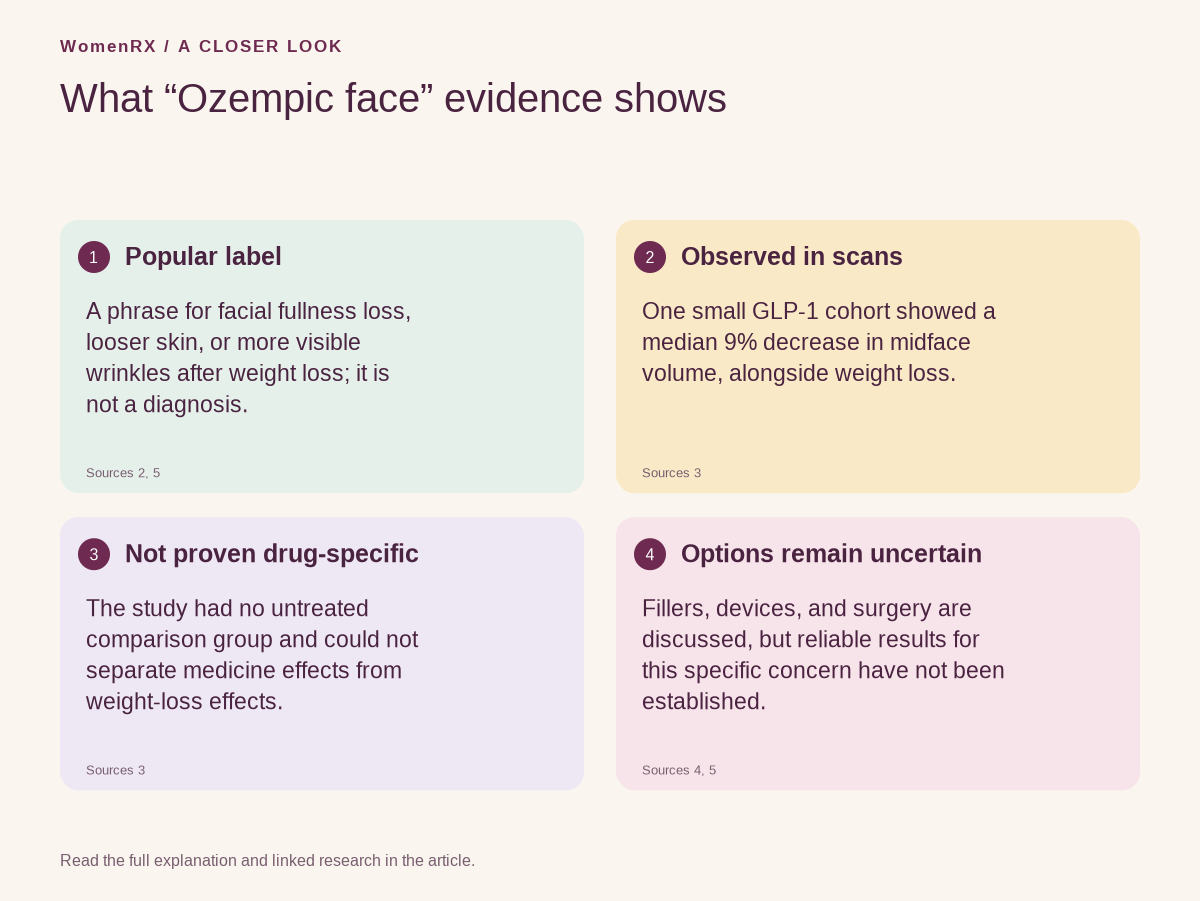
What “Ozempic face” evidence shows
Popular label: A phrase for facial fullness loss, looser skin, or more visible wrinkles after weight loss; it is not a diagnosis.25
Observed in scans: One small GLP-1 cohort showed a median 9% decrease in midface volume, alongside weight loss.3
Not proven drug-specific: The study had no untreated comparison group and could not separate medicine effects from weight-loss effects.3
Options remain uncertain: Fillers, devices, and surgery are discussed, but reliable results for this specific concern have not been established.45
Read the figure as text
Separate the social-media label from observed weight-related changes and from what research has not established.- Popular label: A phrase for facial fullness loss, looser skin, or more visible wrinkles after weight loss; it is not a diagnosis.25
- Observed in scans: One small GLP-1 cohort showed a median 9% decrease in midface volume, alongside weight loss.3
- Not proven drug-specific: The study had no untreated comparison group and could not separate medicine effects from weight-loss effects.3
- Options remain uncertain: Fillers, devices, and surgery are discussed, but reliable results for this specific concern have not been established.45
More questions, answered
Does Ozempic directly cause facial fat loss?
Current evidence shows facial volume changes in a small group of people prescribed GLP-1 medicines, alongside weight loss. It doesn’t establish that semaglutide causes facial fat loss independently of weight loss. 3
Can a cosmetic treatment reverse the changes?
Fillers, skin-tightening procedures, and surgery are discussed as options, but research hasn’t established a reliably effective approach specifically for facial changes after GLP-1-related weight loss. A consultation can clarify likely tradeoffs without guaranteeing an outcome. 4 5
Sources you can check
- Body Weight: MedlinePlusAccessed 2026-09-25Return to first citation
- Implications of Ozempic and Other Semaglutide Medications for Facial Plastic Surgeons.Humphrey CD, Lawrence AC. · Facial plastic surgery : FPS · 2023Return to first citation
- Radiographic Midfacial Volume Changes in Patients on GLP-1 Agonists.Sharma RK, Vittetoe KL, Barna AJ, Takkouche S, Varelas AN, Yang SF, Stephan SJ, Patel PN. · Otolaryngology--head and neck surgery : official journal of American Academy of Otolaryngology-Head and Neck Surgery · 2025Return to first citation
- The Role of GLP-1 Agonists in Esthetic Medicine: Exploring the Impact of Semaglutide on Body Contouring and Skin Health.Haykal D, Hersant B, Cartier H, Meningaud JP. · Journal of cosmetic dermatology · 2025Return to first citation
- [Rapid weight loss through GLP-1 receptor agonists as lifestyle phenomenon and implications for plastic esthetic medicine].Seidel DU, Bode S. · HNO · 2025Return to first citation