Does Semaglutide Cause Facial Changes?
Facial volume can change during semaglutide-associated weight loss, but “Ozempic face” is a nickname, not a diagnosed drug-specific condition.
A slimmer or more lined-looking face during semaglutide treatment may reflect fat loss across the body, including facial fat. In a small imaging study of people taking GLP-1 medicines, greater weight loss was associated with greater loss of superficial midface volume. A change that happens without weight loss is less easily explained that way and deserves a separate conversation. 5
What people mean by “Ozempic face”
The phrase usually describes a face that looks less full, with more noticeable folds, wrinkles, or loose skin after substantial weight loss. It’s a colloquial label, not a specific diagnosis. Plastic-surgery publications have discussed these changes, but the term itself doesn’t tell you whether the medicine, the weight change, or another factor is responsible. 2 3
How weight loss can change facial appearance
Facial fullness partly comes from fat beneath the skin. When that volume decreases during overall weight loss, folds or loose-looking skin may become more noticeable. That’s a plausible explanation for a face that gradually looks less full as weight comes down, not evidence that semaglutide acts on facial fat in a special way. 2 5
A small retrospective imaging study offers one objective look at the change. It examined scans from 20 people who had taken GLP-1 medicines and found that weight loss was associated with a reduction in superficial midface volume. Its small sample can’t predict what will happen to any one person. 5
The amount of weight lost may be relevant: in that study, greater weight loss was associated with greater superficial midface volume loss. A review also describes visible facial changes alongside rapid weight loss, but these findings do not establish a predictable threshold or rate at which an individual’s face will change. 2 5
What age and menopause can, and can’t, tell you
Age may affect how visible a change looks. A review of research on GLP-1 medicines and skin identified advanced age as a possible factor in more noticeable skin changes, but its evidence included different kinds of studies, including case reports and observational research. That makes this a possible influence, not a reliable prediction for an individual. 4
Reviews describe both facial volume loss and skin laxity, but the cited findings do not identify a baseline skin characteristic that predicts a drug-specific change. 2 4
Menopause is a reasonable part of the conversation if you’re noticing changes in your face. The cited review and imaging study do not establish whether menopausal status changes the risk or whether women experience a distinct drug-specific effect. 4 5
What to make of a change you notice
Compare the facial change with what’s happening to your weight. If your face has gradually become less full while you’ve lost weight, reduced facial volume fits what the imaging study observed, though it can’t explain every feature you see in the mirror. 5
If your weight has stayed about the same, or the facial change seems sudden or out of step with your weight loss, the weight-loss explanation is less convincing. That doesn’t identify another cause. It does give you a useful reason to describe the change to the clinician managing your treatment rather than dismissing it as “Ozempic face.” If you’re also losing weight unexpectedly, that’s worth raising in its own right. 1 If you’re considering a change to your medicine, discuss it with that clinician rather than making the decision based on a nickname or a cosmetic claim.
Reviews discuss cosmetic procedures for facial volume loss and skin laxity, but they don’t establish a reliably effective way to restore a person’s previous facial appearance. 2 6
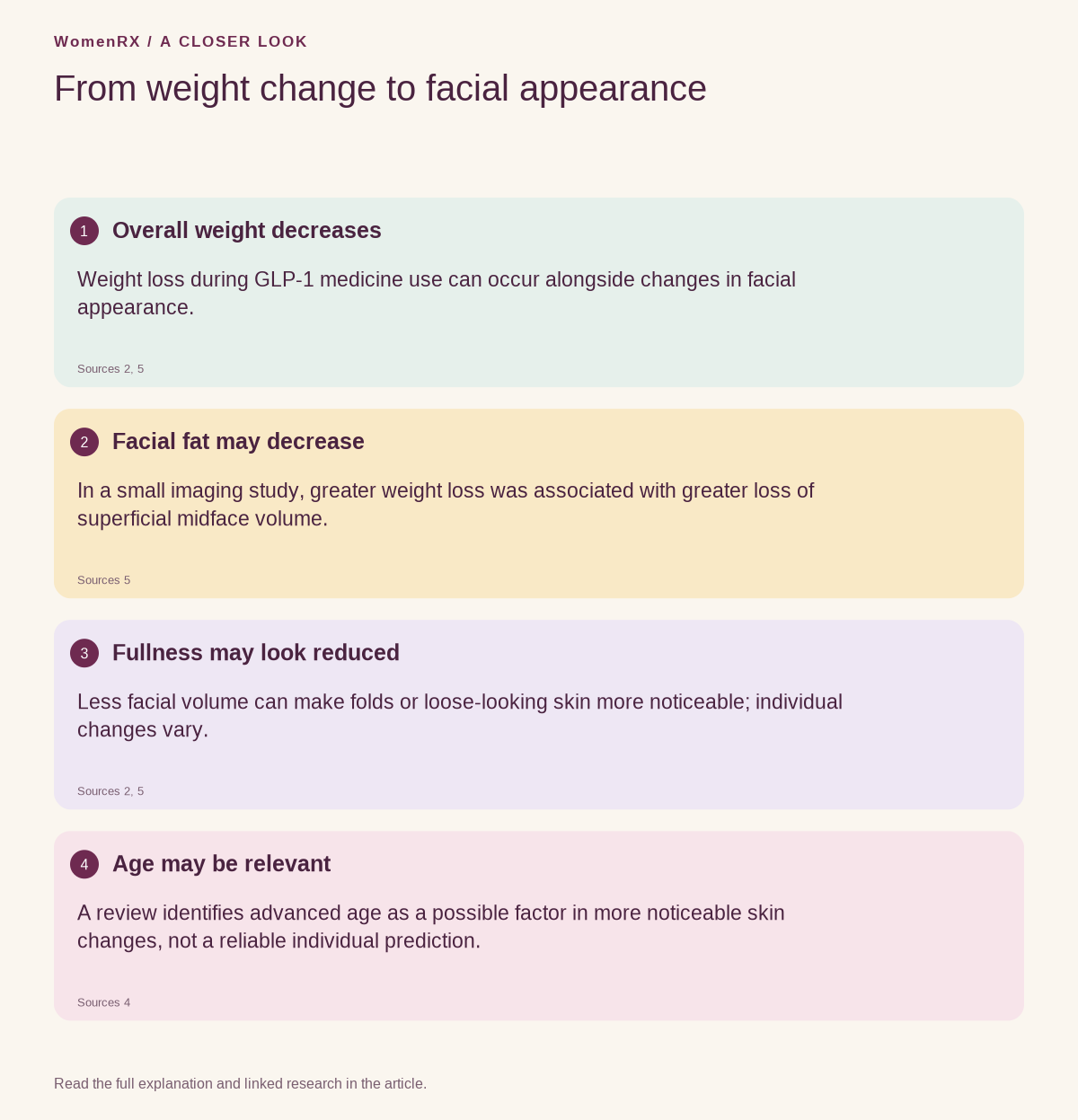
From weight change to facial appearance
Overall weight decreases: Weight loss during GLP-1 medicine use can occur alongside changes in facial appearance.25
Facial fat may decrease: In a small imaging study, greater weight loss was associated with greater loss of superficial midface volume.5
Fullness may look reduced: Less facial volume can make folds or loose-looking skin more noticeable; individual changes vary.25
Age may be relevant: A review identifies advanced age as a possible factor in more noticeable skin changes, not a reliable individual prediction.4
Read the figure as text
This pathway shows how overall weight loss may change facial fullness.- Overall weight decreases: Weight loss during GLP-1 medicine use can occur alongside changes in facial appearance.25
- Facial fat may decrease: In a small imaging study, greater weight loss was associated with greater loss of superficial midface volume.5
- Fullness may look reduced: Less facial volume can make folds or loose-looking skin more noticeable; individual changes vary.25
- Age may be relevant: A review identifies advanced age as a possible factor in more noticeable skin changes, not a reliable individual prediction.4
More questions, answered
Is there a proven way to restore facial volume?
The reviews discuss cosmetic procedures, but the evidence they describe does not establish a reliably effective approach or the best timing for treatment. Be cautious of promises that a particular procedure will restore your previous facial appearance. 2 6
Sources you can check
- Body Weight: MedlinePlusAccessed 2026-09-25Return to first citation
- [Rapid weight loss through GLP-1 receptor agonists as lifestyle phenomenon and implications for plastic esthetic medicine].Seidel DU, Bode S. · HNO · 2025Return to first citation
- "Ozempic Face" in Plastic Surgery: A Systematic Review of the Literature on GLP-1 Receptor Agonist Mediated Weight Loss and Analysis of Public Perceptions.Daneshgaran G, Shauly O, Gould DJ. · Aesthetic surgery journal. Open forum · 2025Return to first citation
- Effects of GLP-1 Receptor Agonists on Skin Quality: A Comprehensive Literature Review.Barone M, Brunetti B, D'Emilio R, Caputo MG, Tenna S, Persichetti P. · Aesthetic plastic surgery · 2026Return to first citation
- Radiographic Midfacial Volume Changes in Patients on GLP-1 Agonists.Sharma RK, Vittetoe KL, Barna AJ, Takkouche S, Varelas AN, Yang SF, Stephan SJ, Patel PN. · Otolaryngology--head and neck surgery : official journal of American Academy of Otolaryngology-Head and Neck Surgery · 2025Return to first citation
- The Role of GLP-1 Agonists in Esthetic Medicine: Exploring the Impact of Semaglutide on Body Contouring and Skin Health.Haykal D, Hersant B, Cartier H, Meningaud JP. · Journal of cosmetic dermatology · 2025Return to first citation