Can You Prevent Facial Changes During Weight Loss?
Facial volume loss can accompany substantial weight loss, but the approaches discussed here haven’t been shown to reliably prevent it.
Facial changes during weight loss are usually understood as a change in facial fat and skin support, not a unique effect of Ozempic. Studies link substantial weight loss with cheek-volume loss and looser skin, but they don’t establish a reliable way to prevent those changes. Be cautious about supplements or cosmetic treatments sold as prevention; treating an appearance change is different from preventing it. 3 5
Why your face may look different
When you lose a substantial amount of weight, fat can decrease in the face as well as elsewhere. A systematic review of studies following major weight loss found that changes often involved less volume in the mid-cheek and more looseness under the chin and along the neck. The studies were limited, and the authors noted that the exact amount and pattern of facial change still need better measurement. 3
That can make hollows, folds, or existing signs of aging more noticeable. It doesn’t mean weight-loss medication has been shown to directly age the skin. Facial changes have also been described after bariatric surgery, and the available GLP-1 research is limited. The popular label “Ozempic face” can make a change associated with weight loss sound like a proven, medication-specific effect when that distinction hasn’t been settled. 3 6
Age may shape how a change appears. One study of people with morbid obesity after bariatric surgery included in the review found that participants older than 40 were more susceptible to facial-volume changes after weight loss. That is limited evidence from a single study, and it doesn’t establish that menopause or female hormones cause the effect. 3
What prevention claims can, and can’t, promise
Slower weight loss: It may sound reasonable that changing more gradually would give skin time to adapt. But a proposed prevention framework based on weight-loss speed is conceptual, not proof that slower loss prevents facial volume changes. The review of facial changes likewise doesn’t establish a pace that protects facial volume. 3 4
Supplements: A product promoted for weight loss isn’t automatically useful for preserving facial fullness or skin. The NIH Office of Dietary Supplements explains that evidence for many weight-loss supplements is limited or inconsistent, and that products can contain multiple ingredients with uncertain effects. That reference doesn’t establish that any supplement prevents facial changes. 1
Fillers and skin treatments: These are proposed as ways to address visible volume loss or skin quality, not proven ways to stop it from happening. A review discussing fillers and collagen-stimulating treatments offers a rationale for cosmetic treatment, but it isn’t evidence that these approaches prevent weight-loss-related changes. Ask what a treatment is meant to improve, what evidence supports that specific claim, and what its risks and costs are before deciding. 5
Changing a medication: If you’re taking a weight-loss medicine and are concerned about your appearance, discuss the concern with the clinician managing your treatment before making changes. Current studies don’t establish that stopping or switching a medicine prevents facial changes. 3 6
A practical way to assess a proposed remedy
Before paying for a supplement, device, injection, or procedure, ask:
- Is the claim to prevent a change, or to treat one that has already appeared?
- Was the approach studied in people experiencing facial changes during weight loss, or only for general skin aging or weight loss?
- Does the evidence measure facial volume or skin changes, rather than a different outcome?
- Is the evidence a controlled human study, or a proposed mechanism or treatment framework?
These distinctions matter. An intervention that improves a visible feature in some people may not prevent the underlying loss of facial fat, and a plausible explanation isn’t the same as a demonstrated result. The facial-treatment literature includes proposals and small or descriptive studies, so claims of reliable prevention deserve particular scrutiny. 3 4 5
If your overall weight loss is sudden and wasn’t planned, arrange a medical evaluation rather than treating it as a cosmetic issue. Unexpected weight loss can have causes other than a weight-loss plan. 2 If facial changes worry you, you can also discuss them with the clinician managing your weight-loss care.
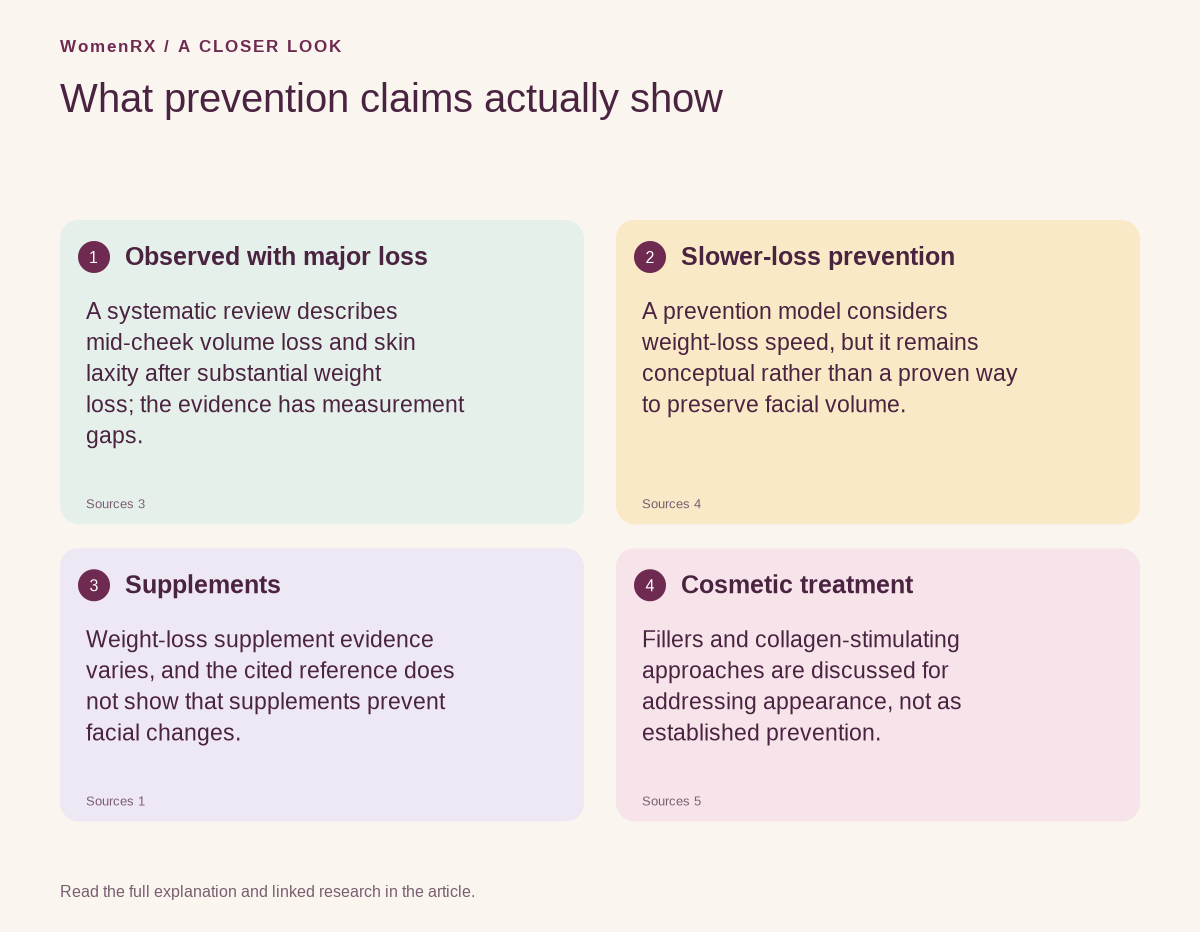
What prevention claims actually show
Observed with major loss: A systematic review describes mid-cheek volume loss and skin laxity after substantial weight loss; the evidence has measurement gaps.3
Slower-loss prevention: A prevention model considers weight-loss speed, but it remains conceptual rather than a proven way to preserve facial volume.4
Supplements: Weight-loss supplement evidence varies, and the cited reference does not show that supplements prevent facial changes.1
Cosmetic treatment: Fillers and collagen-stimulating approaches are discussed for addressing appearance, not as established prevention.5
Read the figure as text
Separate observed facial changes from proposed prevention ideas and treatments aimed at appearance.- Observed with major loss: A systematic review describes mid-cheek volume loss and skin laxity after substantial weight loss; the evidence has measurement gaps.3
- Slower-loss prevention: A prevention model considers weight-loss speed, but it remains conceptual rather than a proven way to preserve facial volume.4
- Supplements: Weight-loss supplement evidence varies, and the cited reference does not show that supplements prevent facial changes.1
- Cosmetic treatment: Fillers and collagen-stimulating approaches are discussed for addressing appearance, not as established prevention.5
More questions, answered
Does losing weight more slowly prevent facial changes?
That hasn’t been established. A proposed prevention model considers weight-loss speed, but it is hypothesis-generating, and the available review doesn’t establish a pace that prevents facial volume changes. 3 4
Is “Ozempic face” a proven direct effect of semaglutide?
The term describes facial changes reported alongside weight loss, but the available reviews don’t establish that semaglutide itself directly causes them. Facial changes have also been described after other forms of substantial weight loss. 3 6
Sources you can check
- Dietary Supplements for Weight Loss - Health Professional Fact SheetAccessed 2026-09-25Return to first citation
- Body Weight: MedlinePlusAccessed 2026-09-25Return to first citation
- Soft Tissue Facial Changes Following Massive Weight Loss Secondary to Medical and Surgical Bariatric Interventions: A Systematic Review.Jafar AB, Jacob J, Kao WK, Ho T. · Aesthetic surgery journal. Open forum · 2024Return to first citation
- Preventing GLP-1-Associated Facial Aging: An Anatomy-Driven Risk Stratification Model and Prevention Algorithm in the "Ozempic Face" Era.Castrellon R, Maita K, Witt E, Young V, Torres-Guzman R, Huaman G. · Aesthetic plastic surgery · 2026Return to first citation
- GLP-1-Induced Weight Loss and the Face: Anatomical Mechanisms and Rationale for Collagen-Stimulating and Volumizing Aesthetic Treatments.Frank K, Guertler A, Hoffmeister V, Kohler L, Nikolis A, Prantl L, Pupo D, Moellhoff N, Hopf M, Heiland M, Alfertshofer M. · Dermatologic surgery : official publication for American Society for Dermatologic Surgery [et al.] · 2026Return to first citation
- "Ozempic Face" in Plastic Surgery: A Systematic Review of the Literature on GLP-1 Receptor Agonist Mediated Weight Loss and Analysis of Public Perceptions.Daneshgaran G, Shauly O, Gould DJ. · Aesthetic surgery journal. Open forum · 2025Return to first citation