GLP-1 Weight Loss: What Lean-Mass Changes Mean
Lean mass can fall as weight comes off, but that measurement alone can’t tell you how much skeletal muscle changed or whether your strength has suffered.
Yes, studies find that lean mass can decrease during weight loss with GLP-1 medicines, including semaglutide. But lean mass isn’t the same as skeletal muscle: it also includes water, organs and other non-fat tissue. In one review of obesity-dose trials, lean mass fell in absolute terms while making up a larger share of the lower total body weight. Neither result, by itself, tells you whether your strength or daily function has changed. 2 4
Two measurements can tell different stories
When weight goes down, both fat mass and lean mass may go down too. A change in the amount of lean mass and a change in its share of body weight aren’t contradictory. If fat mass falls more, lean mass can make up a larger percentage of a smaller total even while its measured amount decreases. 4
That distinction matters when you see a body-composition result. A systematic review and meta-analysis of seven randomized trials in 821 people with obesity found an average decrease in absolute lean mass of 1.74 kg during treatment with GLP-1 medicines at obesity doses. At the same time, lean mass as a proportion of total weight increased by 1.81%, as reported in the review. The results for absolute and percentage lean-mass change varied considerably across studies, so those averages can’t predict what will happen to one person. 4
The US prescribing information for semaglutide also describes greater loss of fat mass than lean mass. That is useful context, not proof that everyone loses lean tissue or a measure of how well an individual’s muscles are working. 2
Lean mass isn’t a muscle reading
Lean mass, sometimes called fat-free mass, includes skeletal muscle but also organs, bones and body fluids. Measurements such as DXA or bioelectrical impedance estimate body compartments; they don’t directly establish how much functional skeletal muscle you have. Hydration and other measurement differences can complicate comparisons, too. 4
Strength and function are separate questions. Can you get up from a chair, carry groceries or climb stairs as you usually do? A scan or scale can’t answer those questions on its own. A review of clinical studies in people with fatty liver disease found no evidence of worsening grip strength or sit-to-stand performance in the small number of studies that measured them, but it also described limited, varied evidence in a specific population. That finding shouldn’t be taken as a guarantee for every person taking a GLP-1 medicine. 3
What the studies say about women
The obesity-dose review reports pooled results without a women-only estimate. Another meta-analysis found no evidence that sex modified lean-mass results, but it combined trials of GLP-1 medicines with trials of a different drug class, SGLT2 inhibitors. That result is reassuring context, not a definitive answer about whether women respond identically to GLP-1 medicines. 4 5
Age and starting strength may make the functional question more relevant: preserving strength can matter especially when muscle reserve is already limited. The evidence doesn’t establish that menopause changes the muscle effect of these medicines. Pregnancy was excluded from the obesity-dose review, so its findings don’t answer questions about use during pregnancy. If pregnancy is possible or planned, raise that separately with the prescriber rather than relying on body-composition studies to answer it. 1 4
If your strength or function is changing
A changing body-composition percentage alone isn’t a reason to assume you’re losing harmful amounts of muscle. But a noticeable change in what you can do is worth bringing to the prescriber’s attention. Describe the change in everyday terms, such as difficulty carrying a usual load or rising from a chair, and when you first noticed it.
Useful questions to discuss:
- What is the measurement telling us? Ask whether the result is an estimate of lean mass, skeletal muscle, or something else, and whether it can be compared fairly with your earlier result.
- How is my function? Ask whether a strength or mobility assessment would add useful information beyond a scan, scale or body-composition percentage.
- Am I eating enough overall? Appetite changes can make it harder to maintain regular nourishment. Ask whether a dietitian or other nutrition support would help you meet your needs while taking the medicine.
- What kind of physical activity fits me? Ask about an approach suited to your health, ability and starting point. Exercise and nutrition interventions are discussed in the research, but current evidence doesn’t establish that a specific plan prevents lean-mass loss for every person on a GLP-1 medicine. 4
- Does my age or health change the goal? If you’re older, have low strength already, or notice declining function, ask how to balance weight goals with preserving the abilities you rely on. 1 4
The useful distinction isn’t simply whether a lean-mass number moved. It’s whether the measurement is meaningful for you, and whether your strength and day-to-day function are holding steady.
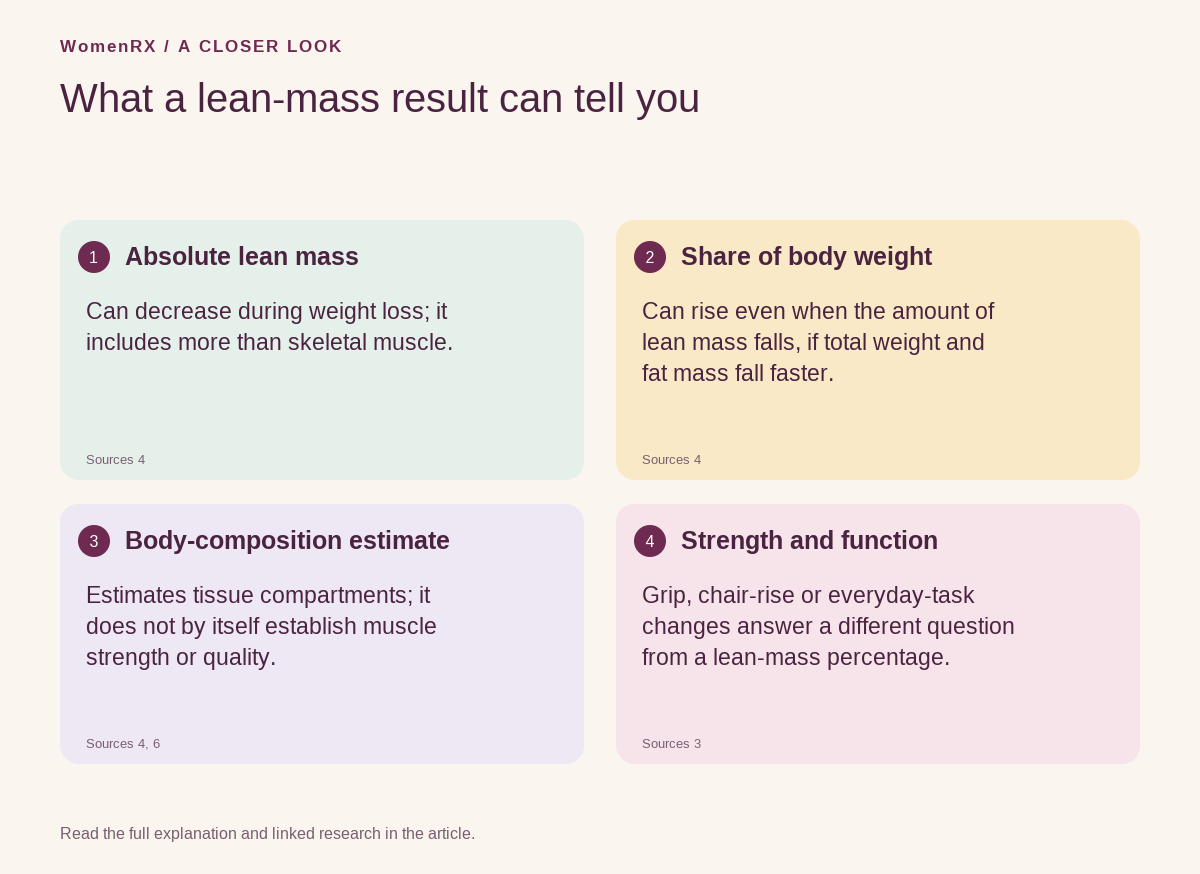
What a lean-mass result can tell you
Absolute lean mass: Can decrease during weight loss; it includes more than skeletal muscle.4
Share of body weight: Can rise even when the amount of lean mass falls, if total weight and fat mass fall faster.4
Body-composition estimate: Estimates tissue compartments; it does not by itself establish muscle strength or quality.46
Strength and function: Grip, chair-rise or everyday-task changes answer a different question from a lean-mass percentage.3
Read the figure as text
A body-composition estimate, a muscle measure and a functional test describe related but different things.- Absolute lean mass: Can decrease during weight loss; it includes more than skeletal muscle.4
- Share of body weight: Can rise even when the amount of lean mass falls, if total weight and fat mass fall faster.4
- Body-composition estimate: Estimates tissue compartments; it does not by itself establish muscle strength or quality.46
- Strength and function: Grip, chair-rise or everyday-task changes answer a different question from a lean-mass percentage.3
More questions, answered
Does a higher lean-mass percentage mean I gained muscle?
Not necessarily. Lean mass can decrease in absolute terms while increasing as a share of total weight if fat mass falls more. A percentage alone can’t establish that you gained muscle. 4
Can a body-composition scale tell whether my strength is changing?
No. A body-composition estimate and a measure of strength or physical performance answer different questions. If your everyday abilities are changing, describe that to your prescriber rather than relying on the scale alone. 3 4
Sources you can check
- Body Weight: MedlinePlusAccessed 2026-09-25Return to first citation
- WEGOVY (SEMAGLUTIDE) INJECTION, SOLUTION WEGOVY (SEMAGLUTIDE) TABLET [NOVO NORDISK PHARMACEUTICAL INDUSTRIES, LP] | US prescribing information and patient instructionsAccessed 2026-09-25Return to first citation
- Effects of GLP-1 Receptor Agonists on Muscle Mass, Strength, and Quality in MASLD: A Systematic Review.Iorra F, Jayakar T, Yee M, Thursz MR, Schaan BD, Manousou P. · Liver international : official journal of the International Association for the Study of the Liver · 2026Return to first citation
- Effect of GLP-1 receptor agonists at doses for obesity management on muscle health: systematic review and meta-analysis of randomized controlled trials (RCTs).Laverde LP, Muñoz-Velandia OM, Alfonso D, Gómez Medina AM. · International journal of obesity (2005) · 2026Return to first citation
- The Effects of Glucagon-Like Peptide-1 Receptor Agonists and Sodium-Glucose Co-Transporter-2 Inhibitors on Lean Body Mass in Humans: A Systematic Review and Meta-Analysis of Randomised Controlled Trials.Jobanputra R, Sargeant JA, Plekhanova T, James E, Almaqhawi A, Webb DR, Davies MJ, Yates T. · Diabetes/metabolism research and reviews · 2026Return to first citation
- Lean Mass Reduction During Glucagon-like Peptide-1 Receptor Agonists-Induced Weight Loss: Rethinking Its Clinical Significance.Moscucci F, Tocci G, Nardoianni G, Savoia C, Contino V, Leo G, Bocale R, Desideri G, Baratta F. · High blood pressure & cardiovascular prevention : the official journal of the Italian Society of Hypertension · 2026Return to first citation