Why Your Face May Change During GLP-1 Weight Loss
Facial volume can shrink as your body loses weight, but “Ozempic face” isn’t a diagnosis or a proven unique effect of the medication.
A leaner or more hollow-looking face during GLP-1 treatment may reflect fat loss that accompanies weight loss, changes that can overlap with aging, or both. Current facial research is limited and doesn’t establish a distinct drug-caused facial side effect. The reviews discussed here don’t provide menopause-specific results. A sudden or unexpected weight change is worth discussing with your prescriber. 1 3
A smaller face, more visible cheekbones, or hollowness around the eyes can feel surprising when you’re focused on changes elsewhere. The phrase “Ozempic face” is a popular label for these appearances, not a medical diagnosis. Facial volume loss has been described after substantial weight loss, but research hasn’t established that GLP-1 medicines cause a unique facial effect apart from the changes associated with losing weight. 3
What may be changing
Fat beneath the skin helps give the cheeks, temples, and area around the eyes their shape. When a person loses a substantial amount of weight, facial fat can also decrease, making hollows or folds more noticeable. In one retrospective imaging analysis discussed in a review, people treated with GLP-1 medicines had a measured decrease in superficial midface volume; the review also describes significant weight loss more generally as a possible explanation for visible facial changes. That kind of finding can show an association, but it can’t by itself separate the effects of the medicine from the effects of weight loss. 3
Age can add another layer. Facial appearance changes over time, and the review distinguishes age-related volume changes from changes seen after weight loss. That doesn’t mean every new hollow or wrinkle is caused by aging, or that a medication has accelerated aging. It means several influences may overlap, and the available evidence doesn’t cleanly untangle them. 3
What “Ozempic face” does not tell you
The nickname may sound like a specific side effect, but it doesn’t establish a diagnosis or explain why someone’s appearance changed. Reviews describe possible effects of GLP-1 or GLP-1/GIP medicines on skin and facial tissues, yet the evidence includes varied study types, and researchers have called for better prospective studies. One review specifically notes that scientific articles measuring medication effects on facial features are scarce. 2 3
That matters for women considering how aging or menopause fits in. The reviews discussed here don’t provide menopause-specific estimates or show whether facial changes differ by sex or life stage. So it would be a stretch to say that menopause makes this effect more likely, or that women experience a proven medication-specific facial change. Age-related facial changes may overlap with weight loss, but their contribution will vary from person to person. 2 3
What you can do without chasing a promise
If your face looks different, consider the whole picture: whether your weight is changing as expected, whether the change has been gradual or sudden, and whether you have other concerns about your treatment. A check-in with your prescriber can help put the pace of weight change in context. Sudden, unexpected weight loss deserves medical attention rather than being written off as an appearance change. 1
Be cautious with products marketed as a guaranteed way to prevent or reverse “Ozempic face.” Reviews discuss cosmetic approaches such as fillers and collagen-stimulating treatments, but a proposed treatment approach is not the same as strong evidence that it works for this specific concern. If you’re considering a procedure, seek an individualized discussion of its potential benefits, risks, and limits rather than relying on promotional claims. 4 5
The practical takeaway: facial changes during weight loss are real for some people, but the nickname oversimplifies their possible causes. A changing appearance alone doesn’t tell you whether a GLP-1 medicine is responsible. Unexpected weight change is a medical question; a cosmetic concern is a separate decision, and neither needs to be driven by a marketing label.
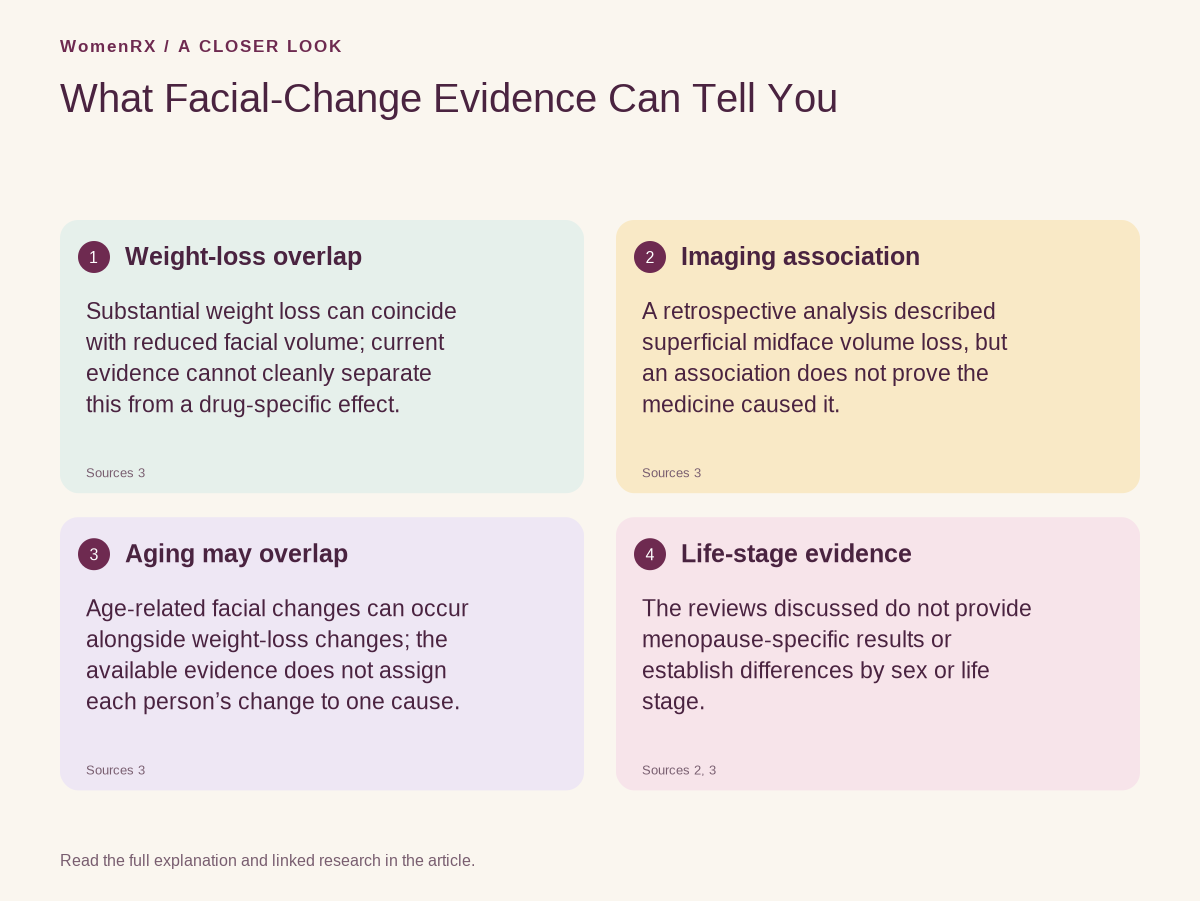
What Facial-Change Evidence Can Tell You
Weight-loss overlap: Substantial weight loss can coincide with reduced facial volume; current evidence cannot cleanly separate this from a drug-specific effect.3
Imaging association: A retrospective analysis described superficial midface volume loss, but an association does not prove the medicine caused it.3
Aging may overlap: Age-related facial changes can occur alongside weight-loss changes; the available evidence does not assign each person’s change to one cause.3
Life-stage evidence: The reviews discussed do not provide menopause-specific results or establish differences by sex or life stage.23
Read the figure as text
Separate changes that may accompany weight loss from claims that a medication uniquely changes the face.- Weight-loss overlap: Substantial weight loss can coincide with reduced facial volume; current evidence cannot cleanly separate this from a drug-specific effect.3
- Imaging association: A retrospective analysis described superficial midface volume loss, but an association does not prove the medicine caused it.3
- Aging may overlap: Age-related facial changes can occur alongside weight-loss changes; the available evidence does not assign each person’s change to one cause.3
- Life-stage evidence: The reviews discussed do not provide menopause-specific results or establish differences by sex or life stage.23
More questions, answered
Does menopause make “Ozempic face” more likely?
The reviews discussed here don’t provide menopause-specific results or establish that menopause increases the chance of facial changes during GLP-1-associated weight loss. Aging and weight loss may overlap, but the evidence doesn’t tell us how much each contributes for an individual woman. 2 3
Should I stop my medication if my face looks different?
A facial appearance change by itself doesn’t establish that the medicine caused it. If your weight is changing unexpectedly or you’re concerned about the pace of loss, discuss it with your prescriber before making treatment decisions. Sudden, unexpected weight loss merits medical review. 1 3
Sources you can check
- Body Weight: MedlinePlusAccessed 2026-09-25Return to first citation
- Effects of GLP-1 Receptor Agonists on Skin Quality: A Comprehensive Literature Review.Barone M, Brunetti B, D'Emilio R, Caputo MG, Tenna S, Persichetti P. · Aesthetic plastic surgery · 2026Return to first citation
- Functional and Aesthetic Periorbital, Ocular Adnexal and Ocular Surface Changes Linked to GLP-1 Receptor Agonists.Kapantais D, Tsoutsanis P. · Journal of clinical medicine · 2025Return to first citation
- Aesthetic Considerations for Preventing and Managing GLP-1 Receptor Agonist-Related Facial Aging.Bommareddy K, Fabi S, Muniz M. · The Journal of clinical and aesthetic dermatology · 2026Return to first citation
- GLP-1-Induced Weight Loss and the Face: Anatomical Mechanisms and Rationale for Collagen-Stimulating and Volumizing Aesthetic Treatments.Frank K, Guertler A, Hoffmeister V, Kohler L, Nikolis A, Prantl L, Pupo D, Moellhoff N, Hopf M, Heiland M, Alfertshofer M. · Dermatologic surgery : official publication for American Society for Dermatologic Surgery [et al.] · 2026Return to first citation