Facial Changes During GLP-1 Weight Loss: What Helps?
A changing face during treatment may reflect lost facial fat as your body loses weight, but a medication-specific effect and a reliable way to prevent it haven’t been established.
“Ozempic face” is a popular phrase, not a diagnosis. Gradual facial hollowing or looser skin can accompany weight loss, but research hasn’t established whether GLP-1 medicines have a separate direct effect or how to prevent it. Sudden facial swelling is different: it may signal a serious allergic reaction, so seek prompt medical advice. Discuss gradual changes and treatment goals with your prescriber. 52
What the phrase describes
People use “Ozempic face” to describe a face that looks less full, more hollow, or looser after weight loss. It isn’t a diagnosis, and the phrase can make a normal body change sound like a unique drug complication.
When your body loses weight, it can lose fat from the face as well as other areas. Less fullness around the cheeks or under the eyes can make lines or loose skin more noticeable. Reports and imaging reviewed in the medical literature describe facial volume changes during GLP-1 treatment, but they don’t show that the medicine itself, rather than weight loss, is the cause. 5
Liraglutide product information describes weight loss as occurring through reduced calorie intake. That helps explain why facial changes can happen during treatment without proving a direct effect of the medicine on facial tissue. 2
What’s known, and what isn’t
Researchers have begun measuring these changes, but the evidence is still limited. A review of facial and eye-related research describes a lack of studies directly measuring the effect of GLP-1 medicines on facial features. It also discusses a proposed direct effect on fat cells, but that mechanism remains a theory rather than a demonstrated explanation in people. 5
The pattern matters, too. Gradual loss of facial fullness during weight loss is different from sudden facial swelling. Liraglutide prescribing information reports serious hypersensitivity reactions, including angioedema and anaphylaxis, and says to seek medical advice promptly if a hypersensitivity reaction occurs. If your face swells suddenly, don’t assume it’s ordinary weight-loss change; seek prompt medical advice. 2
The timing of the change, how much weight you’ve lost, and whether anything else has changed can help your clinician assess it. If facial changes seem out of step with your weight change, or you’re losing weight without intending to, bring that up rather than assuming the medication is the only explanation. 1
There isn’t a clear women-specific answer. One small filler case series included 15 women, but it cannot tell us whether women experience facial changes differently from men. The available evidence also doesn’t establish a distinct GLP-1 effect during perimenopause or after menopause. 45
What you can discuss with your care team
Start with the change that’s bothering you and when you noticed it. Your prescriber can review your overall weight-loss progress, medication plan, and goals, and consider whether another cause deserves attention. If you feel the pace or effects of weight loss aren’t working for you, say so.
Ask what options fit your situation and what each can realistically change. The goal is not to promise that your face can be returned to how it looked before weight loss. It’s to weigh your concerns alongside the reasons you’re taking treatment.
Skincare and procedures aren’t proven prevention
A small 12-week study gave the same topical cream to 33 people experiencing rapid weight loss; 29 completed the study. The researchers reported improvements in several skin and appearance measures. Because this was a small study of one cream, it doesn’t establish that topical products prevent facial volume loss or that the results apply broadly. 3
Fillers and other cosmetic procedures are separate choices, not a required part of treatment. A retrospective case series of 15 women reported improvement after combined injectable treatments, but a small case series cannot establish how well those procedures work for other people or how long results last. If you’re considering a procedure, ask a qualified clinician about its risks, expected results, and alternatives. 4
There’s no established skincare routine, supplement, or treatment adjustment that guarantees prevention or reversal. If the change is mainly loss of fullness, a skin product may not address the same concern as a procedure intended to add volume. Keep the decision grounded in what you want to change, the limits of the evidence, and your overall health goals.
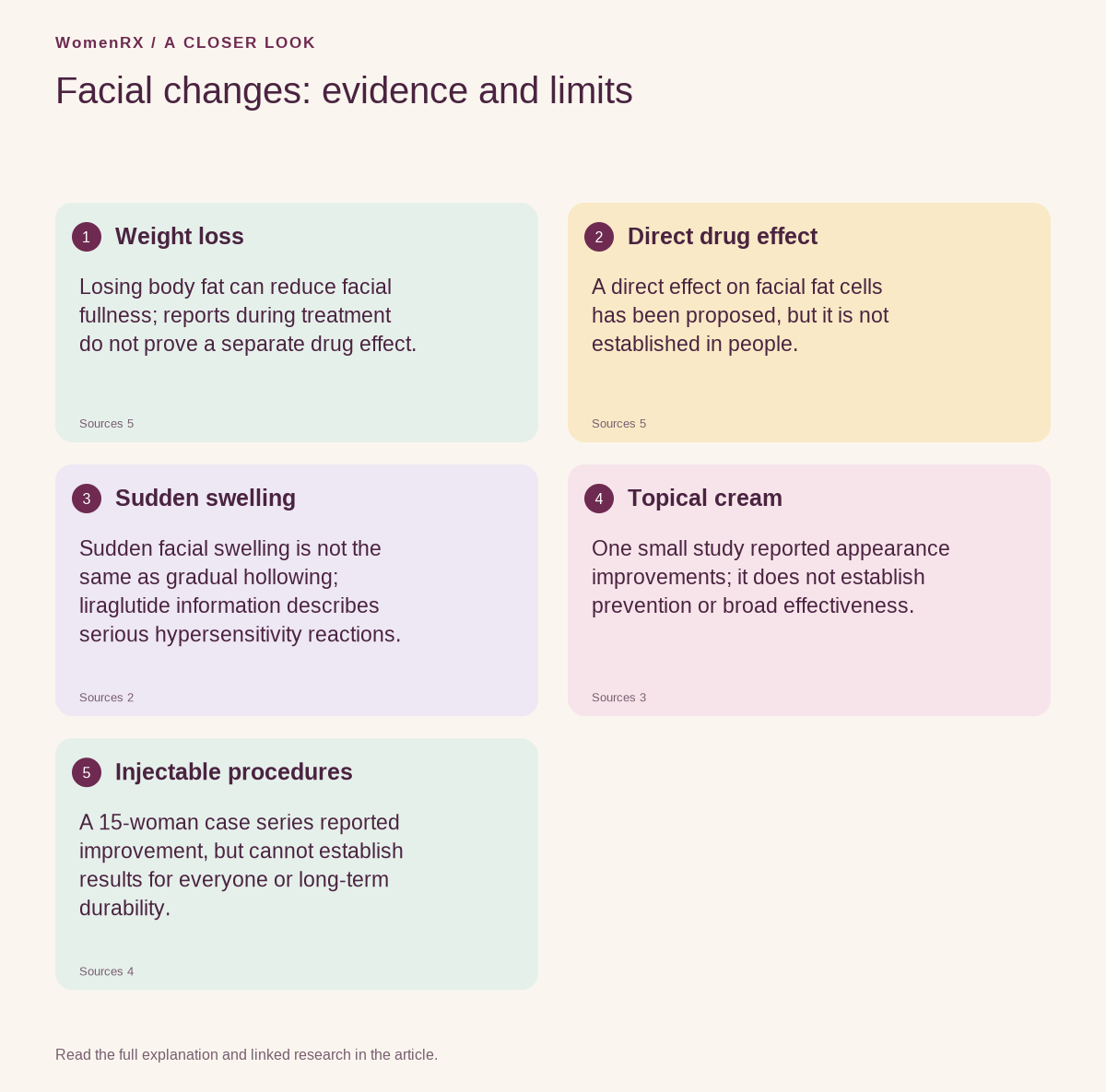
Facial changes: evidence and limits
Weight loss: Losing body fat can reduce facial fullness; reports during treatment do not prove a separate drug effect.5
Direct drug effect: A direct effect on facial fat cells has been proposed, but it is not established in people.5
Sudden swelling: Sudden facial swelling is not the same as gradual hollowing; liraglutide information describes serious hypersensitivity reactions.2
Topical cream: One small study reported appearance improvements; it does not establish prevention or broad effectiveness.3
Injectable procedures: A 15-woman case series reported improvement, but cannot establish results for everyone or long-term durability.4
Read the figure as text
Separate changes that can accompany weight loss from a potentially urgent swelling reaction and claims that remain unproven.- Weight loss: Losing body fat can reduce facial fullness; reports during treatment do not prove a separate drug effect.5
- Direct drug effect: A direct effect on facial fat cells has been proposed, but it is not established in people.5
- Sudden swelling: Sudden facial swelling is not the same as gradual hollowing; liraglutide information describes serious hypersensitivity reactions.2
- Topical cream: One small study reported appearance improvements; it does not establish prevention or broad effectiveness.3
- Injectable procedures: A 15-woman case series reported improvement, but cannot establish results for everyone or long-term durability.4
More questions, answered
Does “Ozempic face” mean the medicine damaged my skin?
Not by itself. It’s a popular description, not a diagnosis. Facial volume changes have been reported during GLP-1 treatment, but research hasn’t established whether the medicine directly causes them apart from weight loss. 5
Can a cream restore facial volume?
A small study of one topical cream reported improvements in appearance and skin measurements, but it doesn’t prove that creams can prevent or reliably restore facial volume. 3
Sources you can check
- Body Weight: MedlinePlusAccessed 2026-09-25Return to first citation
- SAXENDA (LIRAGLUTIDE) INJECTION, SOLUTION [NOVO NORDISK PHARMACEUTICAL INDUSTRIES, LP] | US prescribing information and patient instructionsAccessed 2026-09-25Return to first citation
- Topical Volumizing Cream Improves Facial Volume and Skin Health in Adults With Rapid Weight Loss From Pharmacologic (GLP-1/GIP Agonists), Surgical, or Behavioral Interventions.Nguyen N, Aguilar A, Afzal N, Lee A, Akram W, Duong MN, Sivamani RK. · Journal of cosmetic dermatology · 2026Return to first citation
- Aesthetic Use of Poly-L-Lactic Acid and Hyaluronic Acid Fillers in Medication-Driven Weight Loss Due to GLP-1 Receptor Agonists: Real-World Case Series from Latin America.Avelar LET, Sarlos P, Guarnieri C, Alvarez PP, Rojas GA, Rossiere N, Toro VA, Kamamoto C, Gomes RT, Nogueira A, Miot HA. · Clinical, cosmetic and investigational dermatology · 2026Return to first citation
- Functional and Aesthetic Periorbital, Ocular Adnexal and Ocular Surface Changes Linked to GLP-1 Receptor Agonists.Kapantais D, Tsoutsanis P. · Journal of clinical medicine · 2025Return to first citation