Hair Shedding During GLP-1 Weight Loss: What May Be Behind It
Hair shedding has been reported during GLP-1 treatment, but weight change, nutrition, and other health changes can also matter.
More shedding during treatment can happen, but it doesn’t prove the GLP-1 medicine directly caused it. Hair loss has appeared in clinical-trial analyses and other reports. Rapid weight loss and related changes in eating are plausible contributors, while a direct effect on hair follicles remains unproven. The pattern and what else changed can help guide an evaluation. 3 4
The connection is possible, but the cause isn’t settled
Hair shedding can be upsetting, especially when it begins during a treatment you’re taking for weight management. Reports have linked medicines such as semaglutide, liraglutide, and tirzepatide with hair loss. But an association doesn’t show that a medicine directly affects the hair follicle: weight change, eating less, and other health changes may overlap with treatment. Researchers haven’t established how much each factor contributes. 3
There is a signal in clinical-trial evidence, too. A benefit-harm modeling study drawing on eight randomized trials in people with overweight or obesity who did not have diabetes estimated 57 additional alopecia events per 1,000 people treated with GLP-1 medicines over two years compared with placebo; the estimate ranged from 10 to 176. This pooled, model-based estimate isn’t a prediction of what will happen to you. Most participants were women, but the study didn’t report a women-specific alopecia estimate. 4
A 2025 review also found reports across several GLP-1 medicines, but noted that most studies lacked dermatological diagnostic confirmation and that the type of hair loss was described in only one included study. So the evidence supports paying attention to new shedding, not assuming a proven direct drug effect or a single explanation. 3
The pattern offers clues, not a diagnosis
One possibility is telogen effluvium, a type of increased shedding associated with metabolic stress and the nutritional changes that can accompany rapid weight loss. If your weight has changed quickly or you’ve been eating substantially less, that offers a plausible explanation to explore. It still doesn’t prove what caused your shedding. Low protein intake and poor nutrition are also recognized possible contributors to hair loss. 3 1
Another reported type is androgenetic alopecia, often called pattern hair loss. Pattern hair loss often runs in families; in women, a widening part or gradual overall thinning can be a clue. In the GLP-1 research, however, descriptions of hair-loss types have been limited. What you notice about your hair is worth describing, but that description alone can’t identify the type or its cause. 3 6
A direct medication effect on the hair follicle has been proposed, but it hasn’t been established. That distinction matters: shedding that begins during treatment deserves attention without making the medicine the automatic explanation. 3
Look at what changed alongside treatment
Think back to when you first noticed more hair coming out. How does that line up with starting treatment, changes in weight, or a substantial change in how much you’re eating? Illness, stress, thyroid problems, and other medicines can also contribute to hair loss. Dates and patterns help organize the possibilities, but timing alone can’t identify the cause. 1 2 3
Your life stage may add another possibility. After childbirth, falling estrogen levels can cause noticeable shedding a few months later, even without a medication change. During perimenopause or after menopause, changes in hair density and texture, as well as pattern hair loss, can become more noticeable. Neither context establishes the cause of shedding that starts during GLP-1 treatment. 5 9
If you have heavy menstrual bleeding, mention it too. It’s a common cause of iron deficiency in women, and hair loss can be one symptom of iron deficiency. That makes it a reason to consider whether iron status needs checking, not a reason to assume you’re deficient or start taking iron. 8 7
When an examination could change the answer
If the shedding worries you, contact the clinician who manages your treatment. Describe whether you’re seeing more loose hairs throughout your scalp, a gradually widening part, or a distinct patch. A scalp examination can help distinguish causes that need different approaches. Scaly or inflamed areas also merit assessment, since scalp conditions can cause hair loss; some inflammatory forms can permanently damage follicles if they aren’t caught early. 6 7
Bring up changes in weight, eating, health, and other medicines. If an underlying condition or deficiency is suspected, a clinician may recommend testing rather than guessing from the hair loss alone. Hair-loss treatment depends on the cause, and in some cases addressing an underlying problem helps. 1 7
If treatment has made it harder to eat enough, say so. That’s more useful than assuming you need a hair supplement: low protein intake and poor nutrition are possible contributors, but neither establishes a deficiency in your case. Supplements such as iron, zinc, or biotin are best considered when testing shows a relevant deficiency. 1 7
Discuss the shedding and any proposed treatment change with the clinician who prescribes your medicine. The trial analysis found that overall benefit-harm estimates depended on treatment goals and individual preferences; it did not answer what any one person should do about hair loss. 4
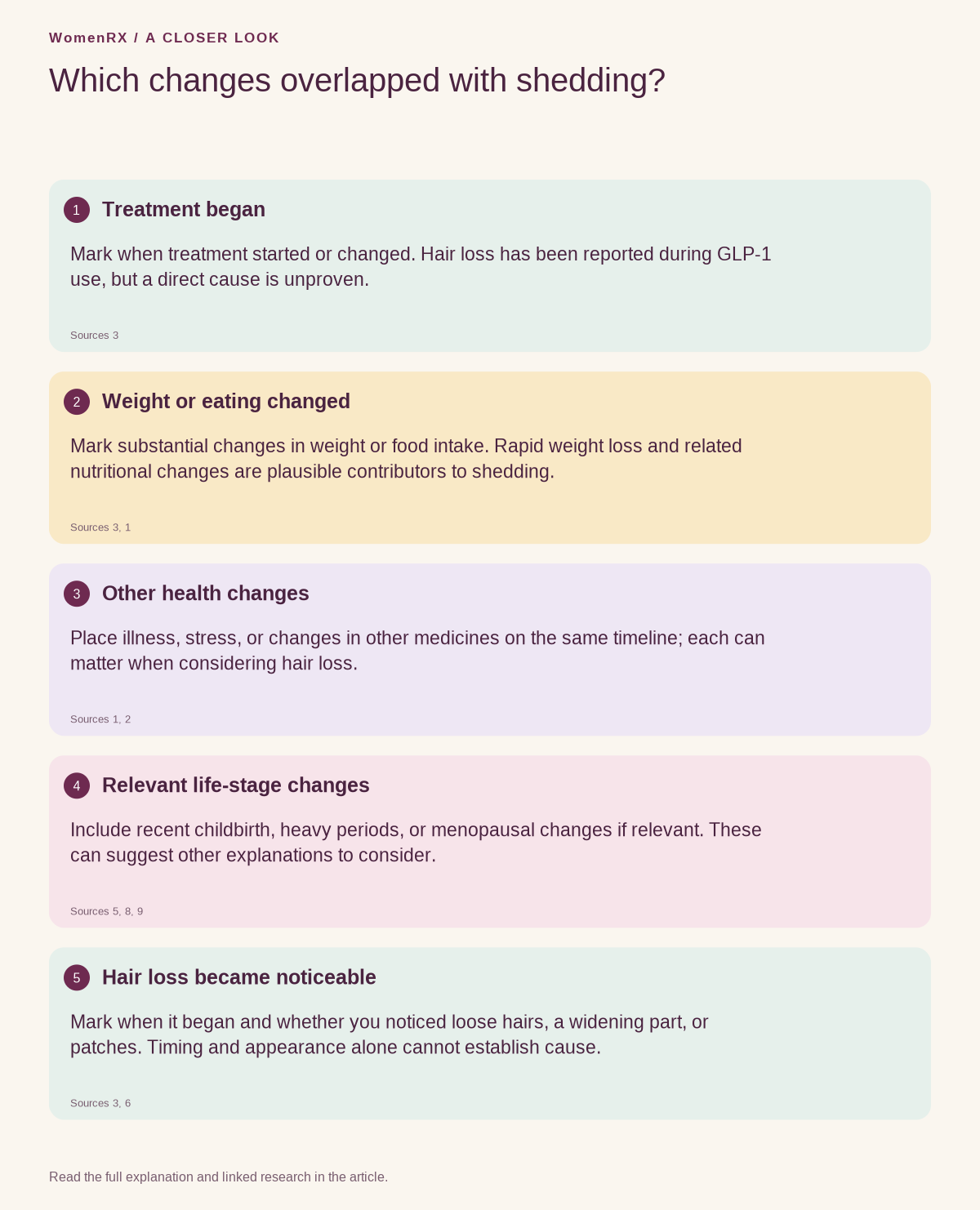
Which changes overlapped with shedding?
Treatment began: Mark when treatment started or changed. Hair loss has been reported during GLP-1 use, but a direct cause is unproven.3
Weight or eating changed: Mark substantial changes in weight or food intake. Rapid weight loss and related nutritional changes are plausible contributors to shedding.31
Other health changes: Place illness, stress, or changes in other medicines on the same timeline; each can matter when considering hair loss.12
Relevant life-stage changes: Include recent childbirth, heavy periods, or menopausal changes if relevant. These can suggest other explanations to consider.589
Hair loss became noticeable: Mark when it began and whether you noticed loose hairs, a widening part, or patches. Timing and appearance alone cannot establish cause.36
Read the figure as text
Place these events on your own timeline. They may happen in a different order, and overlap does not prove a cause.- Treatment began: Mark when treatment started or changed. Hair loss has been reported during GLP-1 use, but a direct cause is unproven.3
- Weight or eating changed: Mark substantial changes in weight or food intake. Rapid weight loss and related nutritional changes are plausible contributors to shedding.31
- Other health changes: Place illness, stress, or changes in other medicines on the same timeline; each can matter when considering hair loss.12
- Relevant life-stage changes: Include recent childbirth, heavy periods, or menopausal changes if relevant. These can suggest other explanations to consider.589
- Hair loss became noticeable: Mark when it began and whether you noticed loose hairs, a widening part, or patches. Timing and appearance alone cannot establish cause.36
More questions, answered
Does hair shedding mean I should stop my GLP-1 medicine?
Shedding alone doesn’t establish that the medicine caused it. Discuss the change and any treatment decision with the clinician who prescribes it. 3 6
Do women have a known higher risk?
The trial analysis included a majority of women, but it didn’t report a women-specific estimate for alopecia. Its results therefore can’t establish whether risk differs by sex. 4
Sources you can check
- Hair Loss | Alopecia | Alopecia Areata | MedlinePlusAccessed 2026-09-25Return to first citation
- Hair loss - NHSAccessed 2026-09-25Return to first citation
- Alopecia as an Emerging Adverse Effect Associated With Glucagon-Like Peptide-1 (GLP-1) Receptor Agonists for Weight Loss: A Scoping Review.Rojas Lopez RF, Lynett Barrera D, Amaya Muñoz MC, Saavedra Diaz MP. · Cureus · 2025Return to first citation
- GLP-1 receptor agonists for weight reduction in people living with obesity but without diabetes: a living benefit-harm modelling study.Moll H, Frey E, Gerber P, Geidl B, Kaufmann M, Braun J, Beuschlein F, Puhan MA, Yebyo HG. · EClinicalMedicine · 2024Return to first citation
- Hair loss in new moms: Dermatologist tipsAccessed 2026-09-25Return to first citation
- Hair loss: Who gets and causesAccessed 2026-09-25Return to first citation
- Hair loss: Diagnosis and treatmentAccessed 2026-09-25Return to first citation
- The misogyny of iron deficiency.Dugan C, MacLean B, Cabolis K, Abeysiri S, Khong A, Sajic M, Richards T, Women's Health research Collaborative. · Anaesthesia · 2021Return to first citation
- Menopause and hair loss in women: Exploring the hormonal transition.Gupta AK, Economopoulos V, Mann A, Wang T, Mirmirani P. · Maturitas · 2025Return to first citation