Hair Shedding During Tirzepatide Weight Loss: What to Check
The timing of shedding, weight change, and other health events can help separate a possible medication signal from other explanations.
Hair shedding has been reported during treatment with tirzepatide and other GLP-1 medicines, but current research can’t show whether tirzepatide itself causes it. Weight loss, changes in nutrition, illness, iron status, and thyroid disease may also matter. Compare when shedding began with these events, and don’t start iron without checking whether you need it. 1 4 6
Hair coming out in the shower or brush can feel alarming, especially when it starts after a new medication. Tirzepatide-associated hair loss is a reported signal, but that timing alone doesn’t prove the drug is the cause. Reviews describe hair-loss reports among people using GLP-1 medicines, including tirzepatide, while also noting that the available studies don’t establish cause and effect. 5 6
A useful next step is to set the dates side by side: when you started tirzepatide, when your weight began changing, when shedding appeared, and what else was happening in your health or life. This won’t diagnose the cause, but it can make the possibilities easier to discuss and help identify factors that might be treatable.
First, notice what kind of hair loss you’re seeing
A temporary shedding pattern is different from gradual thinning or distinct bare patches. Telogen effluvium is a type of diffuse, temporary shedding associated with physical or psychological stressors. It has been reported among the hair-loss patterns in GLP-1 research, but the studies don’t establish that tirzepatide directly triggers it. 6
Gradual thinning may point to a different pattern, while sharply defined patches can be a different type of hair loss altogether. The appearance can help guide an evaluation; it can’t identify the cause on its own. 3 6
Build a timeline, not a verdict
Write down four dates or periods, as best you can remember:
- Medication: When did you start tirzepatide, and when did you notice shedding? A sequence is worth sharing, but it doesn’t prove the medicine caused the change.
- Weight and eating: Was weight changing quickly? Had nausea, reduced appetite, or food restrictions made it hard to eat a varied diet? Poor nutrition and a low-protein diet are recognized possible contributors to hair loss. 1
- Other health events: Note a recent illness, major stress, or a change in health. Illness and stress are recognized possible causes of hair loss. 1 2
- Menstrual and diet history: If you have heavy menstrual bleeding or a restricted diet, mention that too. These are reasons to consider iron status discussed in research on alopecia areata, not evidence that iron deficiency explains tirzepatide-associated shedding. 3
There isn’t enough evidence to give a reliable number of weeks between starting tirzepatide, losing weight, and shedding. Don’t use a guessed delay to rule a cause in or out. The more useful comparison is whether shedding followed weight change, a health event, or another relevant change, and whether the pattern is diffuse or patchy.
Check possible contributors before trying supplements
Iron is one possibility, not a diagnosis. A systematic review and meta-analysis found that women with nonscarring alopecia had lower average ferritin levels than women without it, but the review also described the evidence as lacking a clear-cut association. That supports considering iron status in context, not assuming that low iron explains everyone’s shedding. 4 Research specifically on alopecia areata identifies heavy menstrual bleeding and dietary restriction as relevant history when assessing iron status; it does not establish when testing is needed for shedding during tirzepatide-associated weight loss. 3
Thyroid disease and nutrition can also matter. Thyroid problems, poor nutrition, and a low-protein diet are listed among possible causes of hair loss. If any fit your history, they’re reasonable alternatives to raise rather than focusing only on tirzepatide. 1
Don’t start iron solely because you’ve noticed shedding. Hair-loss treatment depends on the cause, and lower average ferritin among women with hair loss doesn’t show that iron supplements will help someone whose iron status hasn’t been assessed. 1 4 If eating has become difficult during weight loss, describe what you’re managing to eat and drink; that may be more useful than adding iron without assessment.
When it’s worth getting the pattern checked
If shedding is worrying you, is continuing, or you’re noticing patches or a clear change in your hair’s pattern, bring it up with the clinician who manages your care or a dermatologist. A focused discussion can include the medication and weight timeline, recent illness, diet changes, menstrual bleeding, and whether thyroid or iron evaluation fits your situation. Hair loss has different causes, and treatment depends on identifying the one that applies. 1 2
The central question isn’t simply, “Did this start after tirzepatide?” It’s, “What changed before it started, and what kind of hair loss is happening?” That gives you a more useful starting point while the direct drug effect remains uncertain.
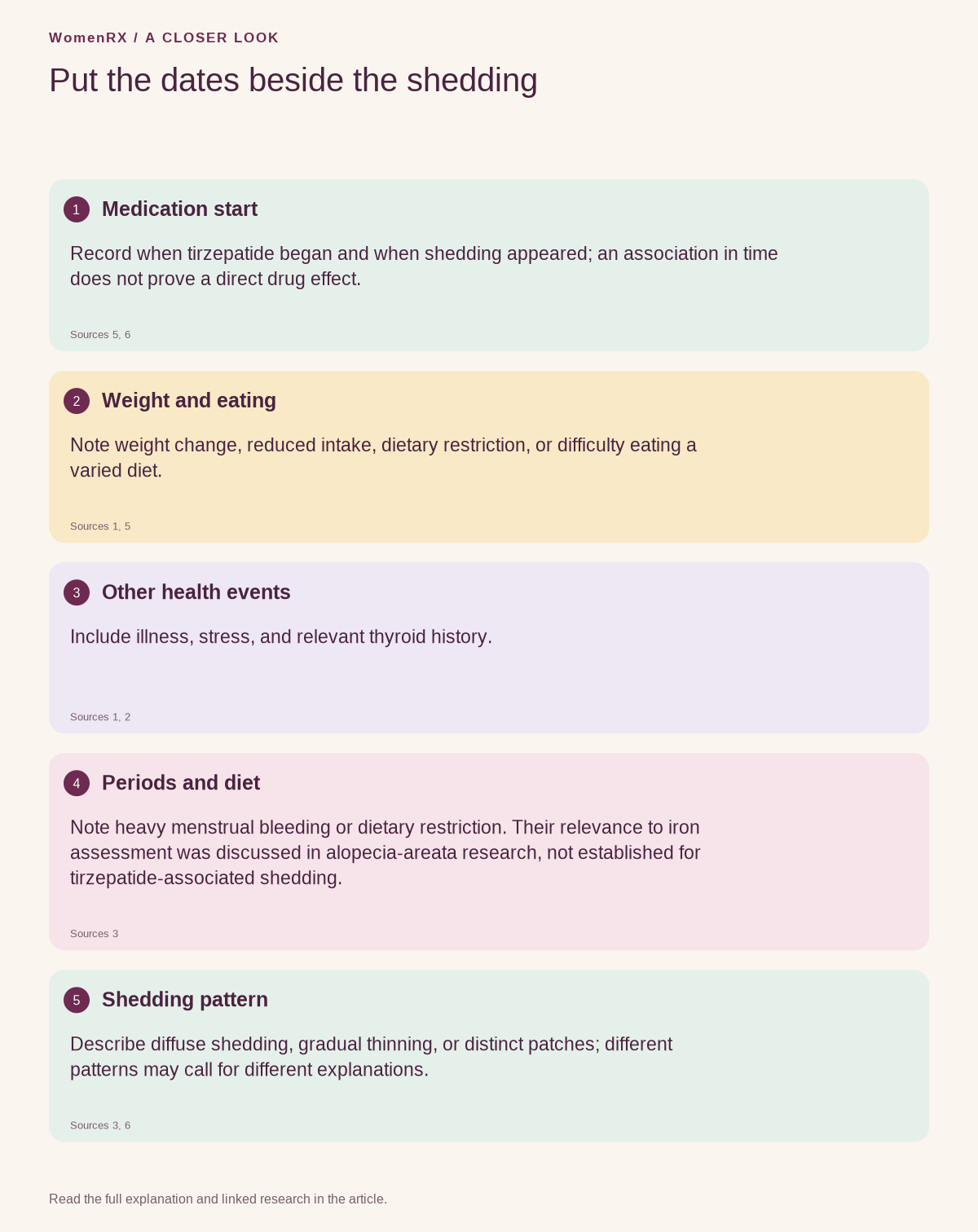
Put the dates beside the shedding
Medication start: Record when tirzepatide began and when shedding appeared; an association in time does not prove a direct drug effect.56
Weight and eating: Note weight change, reduced intake, dietary restriction, or difficulty eating a varied diet.15
Other health events: Include illness, stress, and relevant thyroid history.12
Periods and diet: Note heavy menstrual bleeding or dietary restriction. Their relevance to iron assessment was discussed in alopecia-areata research, not established for tirzepatide-associated shedding.3
Shedding pattern: Describe diffuse shedding, gradual thinning, or distinct patches; different patterns may call for different explanations.36
Read the figure as text
Compare events that may help frame the question. The sequence can guide a conversation, but it cannot diagnose the cause or establish a fixed delay.- Medication start: Record when tirzepatide began and when shedding appeared; an association in time does not prove a direct drug effect.56
- Weight and eating: Note weight change, reduced intake, dietary restriction, or difficulty eating a varied diet.15
- Other health events: Include illness, stress, and relevant thyroid history.12
- Periods and diet: Note heavy menstrual bleeding or dietary restriction. Their relevance to iron assessment was discussed in alopecia-areata research, not established for tirzepatide-associated shedding.3
- Shedding pattern: Describe diffuse shedding, gradual thinning, or distinct patches; different patterns may call for different explanations.36
More questions, answered
Does hair shedding mean I should stop tirzepatide?
Shedding by itself doesn’t establish that tirzepatide caused it. The available reviews describe a possible association but say causality remains unresolved. 5 6
Should I start iron?
Not solely because you’ve noticed shedding. Women with nonscarring alopecia had lower average ferritin in one meta-analysis, but the authors noted that a clear-cut association has not been established. Whether iron testing or supplementation fits depends on your history and evaluation. 4
Sources you can check
- Hair Loss | Alopecia | Alopecia Areata | MedlinePlusAccessed 2026-09-25Return to first citation
- Hair loss - NHSAccessed 2026-09-25Return to first citation
- The Association Between Alopecia Areata and Iron Deficiency Anemia: A Large-Scale Population-Based Case-Control Study.Davidovici B, Drutin Y, Ben-Tov A, Mimouni D, Wohl Y. · Journal of personalized medicine · 2026Return to first citation
- Iron Deficiency and Nonscarring Alopecia in Women: Systematic Review and Meta-Analysis.Treister-Goltzman Y, Yarza S, Peleg R. · Skin appendage disorders · 2022Return to first citation
- Alopecia as an Emerging Adverse Effect Associated With Glucagon-Like Peptide-1 (GLP-1) Receptor Agonists for Weight Loss: A Scoping Review.Rojas Lopez RF, Lynett Barrera D, Amaya Muñoz MC, Saavedra Diaz MP. · Cureus · 2025Return to first citation
- GLP-1 therapies and hair loss: A systematic review of current evidence and implications for counseling.Gupta AK, Teasell EM, Economopoulos V, Mirmirani P. · Science progress · 2026Return to first citation