Hair Shedding During Ozempic-Associated Weight Loss
The timing and pattern of shedding can help you sort through possible causes, even though neither can identify one on its own.
Hair shedding while taking Ozempic could coincide with weight loss, changes in eating, or an unrelated cause. Studies report an association between semaglutide and hair-loss diagnoses, but they don’t show what caused any one person’s shedding. Notice whether hair is coming out across your scalp or thinning gradually in a pattern, then consider what else has changed. 167
First, look at what’s changing
More hair in the shower can feel sudden, even when it’s hard to tell exactly when the change began. Start with a simple distinction: are you seeing increased shedding across your scalp, or does your hair look gradually thinner in a particular pattern?
Telogen effluvium describes diffuse, usually temporary shedding associated with a change in the hair-growth cycle. Female-pattern hair loss is generally more gradual. The two can overlap: an episode of shedding may make existing patterned thinning easier to notice. You don’t need to identify the type yourself, but describing what you see gives a clinician more to work with than “my hair is falling out.” 6
Where Ozempic and weight loss fit
A systematic review found reports of hair loss among people using semaglutide and identified rapid weight loss as one possible contributor. A retrospective study of adults with type 2 diabetes or obesity also found higher odds of certain nonscarring hair-loss diagnoses among semaglutide users than among matched nonusers. These findings show an association. They don’t separate a direct medicine effect from the effects of weight change or establish the cause of an individual’s hair loss. 67
Food intake is worth considering too. For example, if your appetite has changed enough that you’re regularly eating much less, mention that when you describe the shedding. Poor nutrition and a low-protein diet are possible contributors to hair loss. That’s a reason to look at what you’ve been able to eat, not a reason to assume you need a hair supplement. 1
Use timing to build a picture, not a verdict
Think back to when you first noticed more shedding. Was there already gradual thinning before treatment? Did shedding appear during a period of weight change or reduced eating? Was there also an illness or a particularly stressful stretch? Illness, stress, thyroid problems, some medicines, and inherited or age-related thinning are among other possible contributors to hair loss. 1
Write down approximate dates if you know them, but don’t worry about finding a perfect sequence. Research has not established a dependable interval between starting semaglutide or losing weight and noticing shedding. A timeline helps you describe what happened; it cannot prove why it happened. 67
Don’t leave out changes specific to your life
If you have heavy periods, bring them up even if they seem unrelated to your hair. Heavy menstrual bleeding is a common cause of iron deficiency, and hair loss is among the symptoms women report with iron deficiency. That history makes iron worth considering in an evaluation; it does not establish a deficiency or mean you should start iron on your own. 5
Pregnancy or a recent birth also belongs in the picture. Hair changes after pregnancy can occur, but the frequency and definition of postpartum telogen effluvium remain uncertain. Persistent changes shouldn’t automatically be attributed to having had a baby. 34
If you’re in perimenopause or postmenopause, say whether thinning was gradual and present before the newer shedding. Age-related and female-pattern hair loss may be relevant in midlife, but menopause alone isn’t an explanation for every new hair change. 16
When an evaluation is useful
If shedding is continuing, you’re unsure what pattern you’re seeing, or the change is affecting your well-being, make an appointment to have it assessed. A clinician may be able to learn from examining your hair and scalp, alongside your history; treatment depends on the cause. 12
A useful account covers three things: what changed (diffuse shedding, gradual thinning, or both), when you noticed it relative to treatment and weight change, and what else was happening with eating, illness, stress, periods, pregnancy, or other medicines. That keeps the focus on finding the cause rather than assuming Ozempic is either responsible or irrelevant. 156
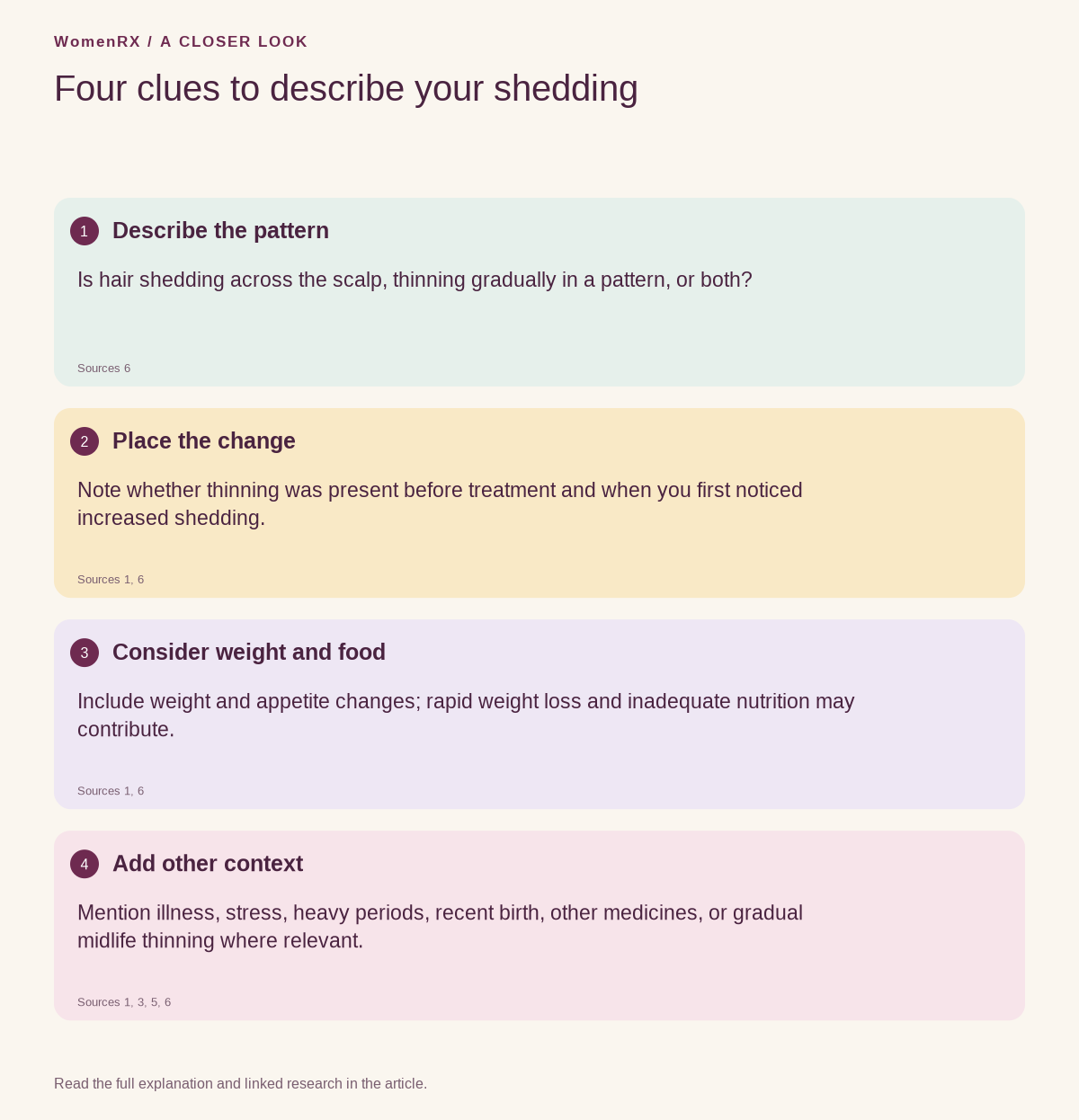
Four clues to describe your shedding
Describe the pattern: Is hair shedding across the scalp, thinning gradually in a pattern, or both?6
Place the change: Note whether thinning was present before treatment and when you first noticed increased shedding.16
Consider weight and food: Include weight and appetite changes; rapid weight loss and inadequate nutrition may contribute.16
Add other context: Mention illness, stress, heavy periods, recent birth, other medicines, or gradual midlife thinning where relevant.1356
Read the figure as text
Use these observations to organize what changed. None can prove that Ozempic caused hair loss.- Describe the pattern: Is hair shedding across the scalp, thinning gradually in a pattern, or both?6
- Place the change: Note whether thinning was present before treatment and when you first noticed increased shedding.16
- Consider weight and food: Include weight and appetite changes; rapid weight loss and inadequate nutrition may contribute.16
- Add other context: Mention illness, stress, heavy periods, recent birth, other medicines, or gradual midlife thinning where relevant.1356
Sources you can check
- Hair Loss | Alopecia | Alopecia Areata | MedlinePlusAccessed 2026-09-25Return to first citation
- Hair loss - NHSAccessed 2026-09-25Return to first citation
- Considerations for cutaneous physiologic changes of pregnancy that fail to resolve postpartum.Anzelc MJ, Bechtel MA. · International journal of dermatology · 2023Return to first citation
- The Postpartum Telogen Effluvium Fallacy.Mirallas O, Grimalt R. · Skin appendage disorders · 2016Return to first citation
- The misogyny of iron deficiency.Dugan C, MacLean B, Cabolis K, Abeysiri S, Khong A, Sajic M, Richards T, Women's Health research Collaborative. · Anaesthesia · 2021Return to first citation
- GLP-1 therapies and hair loss: A systematic review of current evidence and implications for counseling.Gupta AK, Teasell EM, Economopoulos V, Mirmirani P. · Science progress · 2026Return to first citation
- Nonscarring Alopecia in Adults Treated With GLP-1s: A Propensity Score Matched TriNetX Cohort Study.Katragadda R, Hayden J, Saltagi AK, Welschmeyer AF, Quereshy HA, Karasik D, Rabbani CC, Gourishetti SC, Goslawski AM. · The Laryngoscope · 2026Return to first citation