Wegovy and Hair Loss: What the Evidence Can Tell You
Hair shedding has been reported with semaglutide, but weight change, reduced food intake, and other health factors may also matter.
Some studies have found more hair-loss reports or diagnoses among people taking semaglutide and other GLP-1 medicines. That’s a possible association, not proof that Wegovy directly caused an individual person’s shedding. Rapid weight loss and changes in eating may also contribute, and the evidence can’t yet separate those effects reliably. Record what changed and when, then discuss the pattern with your prescriber. 2345
What the evidence says, and what it doesn’t
Hair loss has been reported among people using semaglutide, including in studies of GLP-1 medicines prescribed for weight loss. Reviews describe a possible association, but the underlying research includes different kinds of studies, and many reports did not confirm the type of hair loss through a dermatology examination. A retrospective cohort study also found higher odds of some nonscarring hair-loss diagnoses among semaglutide users. These findings raise a question worth discussing; they don’t show that Wegovy directly caused any one person’s shedding. 234
There’s another possible part of the picture: weight loss itself. Rapid weight loss and metabolic or nutritional changes have been proposed as triggers for telogen effluvium, a form of shedding. In the cohort study, people who had hair-loss outcomes also had lower follow-up body mass index, a finding that may fit with a weight-loss contribution. It doesn’t establish that weight loss caused the shedding, or rule out a medication effect. Reviews also describe the evidence as limited or conflicting. 2345
So the useful distinction isn’t simply “Wegovy or no Wegovy.” The medication, the pace and extent of weight change, changes in food intake, and other health factors may overlap. Current evidence can’t reliably tell you which factor is responsible in an individual case, or predict whether a particular person will experience hair loss.
The pattern and context can help narrow the possibilities
Research reports include telogen effluvium and androgenetic, or pattern, hair loss. One review found that only one of the studies it included described hair-loss subtypes in detail, which is a reminder that the labels in research reports aren’t always based on a close clinical assessment. 23
Hair shedding can have causes beyond a medicine or weight change. Thyroid problems, poor nutrition, a low-protein diet, stress, illness, and family history are among the causes listed in general hair-loss guidance. That doesn’t mean any one of them explains your symptoms; it means they may be relevant context to share. 1
Keep a short record before you discuss it
A few details can make a conversation more useful. Write down when you first noticed a change, whether it has continued or shifted, and whether you’re seeing more loose hairs, less overall fullness, or another change. Note your weight trend and the pace of weight loss, along with changes in appetite, meal patterns, or the range of foods you’re eating. These details can help put the possible weight-loss and nutrition links in context; they don’t diagnose a cause. 234
Also include recent illness or stress, known thyroid problems, and medicines or other health changes around the same time. If you’ve had a recent pregnancy or are in another period of major hormonal change, mention that too: it’s relevant background for an evaluation, even though the studies summarized here don’t establish how those situations interact with Wegovy. 1
Your prescriber can review the timeline and treatment alongside these other factors. If the shedding is upsetting or you’re unsure what kind of hair loss you’re seeing, ask whether an examination or a dermatology assessment would help. Don’t assume that hair shedding proves a nutrient deficiency, and don’t start supplements on that assumption. Don’t change a prescribed treatment solely because the timing seems connected; discuss the concern and your options with the person managing your treatment.
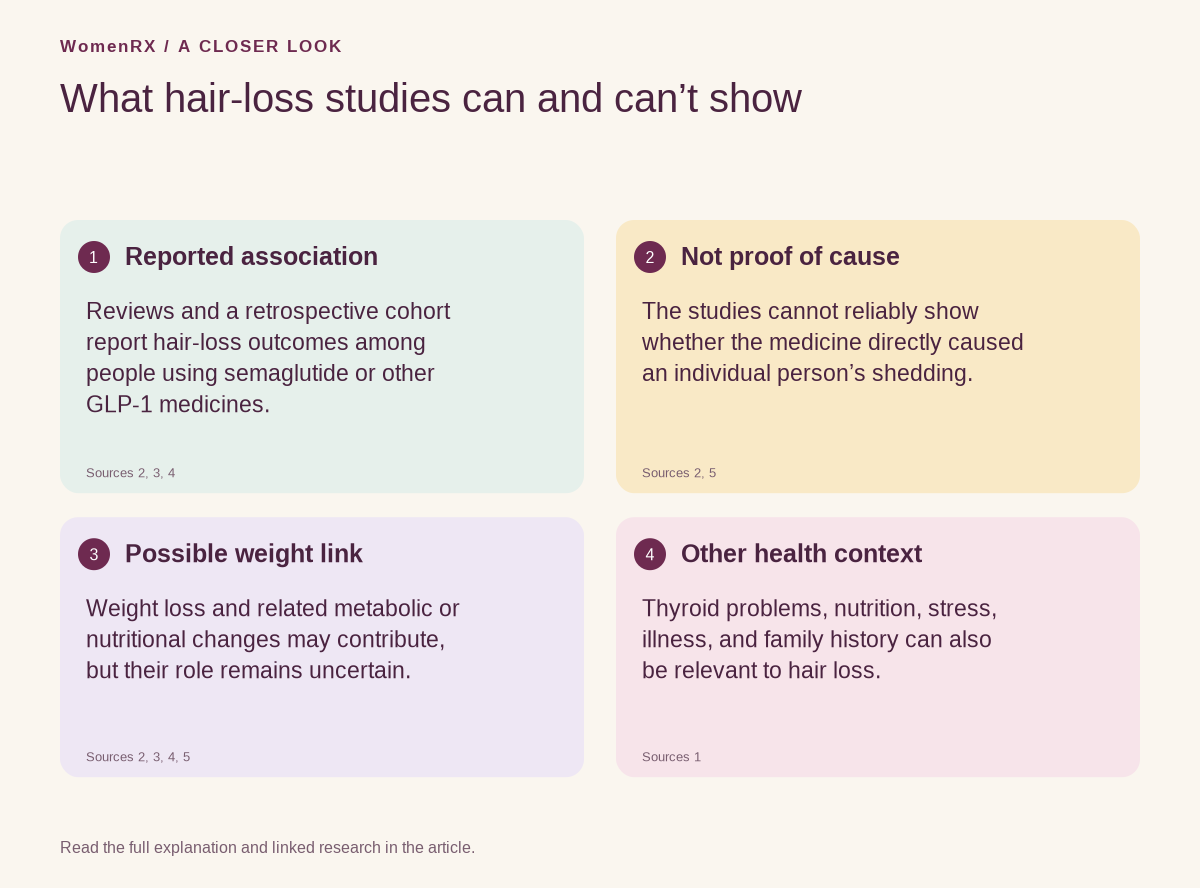
What hair-loss studies can and can’t show
Reported association: Reviews and a retrospective cohort report hair-loss outcomes among people using semaglutide or other GLP-1 medicines.234
Not proof of cause: The studies cannot reliably show whether the medicine directly caused an individual person’s shedding.25
Possible weight link: Weight loss and related metabolic or nutritional changes may contribute, but their role remains uncertain.2345
Other health context: Thyroid problems, nutrition, stress, illness, and family history can also be relevant to hair loss.1
Read the figure as text
Separate observed reports from possible explanations and from other causes worth mentioning.- Reported association: Reviews and a retrospective cohort report hair-loss outcomes among people using semaglutide or other GLP-1 medicines.234
- Not proof of cause: The studies cannot reliably show whether the medicine directly caused an individual person’s shedding.25
- Possible weight link: Weight loss and related metabolic or nutritional changes may contribute, but their role remains uncertain.2345
- Other health context: Thyroid problems, nutrition, stress, illness, and family history can also be relevant to hair loss.1
More questions, answered
Does hair shedding mean I have a nutrient deficiency?
No. Poor nutrition and a low-protein diet can be among several possible contributors to hair loss, but shedding alone can’t identify a deficiency. Share changes in your eating and weight with your clinician rather than assuming a cause or starting supplements on that basis. 1
Should I stop Wegovy if I notice shedding?
The research doesn’t establish that Wegovy is the cause in an individual case. Discuss the change with the prescriber managing your treatment before making a decision about it; the timing, weight trend, food intake, and other health factors may all matter. 245
Sources you can check
- Hair Loss | Alopecia | Alopecia Areata | MedlinePlusAccessed 2026-09-25Return to first citation
- Alopecia as an Emerging Adverse Effect Associated With Glucagon-Like Peptide-1 (GLP-1) Receptor Agonists for Weight Loss: A Scoping Review.Rojas Lopez RF, Lynett Barrera D, Amaya Muñoz MC, Saavedra Diaz MP. · Cureus · 2025Return to first citation
- GLP-1 therapies and hair loss: A systematic review of current evidence and implications for counseling.Gupta AK, Teasell EM, Economopoulos V, Mirmirani P. · Science progress · 2026Return to first citation
- Nonscarring Alopecia in Adults Treated With GLP-1s: A Propensity Score Matched TriNetX Cohort Study.Katragadda R, Hayden J, Saltagi AK, Welschmeyer AF, Quereshy HA, Karasik D, Rabbani CC, Gourishetti SC, Goslawski AM. · The Laryngoscope · 2026Return to first citation
- The Role of Glucagon-Like Peptide-1 Receptor Agonists in Hair Loss: Clinical Evidence and Proposed Mechanisms.Zarabian N, Farah M, Stines A, Friedman A. · Dermatologic surgery : official publication for American Society for Dermatologic Surgery [et al.] · 2026Return to first citation