Wegovy and Lean-Mass Loss: What the Evidence Can Tell You
Wegovy can reduce lean mass as well as fat, but a lean-mass measurement is not the same as a measure of muscle strength or function.
Semaglutide-associated weight loss can include a reduction in lean mass, while fat loss is generally greater. But “lean mass” includes more than skeletal muscle, and a change on a body-composition test doesn’t by itself show that you’ve lost strength or function. Ask what was measured, whether the result would change your care, and how to support nutrition and strength during treatment. 1 5
Lean mass is not a muscle-only reading
Wegovy reduces appetite and calorie intake. Its prescribing information says weight loss involves greater loss of fat mass than lean mass, but that doesn’t mean every person loses the same mix of tissue. 1
The word lean can sound like a direct measurement of muscle. It isn’t. Depending on the method, lean or fat-free mass can include skeletal muscle, organs, bones, body fluids, and changes in hydration. A lower lean-mass result therefore doesn’t tell you, on its own, how much muscle changed or whether your muscles are working less well. 2 5
That distinction matters in everyday life. A scan or scale might show a change while your strength and ability to do usual activities remain steady. Or a change in strength or function could be worth discussing even if a body-composition number seems reassuring. Body weight alone can’t settle either question.
What the semaglutide studies can, and can’t, show
Across randomized trials of GLP-1 medicines used at obesity-treatment doses, a 2026 meta-analysis found that absolute lean mass decreased on average, while lean mass made up a larger share of the weight remaining after treatment. Those are different findings, not a contradiction: the proportion can rise when fat mass falls more. The analysis combined different medicines and studies, and the results for absolute lean-mass change varied substantially, so its average isn’t a forecast for one Wegovy user. 2
A small MRI analysis within the STEP UP trial offers a closer look at muscle. Of 1,407 trial participants, 55 had a valid baseline scan: 49 in the pooled semaglutide groups and 6 in the placebo group. The analysis estimated a reduction in thigh skeletal-muscle volume with semaglutide versus placebo, but the difference was not statistically significant. Sit-to-stand repetitions were reported as 13 at baseline and 15 at week 72 across the pooled semaglutide and placebo groups. With so few scans, especially in the placebo group, this analysis can’t establish what happens to muscle function for an individual. 4
A separate, small retrospective study in routine care found that people receiving semaglutide had lower measured skeletal-muscle and fat-free mass after 12 months, while absolute handgrip strength was preserved in both the semaglutide and lifestyle groups. That’s a useful reminder that tissue measurements and function can move differently. Because the study wasn’t randomized, it can’t show that semaglutide caused each change or predict what will happen to you. 3
Together, these findings support a measured conclusion: lean mass may fall during semaglutide-associated weight loss, but a lean-mass change alone doesn’t establish clinically meaningful muscle impairment. Longer-term evidence about function is still limited. 2 4 5
Make the conversation about function, too
A useful follow-up is more specific than “Did I lose muscle?” You might ask:
- What test produced this result? Was it an estimate of lean mass, fat-free mass, or a more specific measure of muscle? Could changes in hydration affect how it’s interpreted?
- Does it match what I notice? Are everyday activities, exercise, or strength changing, or is this only a number on a scan or scale?
- Would another measure help? Ask whether checking strength or function would add useful information, and whether repeating a body-composition test would change your plan.
- How can I meet nutrition needs while my appetite is lower? Ask what a realistic eating pattern looks like for you, especially if nausea or other digestive symptoms make eating difficult.
- What strength activity fits my health and starting point? Ask how to build or maintain resistance exercise in a way that is appropriate for you.
- When should we revisit this? Agree on what would prompt a check-in, such as a noticeable change in strength, function, or ability to eat adequately.
Nutrition counseling and resistance exercise are commonly proposed as supportive parts of obesity treatment, but evidence that a particular nutrition or exercise plan prevents muscle loss specifically during Wegovy treatment is not settled. Ask for a plan tailored to your health, activity level, and ability to eat, rather than assuming a supplement or a single body-composition number is the answer. 2 5
Make the questions fit your life stage
Age and menopause can affect how relevant a strength or function check feels to you, but the studies summarized here don’t establish a different semaglutide-related lean-mass effect for women by age or menopausal status. The STEP UP MRI analysis reports overall trial results, and the real-world study doesn’t provide a women-specific treatment estimate. Ask your clinician to interpret your baseline strength and health in your own context rather than applying an assumed women-specific percentage. 3 4
If pregnancy is possible or planned, raise that separately from the muscle question. Lean-mass studies don’t answer whether or when Wegovy is appropriate around pregnancy. Ask how your plans affect treatment choices and timing; don’t infer pregnancy guidance from body-composition results.
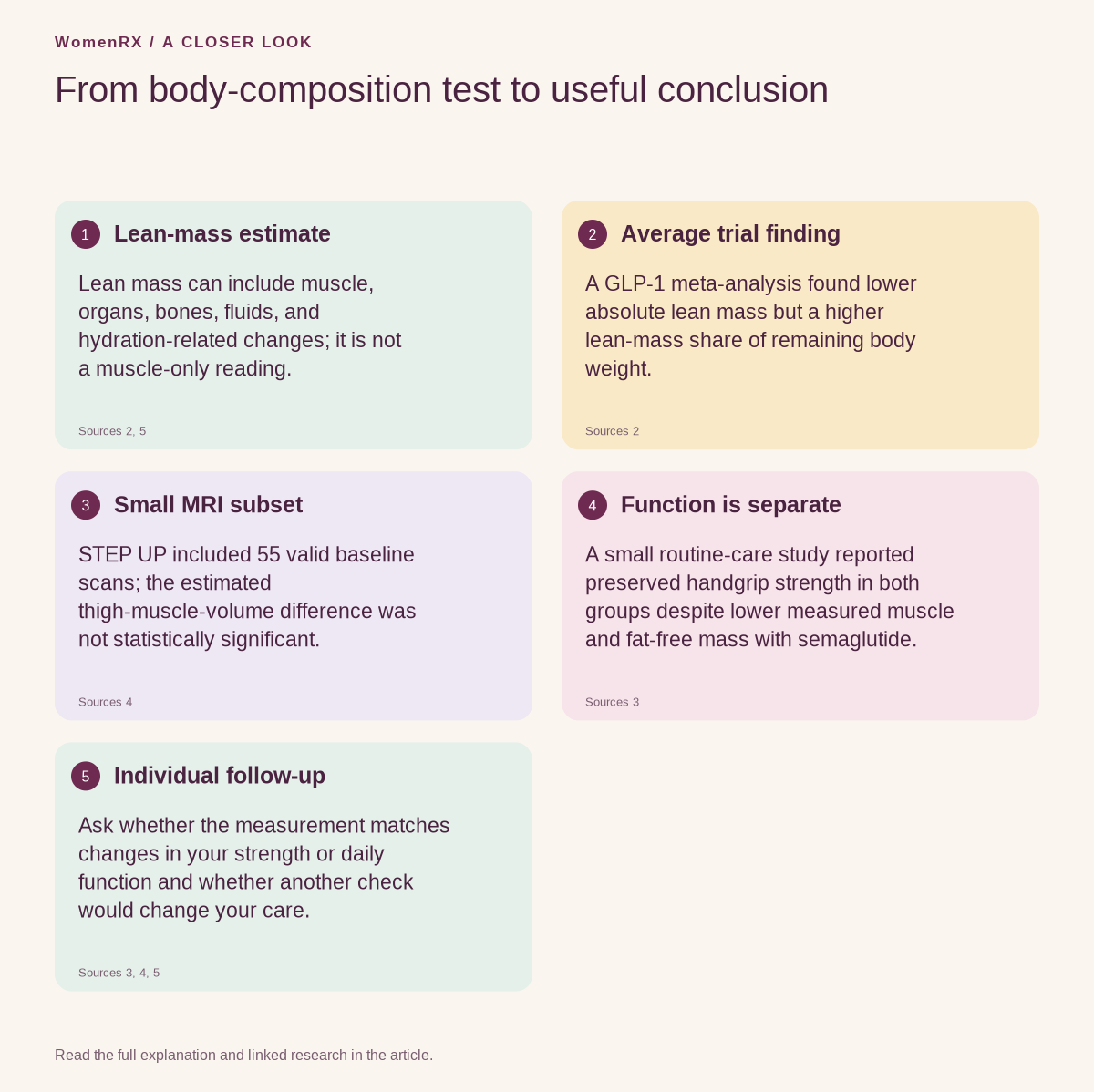
From body-composition test to useful conclusion
Lean-mass estimate: Lean mass can include muscle, organs, bones, fluids, and hydration-related changes; it is not a muscle-only reading.25
Average trial finding: A GLP-1 meta-analysis found lower absolute lean mass but a higher lean-mass share of remaining body weight.2
Small MRI subset: STEP UP included 55 valid baseline scans; the estimated thigh-muscle-volume difference was not statistically significant.4
Function is separate: A small routine-care study reported preserved handgrip strength in both groups despite lower measured muscle and fat-free mass with semaglutide.3
Individual follow-up: Ask whether the measurement matches changes in your strength or daily function and whether another check would change your care.345
Read the figure as text
Follow the evidence from what a test measures to what you can reasonably ask about your own strength and follow-up.- Lean-mass estimate: Lean mass can include muscle, organs, bones, fluids, and hydration-related changes; it is not a muscle-only reading.25
- Average trial finding: A GLP-1 meta-analysis found lower absolute lean mass but a higher lean-mass share of remaining body weight.2
- Small MRI subset: STEP UP included 55 valid baseline scans; the estimated thigh-muscle-volume difference was not statistically significant.4
- Function is separate: A small routine-care study reported preserved handgrip strength in both groups despite lower measured muscle and fat-free mass with semaglutide.3
- Individual follow-up: Ask whether the measurement matches changes in your strength or daily function and whether another check would change your care.345
Sources you can check
- WEGOVY (SEMAGLUTIDE) INJECTION, SOLUTION WEGOVY (SEMAGLUTIDE) TABLET [NOVO NORDISK PHARMACEUTICAL INDUSTRIES, LP] | US prescribing information and patient instructionsAccessed 2026-09-25Return to first citation
- Effect of GLP-1 receptor agonists at doses for obesity management on muscle health: systematic review and meta-analysis of randomized controlled trials (RCTs).Laverde LP, Muñoz-Velandia OM, Alfonso D, Gómez Medina AM. · International journal of obesity (2005) · 2026Return to first citation
- Longitudinal Changes in Body Composition, Adaptive Thermogenesis and Muscle Strength in Patients with Obesity Treated with Semaglutide.Filippi-Arriaga F, Comas M, Prats A, Juan A, Vidal E, Costa P, Flores V, Oliver-Vila C, Fidilio E, Ciudin A. · Obesity facts · 2026Return to first citation
- Effect of Semaglutide on Thigh Skeletal Muscle Volume, Fat Infiltration and Physical Function in People With Obesity: Secondary Analysis of STEP UP.Hjelmesæth J, Bhat S, Garvey WT, Kolnes KJ, Linge J, Lingvay I, Rasmussen NK, Rosenstock J, Wharton S. · Diabetes, obesity & metabolism · 2026Return to first citation
- Lean Mass and Musculoskeletal Preservation in GLP-1-Based Obesity Treatment: Nutrition, Exercise, Supplementation, and Monitoring Strategies.Šantić R, Martinović L, Pavlović N, Rušić D, Kumrić M, Martinović D, Tičinović Kurir T, Božić J. · Metabolites · 2026Return to first citation