Hair Loss on Ozempic: What the Evidence Shows
Hair-loss studies have raised a possible semaglutide link, but the pattern of change and your wider health history can help make an evaluation more useful.
Studies have reported hair loss among people taking semaglutide and other GLP-1 medicines, but they don’t establish that Ozempic is the cause of any one woman’s shedding. Diffuse shedding and gradual patterned thinning are different clues. If the change worries you, an evaluation can help identify the pattern and consider other possible causes. 2 3 4 5
What the research can, and can’t, say
Hair loss has appeared in reports and studies involving GLP-1 medicines, including semaglutide. A 2025 scoping review found that the available studies were few and often lacked a dermatologist-confirmed diagnosis. A later systematic review and meta-analysis reported an association between GLP-1 medicines and nonscarring hair loss, but pooled results don’t establish that semaglutide directly caused shedding in an individual person. 3 6
A retrospective study compared adults taking semaglutide or other GLP-1 medicines with matched nonusers. It found higher odds of some nonscarring hair-loss diagnoses among semaglutide users. Follow-up body mass index was lower among users who had hair-loss outcomes than among users who did not, a finding consistent with weight change potentially playing a part. The study cannot establish why the hair loss occurred. 5
Some review authors say women may be disproportionately affected, but the research doesn’t provide a dependable women-specific risk estimate. The cohort abstract also doesn’t report a separate result for women. Much of the evidence concerns GLP-1 medicines as a group rather than Ozempic alone. 4 5
Shedding or gradual thinning?
Diffuse shedding means noticing more loose hairs across the scalp, rather than a change limited to one spot. Telogen effluvium is one form of diffuse, temporary shedding described in the GLP-1 literature. Physiological or psychological stress can be associated with it, and rapid weight loss has been proposed as one possible stressor during treatment. 3 4
Female-pattern hair loss tends to develop gradually. It can look like diffuse thinning rather than a single bald patch. A period of diffuse shedding may also make an underlying pattern more noticeable. These differences are useful to describe, but a clinician needs to assess the hair and scalp to help identify the pattern. 4
Hair loss can have explanations unrelated to semaglutide. MedlinePlus lists thyroid problems, poor nutrition, low protein intake, stress, and family history among possible causes. These are possibilities to consider, not a diagnosis. 1
Make the history useful
You don’t need to decide what caused the change before seeking an evaluation. A few observations can help make the conversation more specific:
- Describe the pattern: Is hair coming out diffusely, or are you noticing gradual thinning?
- Give the sequence: When did you first notice shedding or thinning? When did you start semaglutide or change treatment? The research hasn’t established a dependable onset window that identifies semaglutide as the cause. 3 4
- Mention weight and health changes: Share weight changes you’ve noticed, along with relevant illness, stress, nutrition concerns, thyroid history, or family history. Thyroid problems, poor nutrition, low protein intake, stress, and family history are recognized possible causes of hair loss. 1 5
If the hair loss worries you, arrange an evaluation rather than waiting to prove it’s related to Ozempic. A clinician can examine your hair and scalp, consider whether the pattern looks more like diffuse shedding or gradual patterned thinning, and assess which other possible causes fit your history. MedlinePlus notes that treatment depends on the cause, so identifying the type of hair loss is a more useful first step than assuming the medication is responsible. 1 2 4
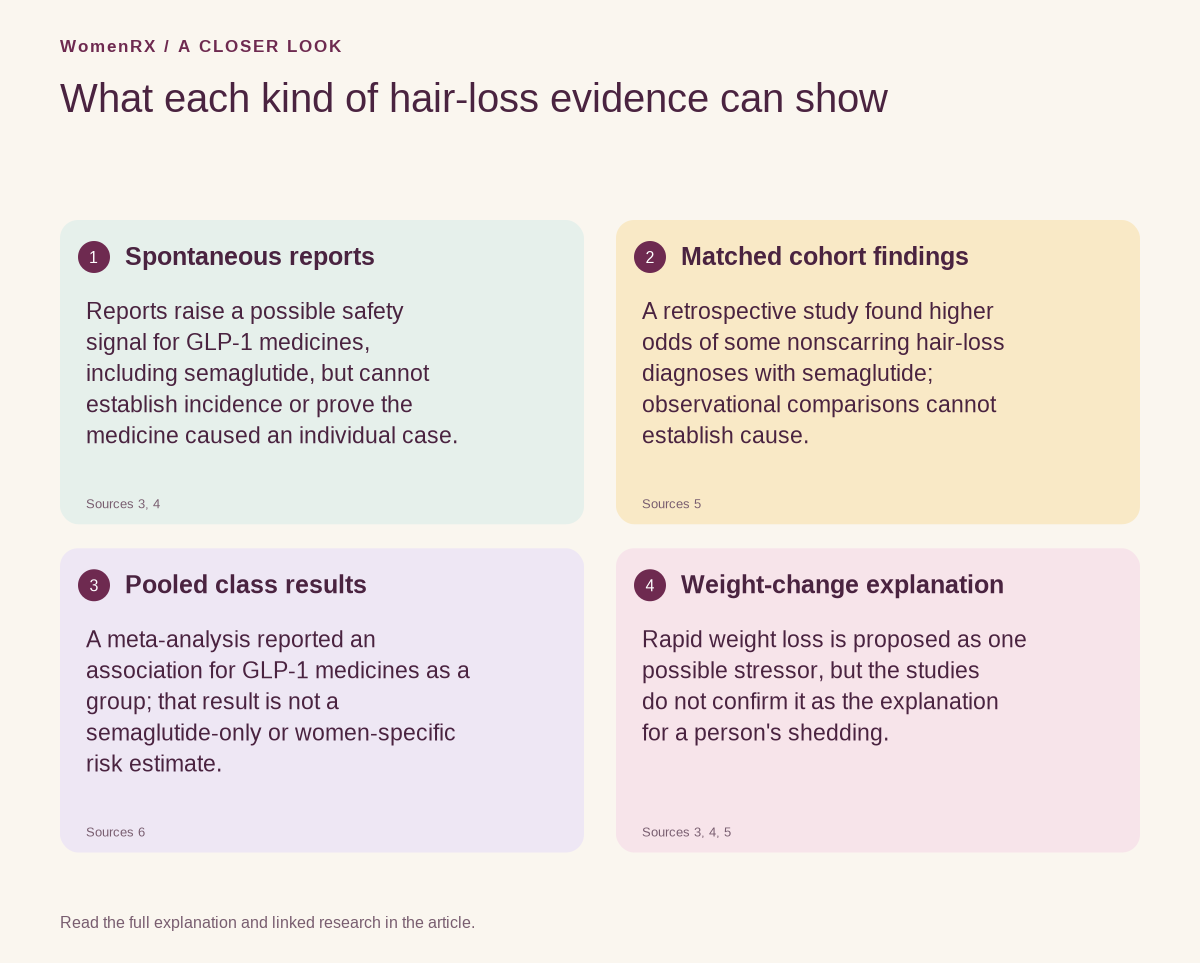
What each kind of hair-loss evidence can show
Spontaneous reports: Reports raise a possible safety signal for GLP-1 medicines, including semaglutide, but cannot establish incidence or prove the medicine caused an individual case.34
Matched cohort findings: A retrospective study found higher odds of some nonscarring hair-loss diagnoses with semaglutide; observational comparisons cannot establish cause.5
Pooled class results: A meta-analysis reported an association for GLP-1 medicines as a group; that result is not a semaglutide-only or women-specific risk estimate.6
Weight-change explanation: Rapid weight loss is proposed as one possible stressor, but the studies do not confirm it as the explanation for a person's shedding.345
Read the figure as text
These evidence types answer different questions: whether hair loss has been reported, whether diagnoses occur more often in comparisons, and whether weight change might contribute.- Spontaneous reports: Reports raise a possible safety signal for GLP-1 medicines, including semaglutide, but cannot establish incidence or prove the medicine caused an individual case.34
- Matched cohort findings: A retrospective study found higher odds of some nonscarring hair-loss diagnoses with semaglutide; observational comparisons cannot establish cause.5
- Pooled class results: A meta-analysis reported an association for GLP-1 medicines as a group; that result is not a semaglutide-only or women-specific risk estimate.6
- Weight-change explanation: Rapid weight loss is proposed as one possible stressor, but the studies do not confirm it as the explanation for a person's shedding.345
More questions, answered
Should I stop Ozempic if my hair is shedding?
The evidence can’t answer that question for you: it doesn’t establish that semaglutide caused any one person’s hair loss. An evaluation can help identify the hair-loss pattern and consider other possible causes before attributing the change to Ozempic. 1 2 3 5
Sources you can check
- Hair Loss | Alopecia | Alopecia Areata | MedlinePlusAccessed 2026-09-25Return to first citation
- Hair loss - NHSAccessed 2026-09-25Return to first citation
- Alopecia as an Emerging Adverse Effect Associated With Glucagon-Like Peptide-1 (GLP-1) Receptor Agonists for Weight Loss: A Scoping Review.Rojas Lopez RF, Lynett Barrera D, Amaya Muñoz MC, Saavedra Diaz MP. · Cureus · 2025Return to first citation
- GLP-1 therapies and hair loss: A systematic review of current evidence and implications for counseling.Gupta AK, Teasell EM, Economopoulos V, Mirmirani P. · Science progress · 2026Return to first citation
- Nonscarring Alopecia in Adults Treated With GLP-1s: A Propensity Score Matched TriNetX Cohort Study.Katragadda R, Hayden J, Saltagi AK, Welschmeyer AF, Quereshy HA, Karasik D, Rabbani CC, Gourishetti SC, Goslawski AM. · The Laryngoscope · 2026Return to first citation
- GLP-1 Receptor Agonists and Alopecia: A Systematic Review and Meta-Analysis of Incidence, Risk, Subtypes, and Mechanisms.Viquez Burboa GU, Flores Guillén MÁR, Duardo González VS. · Skin appendage disorders · 2026Return to first citation