Ozempic, Weight Loss, and Gallstones: What to Know
Upper-abdominal pain on Ozempic deserves attention, but it doesn’t tell you by itself whether you have gallstones.
Ozempic’s prescribing information warns that gallbladder problems have happened in some people taking it. Rapid weight loss is also associated with gallstones, so finding a stone during treatment doesn’t prove what caused it. Upper-abdominal pain, pale stools, jaundice, fever, or vomiting may need prompt evaluation. Severe, persistent abdominal pain has a separate stop-and-call instruction because it may signal pancreatitis. 1 2
Two possible contributors, not one proven cause
Ozempic’s prescribing information tells people taking it to report possible gallbladder symptoms, including upper-abdominal pain and clay-colored stools. That warning is a reason to take new symptoms seriously, but it doesn’t establish that semaglutide caused any one person’s gallstones. 1
Weight change is a separate part of the picture. Rapid weight loss is associated with a higher chance of gallstones, so medication-related effects and weight loss can overlap. If stones are found while you’re taking Ozempic, timing alone can’t tell you which factor mattered. 2
Research in adults with type 2 diabetes adds context, but it doesn’t settle the question for an individual. One observational study of veterans, 91% of whom were male, found a higher rate of gallstones and acute gallbladder inflammation among semaglutide starters than among dulaglutide starters. A separate matched cohort study found associations between GLP-1 medicines and some gallbladder outcomes. These studies can identify patterns, but they can’t prove what caused a particular person’s condition. 3 4
Researchers have proposed that GLP-1 medicines could affect gallbladder movement or bile. These are possible explanations, not a settled account of why stones develop in a particular person. 4
What symptoms can and can’t tell you
Gallstones are often symptom-free. When a stone blocks a bile duct, it can cause pain in the upper abdomen. But pain by itself doesn’t identify the cause: Ozempic can also cause common digestive symptoms, including nausea, vomiting, and abdominal discomfort. 1 2
Notice what comes with the pain. Pale or clay-colored stools are listed as a possible gallbladder warning sign in Ozempic’s medication guide. Yellowing of the skin or eyes, dark urine, and pale stools can also be signs of jaundice related to a gallstone complication. Fever or chills, vomiting, or pain that spreads to your back also make abdominal pain more concerning. 1 2
There’s an important distinction if the pain is severe and doesn’t go away. The Ozempic instructions say to stop using it and call your healthcare provider right away for severe, persistent abdominal pain, with or without vomiting. The pain may spread to the back, and this warning concerns possible pancreatitis, not just gallstones. 1
What an evaluation may involve
For ongoing or concerning upper-abdominal pain, contact your prescriber or seek prompt medical care, and mention that you take semaglutide. Be ready to describe where the pain is, when it began, whether it comes and goes, and whether you have fever, vomiting, pale stools, dark urine, or yellowing of your skin or eyes. Those details can help guide an assessment, but they don’t diagnose gallstones by themselves.
An ultrasound may be used when symptoms suggest gallstones. The result is considered alongside your symptoms and clinical assessment. Stones found by chance may not need treatment if they aren’t causing symptoms; symptomatic stones or complications may need treatment. 2
Seek emergency care for sudden, severe abdominal pain, pain spreading to your back with vomiting, or a high fever or chills. Yellowing of the skin or eyes also needs urgent medical attention. 2
What to do about your next dose
For possible gallbladder symptoms, the medication guide says to tell your healthcare provider right away. It does not give a specific instruction to stop Ozempic for every suspected gallstone. Contact the clinician assessing you for guidance about treatment and your next dose. The exception is severe abdominal pain that won’t go away: the instructions specifically say to stop using Ozempic and call your healthcare provider right away because pancreatitis is possible. 1
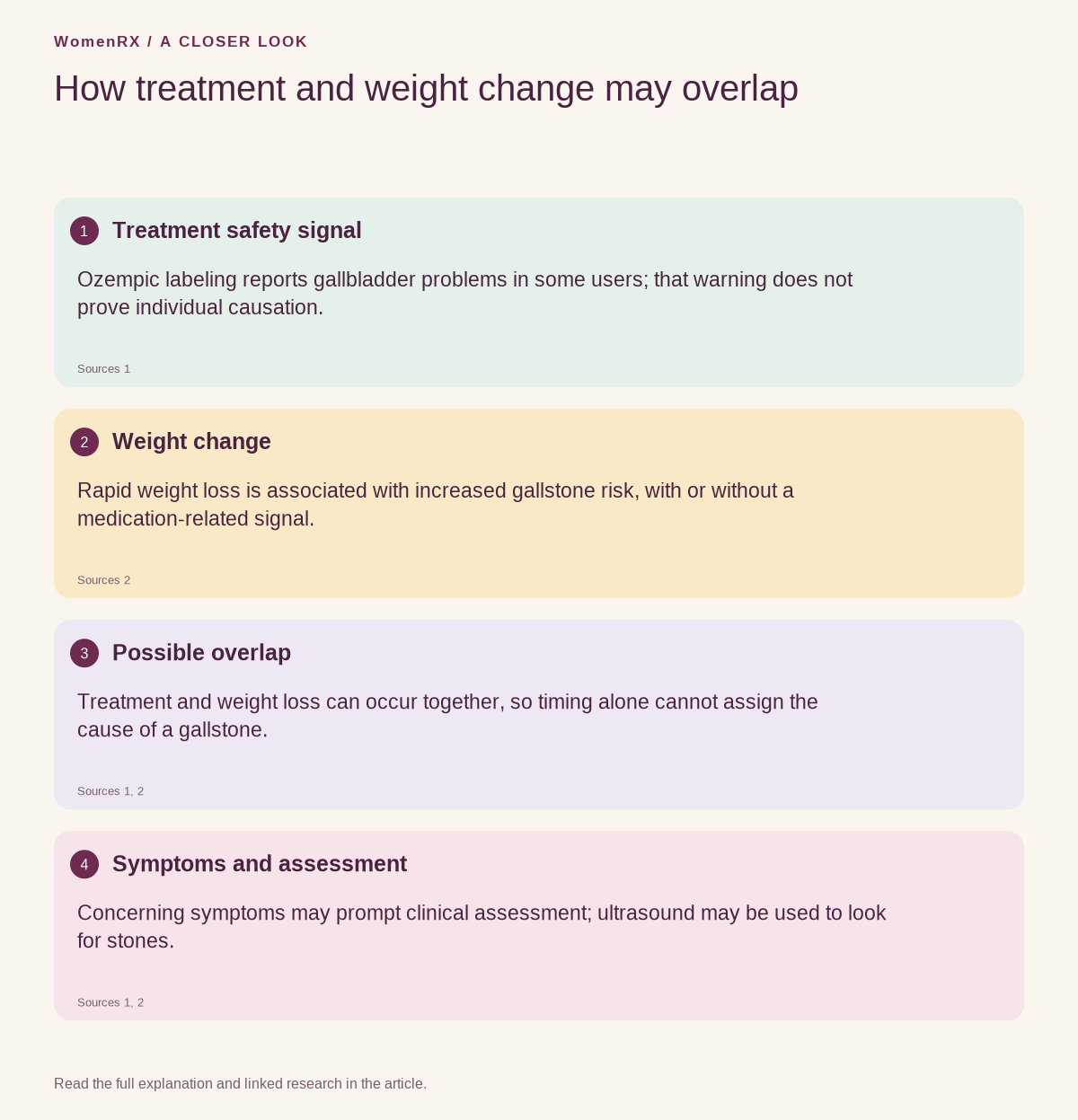
How treatment and weight change may overlap
Treatment safety signal: Ozempic labeling reports gallbladder problems in some users; that warning does not prove individual causation.1
Weight change: Rapid weight loss is associated with increased gallstone risk, with or without a medication-related signal.2
Possible overlap: Treatment and weight loss can occur together, so timing alone cannot assign the cause of a gallstone.12
Symptoms and assessment: Concerning symptoms may prompt clinical assessment; ultrasound may be used to look for stones.12
Read the figure as text
A gallstone found during Ozempic treatment does not reveal its cause. This figure separates the possible contributors from the symptom assessment that may follow.- Treatment safety signal: Ozempic labeling reports gallbladder problems in some users; that warning does not prove individual causation.1
- Weight change: Rapid weight loss is associated with increased gallstone risk, with or without a medication-related signal.2
- Possible overlap: Treatment and weight loss can occur together, so timing alone cannot assign the cause of a gallstone.12
- Symptoms and assessment: Concerning symptoms may prompt clinical assessment; ultrasound may be used to look for stones.12
More questions, answered
Does every stomachache on Ozempic mean gallstones?
No. Abdominal discomfort, nausea, and vomiting can also be common digestive side effects, and many gallstones cause no symptoms. Pain needs to be interpreted with its location, other symptoms, and clinical assessment. 1 2
What test may be used to look for gallstones?
An ultrasound may be used when symptoms suggest gallstones. The result is considered alongside your symptoms and clinical assessment. 2
Sources you can check
- OZEMPIC (SEMAGLUTIDE) INJECTION, SOLUTION [A-S MEDICATION SOLUTIONS] | US prescribing information and patient instructionsAccessed 2026-09-25Return to first citation
- Gallstones - NHSAccessed 2026-09-25Return to first citation
- Liraglutide vs Semaglutide vs Dulaglutide in Veterans With Type 2 Diabetes.Derington CG, Sarwal A, Wei G, Hartsell SE, Throolin M, Singh R, Nevers MR, Zhang C, Katkam N, Takyi A, Chakravartula AR, Babu P, Deshmukh VG, Boucher RE, Drakos SG, Greene T, Shen... · JAMA network open · 2025Return to first citation
- Cohort Study: Risk of Gallstones and Biliary Complications With Glucagon-Like Peptide-1 Receptor Agonists in Type 2 Diabetes.Eldesouki MH, Alkasabrah O, Kloub M, Abosheaishaa H, Elfert K, Sharma A, Andrawes S, Duong N. · United European gastroenterology journal · 2026Return to first citation