Semaglutide for Weight Loss: What Benefits and Risks Look Like
At the Wegovy weight-management dose, trials found substantial average weight loss, but stomach side effects are common and results depend on the population and time studied.
In a 68-week trial of adults with overweight or obesity without diabetes, semaglutide 2.4 mg weekly was associated with an average 14.9% weight loss, compared with 2.4% with placebo; results were smaller in a trial involving type 2 diabetes. Nausea, vomiting, and diarrhea were common with Wegovy injection. Its prescribing information also warns about acute pancreatitis and hypoglycemia. Pregnancy needs separate consideration. 2 3 1
Semaglutide can lead to meaningful weight loss, but the result is an average from a particular trial population, not a promise for any one person. Digestive symptoms were a frequent tradeoff in the weight-management trials, and Wegovy has other labeled warnings. It also matters which semaglutide product and outcome you mean: the weight-loss estimates below concern Wegovy-dose treatment, not every medicine that contains semaglutide. 1
What the weight-loss results actually mean
In STEP 1, adults with overweight or obesity who did not have diabetes lost an average of 14.9% of their starting body weight over 68 weeks with semaglutide 2.4 mg weekly, compared with 2.4% with placebo. 2 3
Results differed in STEP 2, which enrolled adults with overweight or obesity and type 2 diabetes: average weight change at 68 weeks was -9.6% with semaglutide and -3.4% with placebo. That difference is one reason not to assume that a headline result from one study predicts the same outcome in another group. 3
These are group averages, not a target or guarantee. Semaglutide can reduce hunger and increase feelings of fullness, which may help explain why eating less can feel more manageable for some people. The trial results describe what happened while participants were treated; they do not establish that the same weight change will continue after treatment ends. 3
Common side effects, and the practical tradeoff
For adults in Wegovy injection trials for weight reduction, gastrointestinal reactions were reported by 73% of people taking Wegovy and 47% taking placebo. Nausea occurred in 44% versus 16%, vomiting in 25% versus 6%, and diarrhea in 30% versus 16%. These are trial proportions over the study period, not a prediction that you will have a particular symptom. Symptoms were reported most often during dose escalation. 1
Side effects can affect whether someone can stay on treatment. In those adult trials, 4.3% of people receiving Wegovy injection and 0.7% receiving placebo permanently stopped treatment because of a gastrointestinal reaction. 1
A practical point is that persistent nausea, vomiting, or diarrhea can make it hard to keep up with fluids. Wegovy prescribing information reports postmarketing cases of acute kidney injury, most often in people whose gastrointestinal symptoms led to dehydration. These reports do not establish how often this occurs. 1
Wegovy’s prescribing information also lists acute pancreatitis and hypoglycemia as warnings. The digestive-symptom percentages above are not estimates of how often either of those conditions occurs. 1
A separate cardiovascular outcome
Weight change isn’t the only studied outcome. Wegovy labeling includes reducing the risk of major cardiovascular events in adults with known heart disease and overweight or obesity. In SELECT, a trial of 17,604 people with established atherosclerotic cardiovascular disease and overweight or obesity, but without diabetes, semaglutide reduced the combined outcome of cardiovascular death, nonfatal heart attack, or nonfatal stroke compared with placebo over a mean follow-up of 39.8 months. This result applies to that higher-risk group; it is not evidence that every person taking semaglutide will have a lower heart-disease risk. 1 4
What the evidence says about women
The weight-loss figures above are trial averages, not a separate estimate for women. They do not establish a women-specific expected weight loss or show that women have a distinct side-effect profile. One trial of oral Wegovy tablets included 204 adults, 76% of whom were women, but that is a different formulation and does not establish whether results differ by sex with the injection. 1
Pregnancy is a distinct consideration, not an efficacy question. Wegovy prescribing information says animal reproduction studies suggest potential fetal risk, while human pregnancy data are insufficient to establish whether the medicine causes major birth defects, miscarriage, or other adverse outcomes. If you are pregnant, planning a pregnancy, or could become pregnant, raise that with the prescriber before making treatment decisions. 1
Keep the product and purpose clear
Wegovy is labeled for chronic weight management. The weight-loss trial estimates in this article refer to semaglutide 2.4 mg injection, not to any product simply because it contains semaglutide. A separate cardiovascular benefit is also labeled for a defined group of adults with known heart disease and overweight or obesity. 1 3
A useful way to weigh treatment is to compare the outcome you care about with the burden you would be willing to manage: weight change, a cardiovascular outcome for people with established heart disease, common digestive symptoms, and the possibility that symptoms could make continuing treatment difficult. For an individual decision, those tradeoffs depend on your health situation and treatment goal.
Semaglutide benefits and tradeoffs
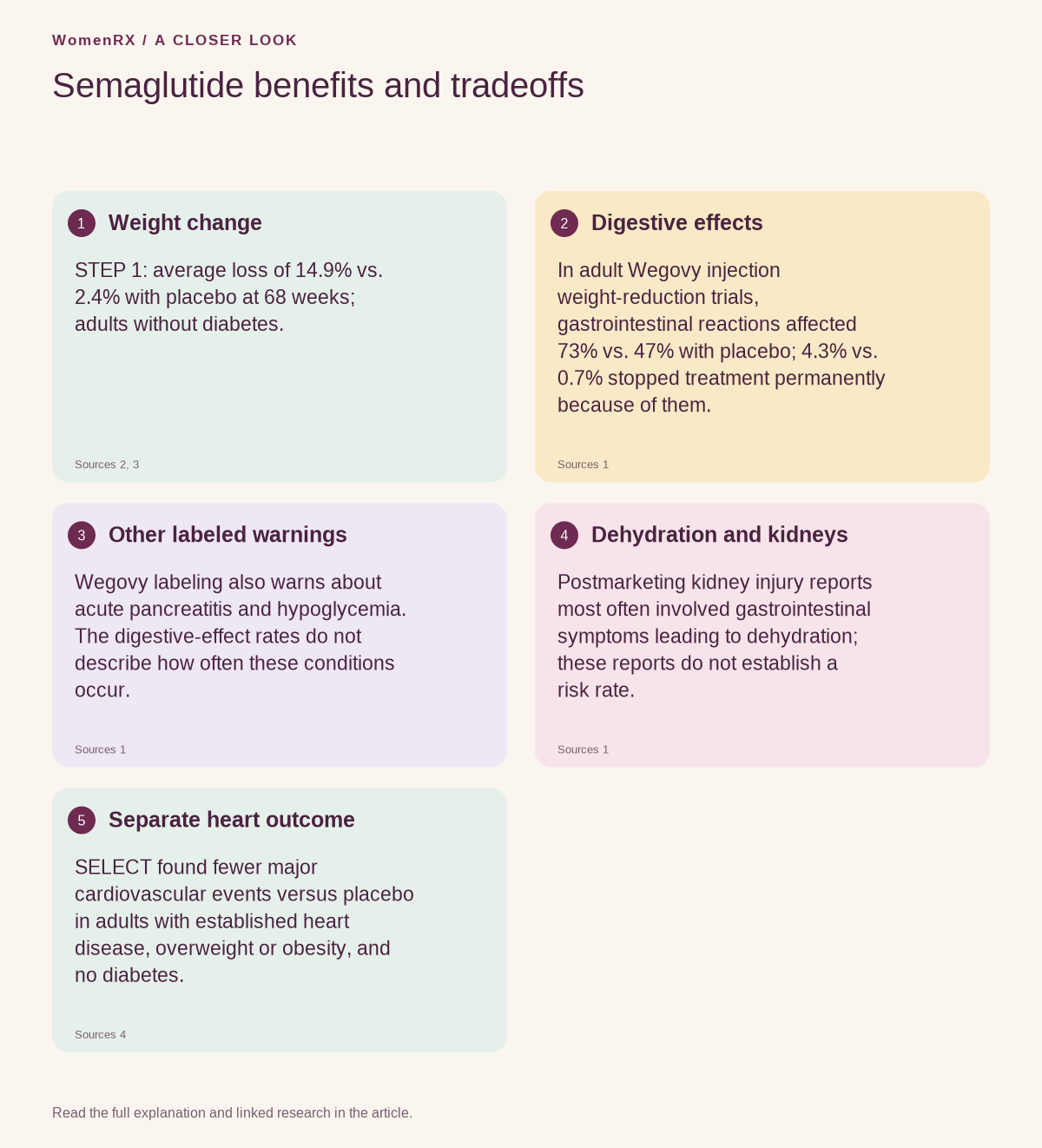
Weight change: STEP 1: average loss of 14.9% vs. 2.4% with placebo at 68 weeks; adults without diabetes.23
Digestive effects: In adult Wegovy injection weight-reduction trials, gastrointestinal reactions affected 73% vs. 47% with placebo; 4.3% vs. 0.7% stopped treatment permanently because of them.1
Other labeled warnings: Wegovy labeling also warns about acute pancreatitis and hypoglycemia. The digestive-effect rates do not describe how often these conditions occur.1
Dehydration and kidneys: Postmarketing kidney injury reports most often involved gastrointestinal symptoms leading to dehydration; these reports do not establish a risk rate.1
Separate heart outcome: SELECT found fewer major cardiovascular events versus placebo in adults with established heart disease, overweight or obesity, and no diabetes.4
Read the figure as text
Compare what was measured, in whom, and the practical tradeoffs without treating trial averages as personal predictions.- Weight change: STEP 1: average loss of 14.9% vs. 2.4% with placebo at 68 weeks; adults without diabetes.23
- Digestive effects: In adult Wegovy injection weight-reduction trials, gastrointestinal reactions affected 73% vs. 47% with placebo; 4.3% vs. 0.7% stopped treatment permanently because of them.1
- Other labeled warnings: Wegovy labeling also warns about acute pancreatitis and hypoglycemia. The digestive-effect rates do not describe how often these conditions occur.1
- Dehydration and kidneys: Postmarketing kidney injury reports most often involved gastrointestinal symptoms leading to dehydration; these reports do not establish a risk rate.1
- Separate heart outcome: SELECT found fewer major cardiovascular events versus placebo in adults with established heart disease, overweight or obesity, and no diabetes.4
More questions, answered
What does the evidence say about semaglutide during pregnancy?
Animal reproduction studies suggest potential fetal risk, but available human data are insufficient to establish the risk of birth defects, miscarriage, or other adverse outcomes. Pregnancy should be discussed separately from expected weight loss. 1
Do the weight-loss results apply to Ozempic?
The weight-loss estimates here come from trials of Wegovy-dose semaglutide, particularly 2.4 mg injection. They should not be treated as results for every semaglutide product or indication. 1 3
Sources you can check
- WEGOVY (SEMAGLUTIDE) INJECTION, SOLUTION WEGOVY (SEMAGLUTIDE) TABLET [NOVO NORDISK PHARMACEUTICAL INDUSTRIES, LP] | US prescribing information and patient instructionsAccessed 2026-09-25Return to first citation
- US Population Eligibility and Estimated Impact of Semaglutide Treatment on Obesity Prevalence and Cardiovascular Disease Events.Wong ND, Karthikeyan H, Fan W. · Cardiovascular drugs and therapy · 2025Return to first citation
- Semaglutide for the treatment of overweight and obesity: A review.Bergmann NC, Davies MJ, Lingvay I, Knop FK. · Diabetes, obesity & metabolism · 2023Return to first citation
- Effect of Semaglutide on the Inflammatory Biomarker High-Sensitivity CRP in Patients With Established Cardiovascular Disease and Overweight or Obesity in SELECT: A Prespecified Secondary Analysis.Plutzky J, Bogdański P, Colhoun HM, Dağdelen S, Deanfield JE, Emerson SS, Hovingh GK, Kahn SE, Ekström K, Latkovskis G, Lehrke M, Hardt-Lindberg S, Lingvay I, Nicholls SJ, Kalayci ... · Circulation · 2026Return to first citation