What Weight Change Can Look Like in Month One
The first month of Wegovy injections uses a starting dose, so an early weigh-in can’t predict your longer-term result.
There isn’t a reliable amount of weight everyone should lose in the first month of semaglutide. For Wegovy injections, the first four weeks are the starting-dose phase, with planned increases afterward to help reduce digestive side effects. A flat or changing scale reading this early isn’t a verdict on treatment. If you menstruate, fluid changes can also affect a short-term reading. 1 2 5
A month is a snapshot, not a verdict
If the scale has barely moved after a few weeks, that alone doesn’t tell you whether semaglutide will help over time. For Wegovy injections, the labeled schedule begins with a starting dose for weeks one through four, then increases in stages. The gradual increase is intended to reduce gastrointestinal side effects. Your first month is therefore not a test of how you’ll respond after more time on treatment. 1
The product matters here. Wegovy’s injection schedule and weight-management trial results shouldn’t be treated as a month-one forecast for every semaglutide formulation or for someone taking semaglutide to manage type 2 diabetes.
What a trial average can, and can’t, tell you
In a randomized, open-label trial in Indian adults with obesity, or overweight with a related health condition, researchers compared two semaglutide injections using the same dose-escalation schedule. At 24 weeks, the average weight change was 11.25% below starting weight with the test formulation and 11.50% below starting weight with the reference formulation. These were averages within two active-treatment groups, not a comparison with placebo and not results from the first month. 3
The trial shows why a later result shouldn’t be squeezed into a monthly promise. It doesn’t tell you how much you should have lost by week four. Its reported results also don’t provide a separate first-month estimate for women. 3
Why your scale reading can jump around
Scale weight includes water and other body tissues, not just body fat. Everyday factors can affect the number, so a rise or flat reading over a short interval doesn’t necessarily mean that body fat increased or that treatment has stopped working. 2
If you have menstrual cycles, timing can add another layer. In a study that measured 42 women twice weekly through a cycle, average weight was about 0.45 kg (roughly one pound) higher during menstruation than in the first week of the cycle; the difference was mostly associated with extracellular water. That’s an observation in a small study, not a predictable change for every woman or a distinct effect of semaglutide. 5
For a more useful comparison, weigh under similar conditions and look at the pattern across several weeks rather than drawing a conclusion from one reading. This won’t tell you exactly how much change is fat, but it can make your scale trend easier to interpret. 2
When the scale isn’t the main concern
If little has changed on the scale but you otherwise feel well, the first month alone isn’t enough to judge your longer-term response. Bring the trend up when you review how treatment is going, rather than treating a single weigh-in as a pass-or-fail test. 1 2
Symptoms deserve attention regardless of what the scale says. Nausea, vomiting, and diarrhea are reported with Wegovy injections, particularly during dose escalation. If vomiting or diarrhea makes it hard to keep fluids down, contact your prescriber promptly: dehydration has been linked to kidney injury in people taking semaglutide. Seek urgent medical help for severe stomach or back pain that doesn’t go away. 1 4
And if weight drops suddenly or unexpectedly, discuss it rather than assuming faster is better. MedlinePlus recommends checking sudden, unexpected weight changes; Wegovy’s prescribing information also notes that substantial or rapid weight loss can increase gallstone risk. Neither provides a single month-one loss threshold that fits everyone. 2 1
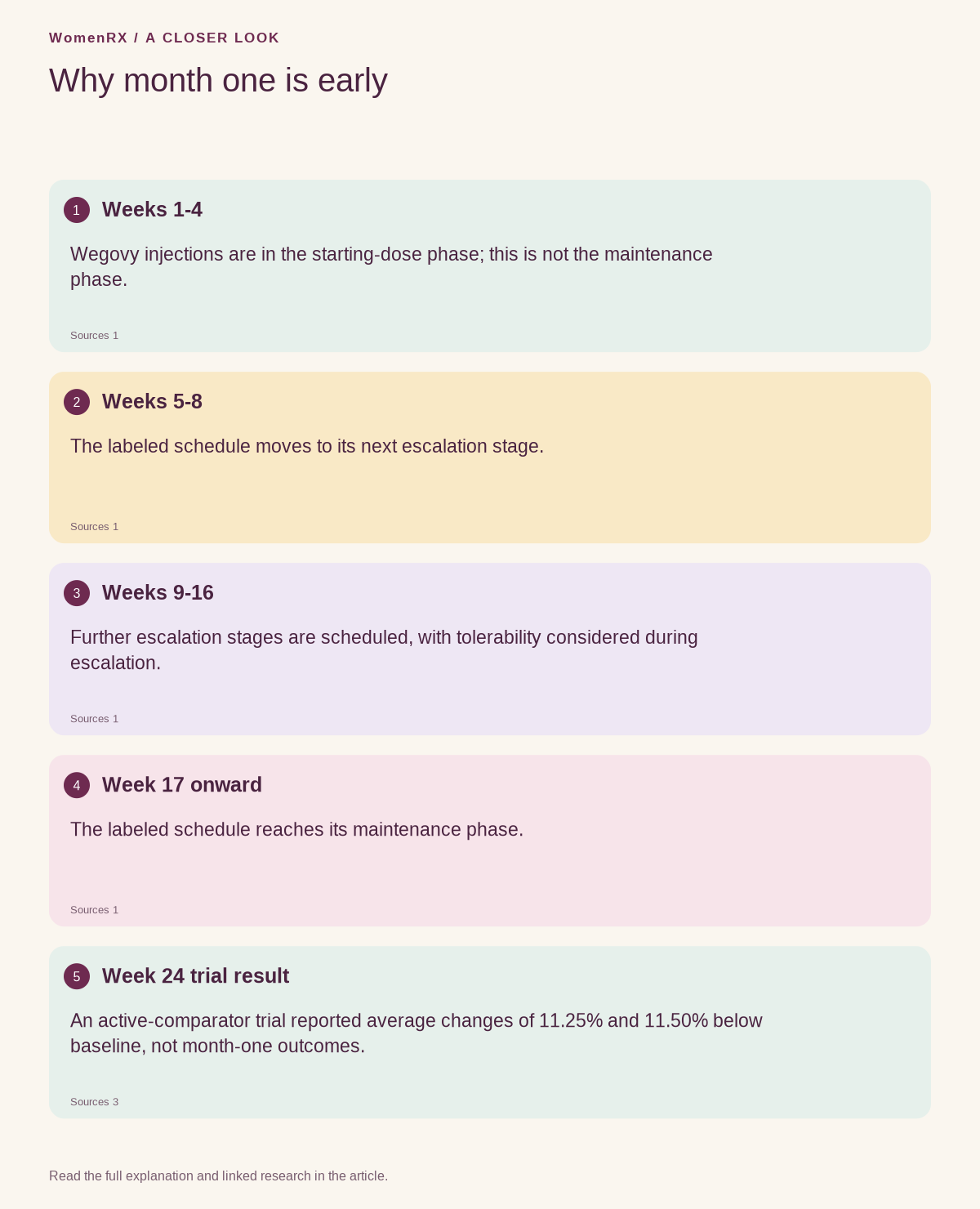
Why month one is early
Weeks 1-4: Wegovy injections are in the starting-dose phase; this is not the maintenance phase.1
Weeks 5-8: The labeled schedule moves to its next escalation stage.1
Weeks 9-16: Further escalation stages are scheduled, with tolerability considered during escalation.1
Week 17 onward: The labeled schedule reaches its maintenance phase.1
Week 24 trial result: An active-comparator trial reported average changes of 11.25% and 11.50% below baseline, not month-one outcomes.3
Read the figure as text
The Wegovy injection schedule shows when doses are planned to increase. A separate trial measured its main weight outcome at 24 weeks. 1 3- Weeks 1-4: Wegovy injections are in the starting-dose phase; this is not the maintenance phase.1
- Weeks 5-8: The labeled schedule moves to its next escalation stage.1
- Weeks 9-16: Further escalation stages are scheduled, with tolerability considered during escalation.1
- Week 17 onward: The labeled schedule reaches its maintenance phase.1
- Week 24 trial result: An active-comparator trial reported average changes of 11.25% and 11.50% below baseline, not month-one outcomes.3
Sources you can check
- WEGOVY (SEMAGLUTIDE) INJECTION, SOLUTION WEGOVY (SEMAGLUTIDE) TABLET [NOVO NORDISK PHARMACEUTICAL INDUSTRIES, LP] | US prescribing information and patient instructionsAccessed 2026-09-25Return to first citation
- Body Weight: MedlinePlusAccessed 2026-09-25Return to first citation
- Efficacy and safety of semaglutide injection in comparison with reference semaglutide for chronic weight management in indian adults with obesity: A phase III randomized non-inferiority trial.Sharma PK, Redkar SV, Madhav Karmalkar A, Anand S, Patil VS, Nurulhasan AR, Manan Bharatkumar P, Barge V, Shah SJ, Patel CB, Choudhary A, Sudheer K, Rambabu K, Narasinga Rao S, Swa... · Metabolism open · 2026Return to first citation
- Semaglutide: a medicine to manage type 2 diabetes or treat obesity - NHSAccessed 2026-09-25Return to first citation
- Changes in body weight and body composition during the menstrual cycle.Kanellakis S, Skoufas E, Simitsopoulou E, Migdanis A, Migdanis I, Prelorentzou T, Louka A, Moschonis G, Bountouvi E, Androutsos O. · American journal of human biology : the official journal of the Human Biology Council · 2023Return to first citation