What Weight Change After Two Months on Semaglutide Means
At two months, your weight change is worth discussing, but it isn’t a verdict on how treatment will work for you.
If you’re using weekly semaglutide for weight management, two months is usually an early check-in, not the end of dose escalation. One trial reported average weight loss at week eight, but its group average can’t tell you what you should have lost. Look at your weight trend alongside your current dose and how you’re feeling, then discuss concerns with your prescriber rather than changing the dose yourself. 56
Why eight weeks is an early checkpoint
Weekly semaglutide for weight management is generally increased gradually. In the STEP 4 trial, participants spent 16 weeks escalating the dose, followed by four weeks at the trial’s maintenance dose before they were randomized for the next phase. That places an eight-week weigh-in partway through the escalation used in that study, not at its long-term outcome. Your own schedule may differ, so the dose you’ve actually reached matters when you interpret the scale. 6
There is a useful eight-week reference point, with limits. In a 24-week trial conducted in India, the estimated average weight change at week eight was a 3.35% loss from starting weight among participants assigned to reference semaglutide injection. By week 24, the estimated average loss in that group was 11.50%. Those are group results from a study of adults with obesity, or overweight with a specified weight-related condition. They aren’t an eight-week target for you, and the week-24 result shouldn’t be treated as a forecast from your week-eight reading. 5
Longer trials also studied treatment alongside changes in eating and activity. For example, the 68-week STEP 3 trial combined semaglutide or placebo with intensive behavioral therapy and an initial low-calorie diet. Its final results cannot be translated into a promised two-month number for someone following a different plan. The trial enrolled mostly women, but its reported weight result was for the study group, not a separate women’s estimate. 7
Read the trend and the side effects together
A lower number isn’t the only thing to bring to a two-month follow-up. Ask yourself whether your weight readings show a general direction or just a change between two days. Note which medication and dose you’re taking, whether the planned escalation has happened, and whether nausea or other stomach symptoms are affecting meals or daily life. Gastrointestinal events were the most common treatment-emergent adverse events in one 24-week semaglutide injection trial. 4
That combination gives your prescriber more to work with than a weight number alone. For example, a nearly unchanged reading with troublesome stomach symptoms calls for a conversation about how treatment is going, not an attempt to speed up dose increases. Likewise, early weight loss doesn’t mean you need to push through side effects without mentioning them. The next-dose decision belongs in that conversation.
If you have periods, you may notice bloating around one. That can be useful context for how you feel when you weigh yourself, but it isn’t a validated number to subtract from the scale or a reason to dismiss a longer-term trend. 3
When to raise a concern before routine follow-up
If bloating doesn’t go away, arrange a medical assessment. If you’re bloated and also vomiting or have a stomach ache, seek care promptly rather than waiting for a routine weigh-in. This is general guidance about bloating, not a way to identify a semaglutide side effect. 3
If pregnancy is possible, weight change isn’t a way to judge what’s happening. Pregnancy safety is a separate question from weight-loss progress: semaglutide product information describes reproductive findings in animals, while human pregnancy data are insufficient to establish drug-related risk. The Wegovy information also says that background risks of birth defects and miscarriage are unknown for its indicated populations; that is distinct from estimating any risk caused by the medicine. 12
The most useful two-month question is therefore not “Did I hit the right number?” It’s “Given my weight trend, the dose I’ve reached, and how I’m tolerating it, what’s the appropriate next step?”
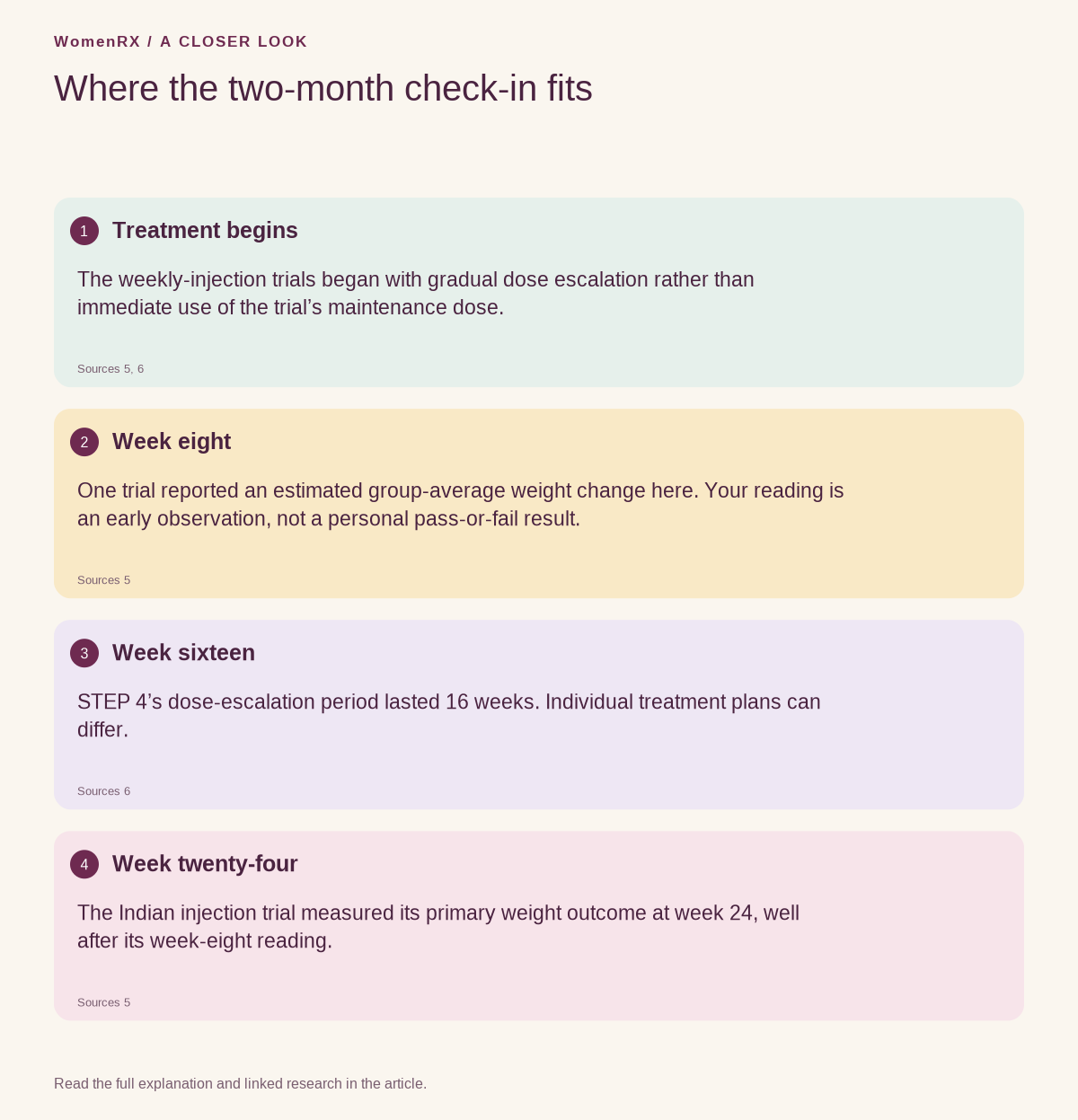
Where the two-month check-in fits
Treatment begins: The weekly-injection trials began with gradual dose escalation rather than immediate use of the trial’s maintenance dose.56
Week eight: One trial reported an estimated group-average weight change here. Your reading is an early observation, not a personal pass-or-fail result.5
Week sixteen: STEP 4’s dose-escalation period lasted 16 weeks. Individual treatment plans can differ.6
Week twenty-four: The Indian injection trial measured its primary weight outcome at week 24, well after its week-eight reading.5
Read the figure as text
A research timeline helps show why an early weigh-in and a later trial result answer different questions. It is not a dosing schedule to follow.- Treatment begins: The weekly-injection trials began with gradual dose escalation rather than immediate use of the trial’s maintenance dose.56
- Week eight: One trial reported an estimated group-average weight change here. Your reading is an early observation, not a personal pass-or-fail result.5
- Week sixteen: STEP 4’s dose-escalation period lasted 16 weeks. Individual treatment plans can differ.6
- Week twenty-four: The Indian injection trial measured its primary weight outcome at week 24, well after its week-eight reading.5
More questions, answered
Does the eight-week trial average apply to Ozempic or oral semaglutide?
No. The 3.35% figure came from the reference weekly semaglutide injection group in a particular weight-management trial. It should not be used as an expected eight-week result for an oral product or a different treatment plan. 52
Sources you can check
- WEGOVY (SEMAGLUTIDE) INJECTION, SOLUTION WEGOVY (SEMAGLUTIDE) TABLET [NOVO NORDISK PHARMACEUTICAL INDUSTRIES, LP] | US prescribing information and patient instructionsAccessed 2026-09-25Return to first citation
- OZEMPIC (ORAL SEMAGLUTIDE) TABLET RYBELSUS (ORAL SEMAGLUTIDE) TABLET [NOVO NORDISK PHARMACEUTICAL INDUSTRIES, LP] | US prescribing information and patient instructionsAccessed 2026-09-25Return to first citation
- Bloating - NHSAccessed 2026-09-25Return to first citation
- Semaglutide Injection Once-Weekly for Weight Management in Adults: Results From A Randomized Phase III, Active-Controlled Study.Ambika Gopalakrishnan U, Joshi A, Kumar H, Giri R, Maheshwari S, Prasad VS, Shukla J, M Chowdaiah R, Agrawal NK, Rasal Y, Sahoo B, Bhandari S, Gowda A, Phadke U, Supe P, Pathak N, ... · Diabetes, obesity & metabolism · 2026Return to first citation
- Efficacy and safety of semaglutide injection in comparison with reference semaglutide for chronic weight management in indian adults with obesity: A phase III randomized non-inferiority trial.Sharma PK, Redkar SV, Madhav Karmalkar A, Anand S, Patil VS, Nurulhasan AR, Manan Bharatkumar P, Barge V, Shah SJ, Patel CB, Choudhary A, Sudheer K, Rambabu K, Narasinga Rao S, Swa... · Metabolism open · 2026Return to first citation
- Effect of Continued Weekly Subcutaneous Semaglutide vs Placebo on Weight Loss Maintenance in Adults With Overweight or Obesity: The STEP 4 Randomized Clinical Trial.Rubino D, Abrahamsson N, Davies M, Hesse D, Greenway FL, Jensen C, Lingvay I, Mosenzon O, Rosenstock J, Rubio MA, Rudofsky G, Tadayon S, Wadden TA, Dicker D, STEP 4 Investigators. · JAMA · 2021Return to first citation
- Effect of Subcutaneous Semaglutide vs Placebo as an Adjunct to Intensive Behavioral Therapy on Body Weight in Adults With Overweight or Obesity: The STEP 3 Randomized Clinical Trial.Wadden TA, Bailey TS, Billings LK, Davies M, Frias JP, Koroleva A, Lingvay I, O'Neil PM, Rubino DM, Skovgaard D, Wallenstein SOR, Garvey WT, STEP 3 Investigators. · JAMA · 2021Return to first citation