Semaglutide for Weight Management: What to Weigh Before Starting
Choosing semaglutide means weighing whether a weight-management product fits your health goals, daily routine, safety needs and longer-term plans.
Wegovy is a semaglutide option for adults with obesity, or with overweight and at least one weight-related condition. It comes as an injection and a tablet, while Ozempic and Rybelsus have different, diabetes-focused indications. If Wegovy might fit, the next discussion is about the specific formulation, your medical history, pregnancy, contraception or breastfeeding plans, and follow-up over time. 12
Start with the goal, not the brand name
Semaglutide acts on a GLP-1 pathway involved in appetite and food intake. In a systematic review of phase 3 randomized trials lasting at least a year, semaglutide at weight-management doses reduced body weight compared with placebo in adults with overweight or obesity. That finding is a reason to consider treatment, not a prediction of how much weight you personally would lose. 46
A Wegovy injection trial offers a more concrete sense of the possible benefit. Among 1,961 adults with obesity, or overweight and a weight-related condition, who did not have type 2 diabetes, the estimated average weight change after 68 weeks was a 14.9% loss with Wegovy injection versus a 2.4% loss with placebo. Both groups received guidance on eating less and increasing physical activity. Those are group averages from a particular trial, not a target or a promise for you. 2
First, be clear about what you want treatment to change. Weight may be one goal; a weight-related health condition may be another. Your weight history, other health conditions, and readiness for an ongoing eating and activity plan all belong in the discussion. BMI describes weight relative to height, but it’s only one part of that broader health picture. 3
For adult weight reduction, Wegovy injection and Wegovy tablets are indicated for people with obesity, or with overweight and at least one weight-related condition. Several Wegovy weight-loss trials, including the injection trial above and a tablet trial, enrolled adults with a BMI of 30 or higher, or a BMI of 27 to 29.9 plus a weight-related condition such as hypertension or dyslipidemia. Entry criteria varied across trials. Those trial entry thresholds help explain the evidence; the product indication describes who the treatment is intended for, while your health history and safety considerations still shape whether it’s a suitable choice. 23
Same ingredient, different products and routines
Wegovy’s US prescribing information includes weight-reduction dosing for adults in both an injection and a tablet. The injection starts at 0.25 mg weekly, increases every four weeks, and has adult weight-reduction maintenance doses of 1.7 mg or the recommended 2.4 mg weekly. The label also permits an increase to 7.2 mg weekly after at least four weeks at 2.4 mg if further weight reduction is clinically indicated. The tablet starts at 1.5 mg daily, increases every 30 days through 4 mg and 9 mg, and has a 25 mg daily maintenance dose. It has morning empty-stomach requirements that affect when you can eat, drink, or take other oral medicines. Both formulations are intended to be used alongside a reduced-calorie diet and increased physical activity. Those differences can matter more in daily life than whether you generally prefer a pill or a shot. 2
Ozempic and Rybelsus also contain semaglutide, but their diabetes-focused dosing should not be treated as interchangeable with Wegovy’s weight-reduction dosing. Even Rybelsus and Ozempic tablets are not substitutable milligram for milligram. Ask which specific product and formulation is being proposed and what goal it’s meant to address. 126
Review the safety questions that could change the choice
Digestive effects are a practical consideration: Wegovy’s dosing is increased gradually to reduce gastrointestinal adverse reactions, and its labeling directs maintenance-dose choices to account for response and tolerability. In adult weight-reduction trials, 73% of Wegovy injection recipients reported a gastrointestinal adverse reaction, versus 47% on placebo; severe reactions were reported by 4.1% versus 0.9%. In a separate Wegovy tablet weight-reduction trial, severe gastrointestinal reactions were reported by 2% on tablets versus 0% on placebo. These trials were not a head-to-head comparison of the formulations. If digestive effects make treatment hard to live with, that belongs in follow-up alongside changes in weight. 2
Some parts of your history matter before choosing a product. NIDDK lists a personal or family history of medullary thyroid cancer, or multiple endocrine neoplasia syndrome type 2, as reasons not to take Wegovy. If you have diabetes, Wegovy’s labeling calls for blood-glucose monitoring before and during treatment. 26
There’s also a difference between an expected digestive effect and a symptom that needs prompt attention. Wegovy’s labeling says severe or persistent abdominal pain, sometimes reaching the back and with or without vomiting, may signal pancreatitis. Upper abdominal pain, fever or yellowing of the skin or eyes may signal a gallbladder problem. Vomiting or diarrhea that does not go away can cause dehydration and kidney problems; swelling of the face or throat or trouble breathing may signal a serious allergic reaction. These warnings also appear in the labeling for Rybelsus and Ozempic tablets. Review the warnings for the specific product being proposed rather than assuming every formulation has identical safety information. 12
Bring a complete medicine list. Rybelsus and Ozempic tablet labeling warns of an increased risk of low blood sugar when either tablet is used with insulin or a sulfonylurea. Wegovy’s labeling says it delays stomach emptying and may affect absorption of oral medicines; it cites a semaglutide-tablet study in which levothyroxine exposure increased. Discuss monitoring for the specific product and medicines you use rather than changing medication on your own. 12
Pregnancy plans and breastfeeding change the conversation
If pregnancy may be in your plans, discuss timing before starting. Wegovy’s labeling says to stop it at least two months before a planned pregnancy because semaglutide remains in the body for a long time. It also says to discontinue Wegovy used for weight reduction when pregnancy is recognized: weight loss offers no benefit during pregnancy and may cause fetal harm. The pregnancy-outcome data are insufficient to establish the drug’s risks in humans. 2
If pregnancy is possible but not planned, ask what contraception approach fits your plans while taking Wegovy and when to revisit that plan if you decide to conceive. 2
Breastfeeding calls for a formulation-specific discussion. Wegovy tablets contain an absorption enhancer whose components enter human milk; the labeling says breastfeeding is not recommended during treatment with those tablets because the potential effects on an infant are unknown. For Wegovy injection, the labeling reports no data on semaglutide in human milk or its effects on a breastfed infant and calls for weighing the benefits of breastfeeding against the need for treatment and possible risks. The tablet warning does not prove the injection is safe, and the lack of injection data does not mean harm has been shown. 2
Wegovy’s label reports weight reduction irrespective of sex, but does not report weight-loss results by menopause status. If menopause affects your weight-management priorities, include that in the discussion. 2
Make a plan for continuing or stopping
Follow-up has two jobs: assessing whether treatment is helping and whether its routine remains workable. Wegovy’s maintenance-dose choices account for response and tolerability; if you have diabetes, blood-glucose monitoring is also part of care. Review changes in weight, digestive symptoms, your ability to eat and drink comfortably, and whether the eating and activity plan still fits your life. If you take Rybelsus or Ozempic tablets, their labeling says to promptly report vomiting or diarrhea that does not go away. 12
Continuing treatment can matter for maintaining weight loss. In a Wegovy injection trial, 902 adults began a 20-week treatment run-in; 803 who reached the maintenance dose were then assigned to continue Wegovy or switch to placebo. Over the following 48 weeks, estimated average weight changed by a further 7.9% loss in the continuation group, versus a 6.9% gain in the group switched to placebo, measured from the time of that assignment. Because people who stopped during the run-in or did not reach the maintenance dose were not assigned to either group, these results do not predict what will happen to everyone who starts or stops treatment. 2
Obesity treatment can involve ongoing nutrition, activity and other support as well as medication. If treatment may end because of pregnancy plans, side effects or another change in circumstances, discuss what support would continue afterward. Researchers are studying whether gradually reducing semaglutide differs from stopping it at once, but that trial is a protocol, not a result showing that tapering prevents weight regain. Don’t make a stopping plan depend on an unproved strategy. 35
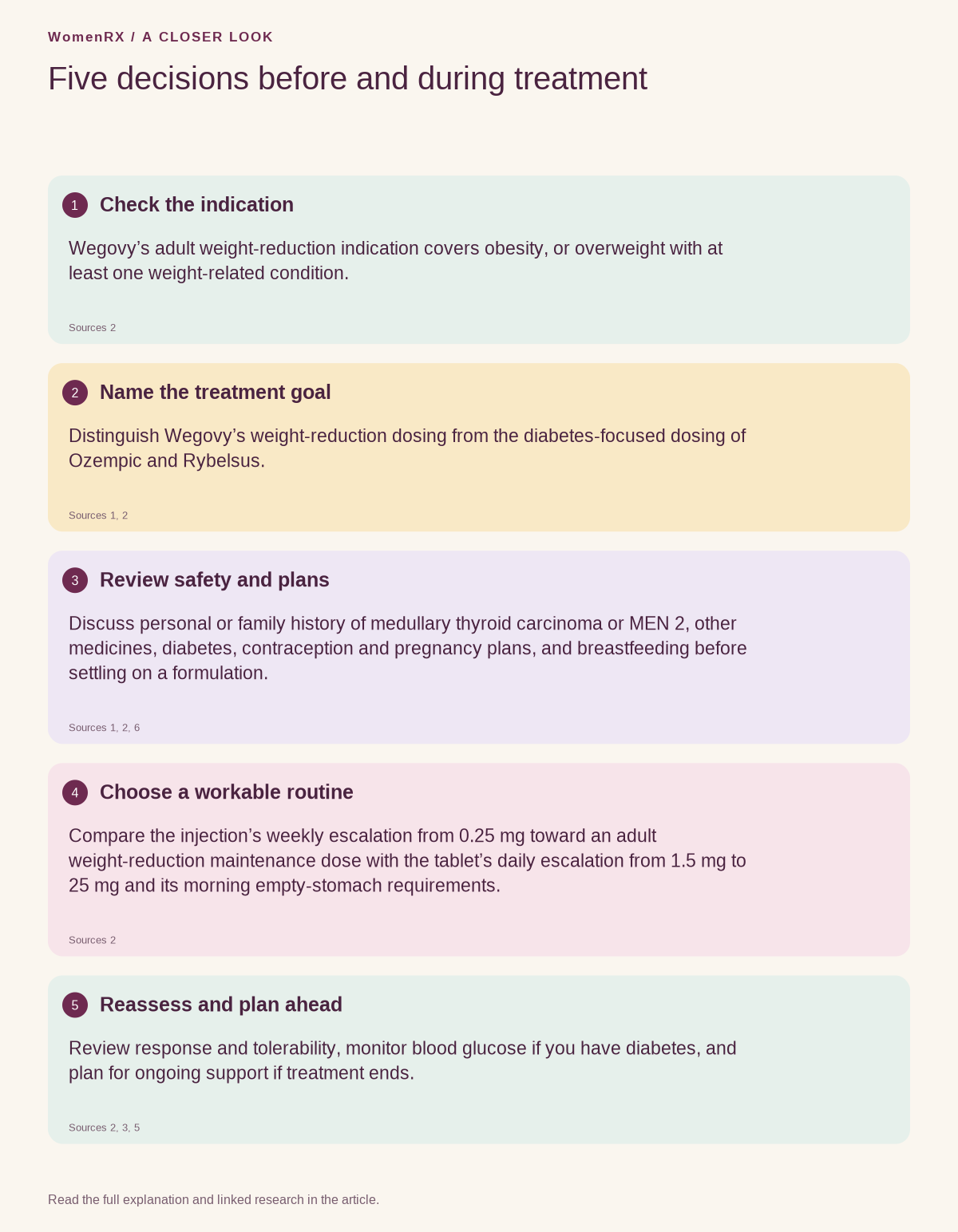
Five decisions before and during treatment
Check the indication: Wegovy’s adult weight-reduction indication covers obesity, or overweight with at least one weight-related condition.2
Name the treatment goal: Distinguish Wegovy’s weight-reduction dosing from the diabetes-focused dosing of Ozempic and Rybelsus.12
Review safety and plans: Discuss personal or family history of medullary thyroid carcinoma or MEN 2, other medicines, diabetes, contraception and pregnancy plans, and breastfeeding before settling on a formulation.126
Choose a workable routine: Compare the injection’s weekly escalation from 0.25 mg toward an adult weight-reduction maintenance dose with the tablet’s daily escalation from 1.5 mg to 25 mg and its morning empty-stomach requirements.2
Reassess and plan ahead: Review response and tolerability, monitor blood glucose if you have diabetes, and plan for ongoing support if treatment ends.235
Read the figure as text
Use this sequence to connect Wegovy’s adult indication with product choice, safety and longer-term care.- Check the indication: Wegovy’s adult weight-reduction indication covers obesity, or overweight with at least one weight-related condition.2
- Name the treatment goal: Distinguish Wegovy’s weight-reduction dosing from the diabetes-focused dosing of Ozempic and Rybelsus.12
- Review safety and plans: Discuss personal or family history of medullary thyroid carcinoma or MEN 2, other medicines, diabetes, contraception and pregnancy plans, and breastfeeding before settling on a formulation.126
- Choose a workable routine: Compare the injection’s weekly escalation from 0.25 mg toward an adult weight-reduction maintenance dose with the tablet’s daily escalation from 1.5 mg to 25 mg and its morning empty-stomach requirements.2
- Reassess and plan ahead: Review response and tolerability, monitor blood glucose if you have diabetes, and plan for ongoing support if treatment ends.235
More questions, answered
Is a Wegovy tablet the same as an Ozempic or Rybelsus tablet?
No. They contain semaglutide, but the product-specific dosing and treatment goals differ. The Wegovy tablet label includes adult weight reduction; Ozempic and Rybelsus tablets have diabetes-focused indications for blood-sugar control and for reducing major cardiovascular events in certain adults with type 2 diabetes. They shouldn’t be compared or switched by matching milligrams. 12
Sources you can check
- OZEMPIC (ORAL SEMAGLUTIDE) TABLET RYBELSUS (ORAL SEMAGLUTIDE) TABLET [NOVO NORDISK PHARMACEUTICAL INDUSTRIES, LP] | US prescribing information and patient instructionsAccessed 2026-09-25Return to first citation
- WEGOVY (SEMAGLUTIDE) INJECTION, SOLUTION WEGOVY (SEMAGLUTIDE) TABLET [NOVO NORDISK PHARMACEUTICAL INDUSTRIES, LP] | US prescribing information and patient instructionsAccessed 2026-09-25Return to first citation
- Obesity: MedlinePlusAccessed 2026-09-25Return to first citation
- Analysis of the efficacy and safety of liraglutide, semaglutide, and tirzepatide for the treatment of overweight and obesity: a systematic review and network meta-analysis.Pałka W, Moćko P, Śladowska K, Holko P, Kawalec P. · Journal of endocrinological investigation · 2026Return to first citation
- Impact of semaglutide withdrawal on cardiometabolic profile and physiology of energy balance: Recovery effects after semaglutide termination - The REST trial study protocol.Yevusiak T, Weisman A, Retnakaran R, Wharton S, Drucker DJ, Kramer CK. · PloS one · 2026Return to first citation
- Prescription Medications to Treat Overweight & Obesity - NIDDKAccessed 2026-09-25Return to first citation