Semaglutide for Weight Management: Decisions From Start to Stop
A useful semaglutide plan covers eligibility, side effects, pregnancy plans, and what happens if treatment pauses or ends.
If you’re considering semaglutide for weight management, start by checking whether Wegovy fits your weight-related health needs and whether its injection or tablet form suits you. Ozempic contains semaglutide but has different US indications. Before starting, discuss relevant medical history and pregnancy or breastfeeding plans. Follow-up should cover tolerability as well as weight change, and a plan for maintenance or stopping.167
First, get clear on the product and the goal
Semaglutide is the medicine name, not a single treatment plan. In the US, Wegovy has injection and tablet forms indicated for long-term weight reduction in adults with obesity, or with overweight and at least one weight-related condition, alongside changes to eating and physical activity. Clinicians commonly use a body mass index (BMI) of 30 or higher for obesity, or 27 or higher plus a weight-related health problem, when considering weight-management medication. BMI is a starting point for the conversation, not the whole assessment.16
Ozempic is a different semaglutide product. Its US indications concern adults with type 2 diabetes, including blood sugar control and risk reduction in specified groups; weight management is not one of its listed indications. Ask which product and form your prescriber means rather than treating the brand names as interchangeable.7
Then put weight in the context of your health. Obesity care can include changes to eating and activity, medication, and, for some people, procedures or surgery. The right approach depends partly on your other health conditions and what you’re willing and able to sustain. Semaglutide for weight management is used alongside changes to eating and physical activity, not in place of them.21
A useful first conversation is specific: What health outcome are we hoping to improve, why is this product a fit for me, and what would make us change the plan? Bring up your medical and family history. Wegovy should not be used by someone with a personal or family history of medullary thyroid cancer or with multiple endocrine neoplasia syndrome type 2 (MEN 2), or by someone who has had a serious allergic reaction to semaglutide or a Wegovy ingredient.1
Before starting, make a reproductive-health checkpoint
If you’re pregnant or planning a pregnancy, raise that before starting weight-management medication. For Wegovy used for weight reduction, the US prescribing information says to stop treatment when pregnancy is recognized and to discontinue it at least two months before a planned pregnancy. Human pregnancy data are insufficient to establish its risks, so an unplanned exposure calls for a discussion about what happened, not an assumption that harm has or hasn’t occurred.1
If you’re breastfeeding, say so even if pregnancy isn’t on your mind. The US guidance differs by Wegovy form: breastfeeding is not recommended with Wegovy tablets because of uncertainty about an ingredient that helps the tablet be absorbed. For Wegovy injection, there are no human milk data on injected semaglutide or its effects on the infant or milk production; the prescribing information calls for weighing breastfeeding’s benefits alongside the mother’s need for treatment and possible risks. The product and your feeding plans both matter here.1
Semaglutide also shouldn’t be counted on to improve fertility. A retrospective study of women already receiving infertility care found lower pregnancy and live-birth rates among those with prior semaglutide treatment than among matched controls. Because it was observational and could not standardize the amount of weight lost, it cannot establish that semaglutide caused those differences or predict what will happen for an individual woman.5
Starting is a gradual phase, not a test of willpower
Wegovy injection and tablets have different schedules for gradually increasing treatment toward a maintenance level. The injection prescribing information also addresses restarting at a lower level after multiple missed injections to reduce gastrointestinal reactions. Those details are reasons to follow the plan for your specific product and to check in before improvising after a treatment gap, not instructions to adjust treatment yourself.1
At follow-up, describe what treatment is like to live with, not just what the scale says. For example, are nausea, vomiting, diarrhea, constipation, or stomach discomfort getting in the way of meals or daily life? Can you keep up the eating and activity changes you planned? In the STEP 4 trial, gastrointestinal events were reported by 49.1% of participants who continued weekly injectable semaglutide and 26.1% who switched to placebo during the randomized 48-week period. Everyone randomized had already completed a 20-week semaglutide run-in, so those figures don’t describe the experience of everyone who starts.14
Know when a symptom changes the plan. Persistent or severe abdominal pain, sometimes spreading to the back, can be a sign of pancreatitis and needs prompt assessment. Vomiting or diarrhea can lead to dehydration and kidney problems, so tell your prescriber if those symptoms are making it hard to stay hydrated. Wegovy’s warnings also call for prompt medical advice if a serious allergic reaction is suspected.1
A productive review can end with one of several decisions: continue the current plan, address tolerability, reconsider whether this product is a fit, or discuss another approach. There’s no need to wait for a particular scale number before mentioning a side effect that’s affecting your day.
Plan for maintenance before deciding to stop
Treatment may be a longer-term commitment. STEP 4 gives a useful comparison: among adults without diabetes who reached the maintenance dose after 20 weeks of weekly injectable semaglutide, average weight changed by −7.9% over the next 48 weeks in those who continued treatment, versus +6.9% in those switched to placebo. Both groups continued lifestyle intervention. Most randomized participants were women, but the reported result was for the group overall, not a separate women’s estimate.4
That doesn’t mean every person regains weight after stopping, or that stopping is the wrong choice. It does mean a possible stop deserves a follow-up plan. Ask what changes you’ll watch for, how your other health measures will be reviewed, and what options you’ll discuss if weight returns. In exploratory analyses of STEP trials involving adults without diabetes, improvements in several cardiometabolic risk factors during treatment deteriorated after the switch to placebo.3
If you’ve stopped because of side effects, a change in pregnancy plans, or another reason, say which. The next decision depends on why treatment changed; restarting after a gap isn’t necessarily the same as carrying on uninterrupted.1
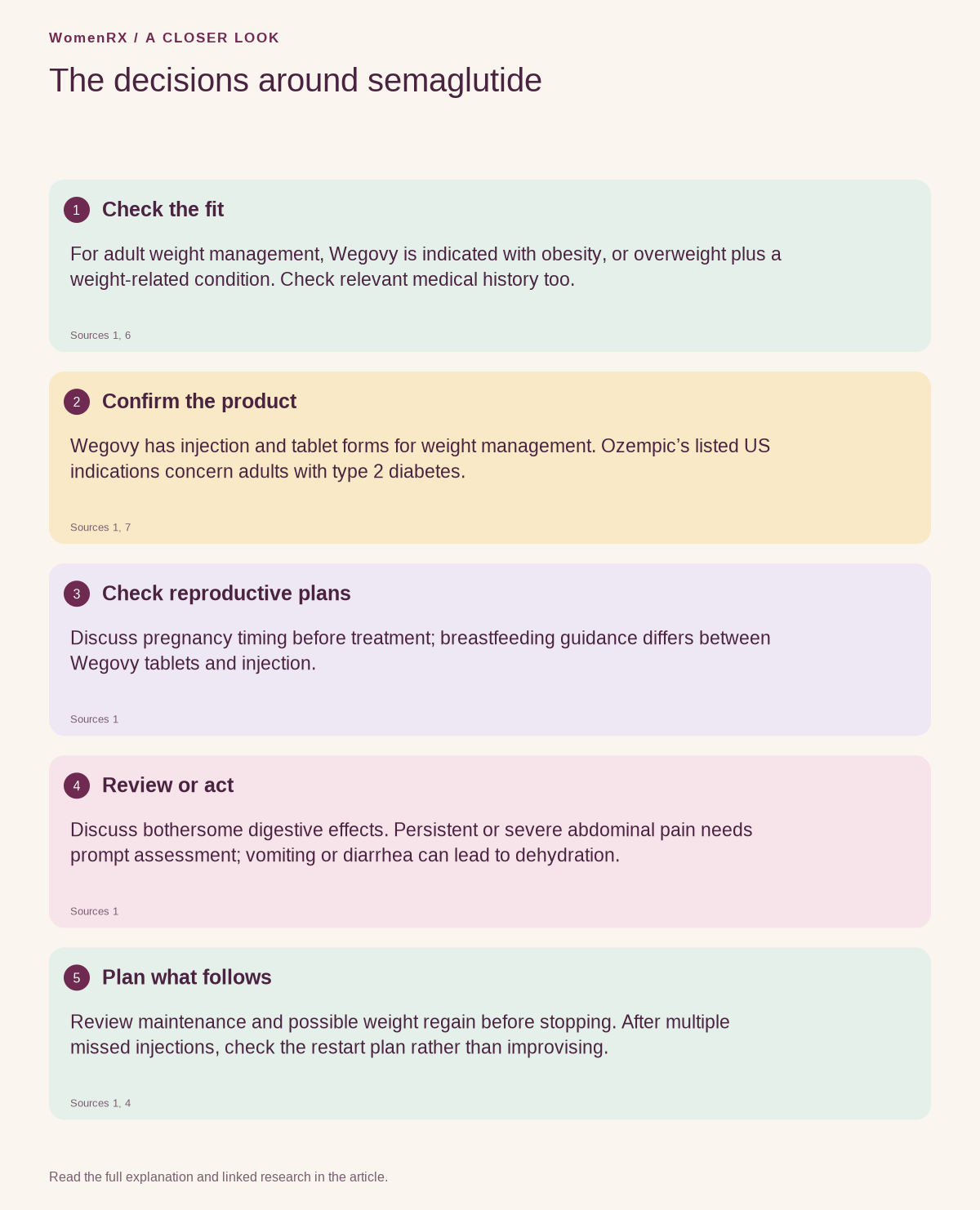
The decisions around semaglutide
Check the fit: For adult weight management, Wegovy is indicated with obesity, or overweight plus a weight-related condition. Check relevant medical history too.16
Confirm the product: Wegovy has injection and tablet forms for weight management. Ozempic’s listed US indications concern adults with type 2 diabetes.17
Check reproductive plans: Discuss pregnancy timing before treatment; breastfeeding guidance differs between Wegovy tablets and injection.1
Review or act: Discuss bothersome digestive effects. Persistent or severe abdominal pain needs prompt assessment; vomiting or diarrhea can lead to dehydration.1
Plan what follows: Review maintenance and possible weight regain before stopping. After multiple missed injections, check the restart plan rather than improvising.14
Read the figure as text
Follow the decision points, including when a side effect calls for a change in plans.- Check the fit: For adult weight management, Wegovy is indicated with obesity, or overweight plus a weight-related condition. Check relevant medical history too.16
- Confirm the product: Wegovy has injection and tablet forms for weight management. Ozempic’s listed US indications concern adults with type 2 diabetes.17
- Check reproductive plans: Discuss pregnancy timing before treatment; breastfeeding guidance differs between Wegovy tablets and injection.1
- Review or act: Discuss bothersome digestive effects. Persistent or severe abdominal pain needs prompt assessment; vomiting or diarrhea can lead to dehydration.1
- Plan what follows: Review maintenance and possible weight regain before stopping. After multiple missed injections, check the restart plan rather than improvising.14
More questions, answered
Does regaining weight after stopping mean semaglutide failed?
No. In a randomized trial of adults who had reached the maintenance dose, the group switched to placebo gained weight on average over the following 48 weeks, while the group continuing weekly injectable semaglutide lost more. That group result can inform a maintenance plan, but it cannot predict your individual outcome.4
Are the trial results specific to women?
Not exactly. Women made up 79% of the participants randomized in STEP 4, but the cited weight-change result combines participants rather than reporting a separate effect for women.4
Sources you can check
- WEGOVY (SEMAGLUTIDE) INJECTION, SOLUTION WEGOVY (SEMAGLUTIDE) TABLET [NOVO NORDISK PHARMACEUTICAL INDUSTRIES, LP] | US prescribing information and patient instructionsAccessed 2026-09-25Return to first citation
- Obesity: MedlinePlusAccessed 2026-09-25Return to first citation
- Semaglutide improves cardiometabolic risk factors in adults with overweight or obesity: STEP 1 and 4 exploratory analyses.Kosiborod MN, Bhatta M, Davies M, Deanfield JE, Garvey WT, Khalid U, Kushner R, Rubino DM, Zeuthen N, Verma S. · Diabetes, obesity & metabolism · 2023Return to first citation
- Effect of Continued Weekly Subcutaneous Semaglutide vs Placebo on Weight Loss Maintenance in Adults With Overweight or Obesity: The STEP 4 Randomized Clinical Trial.Rubino D, Abrahamsson N, Davies M, Hesse D, Greenway FL, Jensen C, Lingvay I, Mosenzon O, Rosenstock J, Rubio MA, Rudofsky G, Tadayon S, Wadden TA, Dicker D, STEP 4 Investigators. · JAMA · 2021Return to first citation
- Impact of semaglutide pretreatment on reproductive outcomes in women with overweight and obesity with infertility: a real-world multicenter cohort study.Wu YC, Hsu JC, Su EC, Chen CH, Chang TH. · Reproductive biology and endocrinology : RB&E · 2026Return to first citation
- Prescription Medications to Treat Overweight & Obesity - NIDDKAccessed 2026-09-25Return to first citation
- OZEMPIC (SEMAGLUTIDE) INJECTION, SOLUTION [NOVO NORDISK PHARMACEUTICAL INDUSTRIES, LP] | US prescribing information and patient instructionsAccessed 2026-09-25Return to first citation